
The Clear Ice Maker Market: Strategic Shifts and Commercial Opportunities Through 2032
The global market for clear ice makers has evolved from a niche curiosity into a strategically significant segment within the broader beverage and food-service equipment landscape. Driven by a convergence of premiumization in hospitality, rising aspirations in residential luxury kitchens, and technological maturation in directional freezing and commercial refrigeration systems, the industry is entering a phase where differentiation increasingly hinges on engineering quality, brand positioning, and ecosystem integration rather than pure volume. Over the 2020–2025 historical window, the market expanded from roughly $466.5 million to $618.5 million, reflecting steady adoption despite periodic supply-chain friction and macroeconomic volatility. The forward trajectory points to a compound annual growth rate of 5.8% across the forecast horizon through 2032, culminating in an estimated market size near $917.7 million. This growth profile suggests a maturing but still expanding market where winners will be determined by how effectively companies align product architecture with end-use expectations, regional affordability thresholds, and evolving compliance requirements.
Market Landscape and Core Challenges
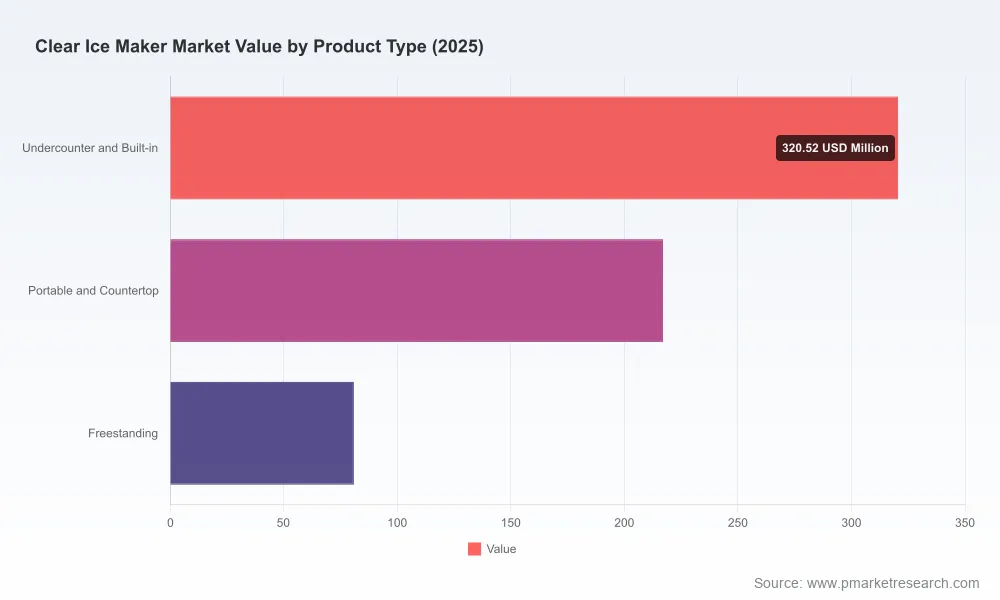
The current market structure reflects balanced penetration across multiple dimensions. North America remains the largest single region, Europe follows with a substantial footprint, and Asia Pacific continues to build momentum as premium beverage culture and modern kitchen upgrades gain traction. In terms of product architecture, undercounter and built-in configurations capture the largest share, reflecting their integration into professional back-of-house workflows and high-end residential cabinetry. Portable and countertop designs form a strong second tier, while freestanding units occupy a narrower but specialized niche. On the demand side, commercial kitchens and bars remain the dominant application environment, with residential luxury kitchens representing a fast-growing complement as consumers invest in experiential home entertainment and premium drink preparation. The market concentration profile, with a combined three-firm share near 38.5% and a five-firm share near 54.2%, indicates a moderately fragmented landscape where scale advantages exist but do not yet translate into overwhelming dominance. This structure creates room for focused differentiation, regional specialization, and targeted premium positioning.
Key Challenges at the Inflection Point
- Quality consistency and consumer trust remain critical. Clear ice is fundamentally a purity and clarity proposition, and any perception of cloudiness, off-flavors, or mechanical failure directly undermines the premium narrative. Manufacturers must manage water-treatment dependencies, freeze-rate consistency, and component durability across diverse operating conditions.
- Regulatory scrutiny and safety assurance are tightening. The broader ice maker category has faced recalls and safety reviews tied to mechanical hazards in consumer units, reinforcing the need for rigorous design validation, transparent incident management, and proactive compliance communication. This environment raises the cost of market entry for smaller players and rewards established manufacturers with mature quality systems.
- Capital intensity and supply-chain complexity press margins. Commercial-grade units require refrigeration components, precise sensors, and filtration subsystems, while consumer units increasingly compete on aesthetics and user experience. Volatility in component availability, logistics costs, and regional energy-efficiency expectations can compress returns unless product roadmaps are aligned with manufacturability and serviceability goals.
Core Growth Drivers
Several underlying forces explain why the clear ice maker market is moving from incremental growth to structurally higher relevance.
PW Consulting
Technological Innovation and the Clarity Standard
The central technological narrative is the shift from “ice as utility” to “ice as presentation and experience.” Directional freezing methods, improved water-flow control, and more reliable defrost cycles have expanded the feasibility of producing transparent cubes, large-format spheres, and specialized shapes with reduced bubble formation. In consumer settings, countertop systems are increasingly engineered to deliver visually striking results from tap water, reducing reliance on pre-filtered inputs and improving convenience. In commercial environments, manufacturers are pushing higher daily output, tighter cube uniformity, and integration with back-of-house workflows so that ice production becomes predictable and service-friendly. The net effect is a widening scope of use cases: premium spirits service, craft cocktail programs, upscale dining presentation, and luxury kitchen status signaling all benefit from the aesthetic and melting-rate characteristics associated with clear ice.
Policy, Regulation, and Compliance as a Competitive Variable
Regulatory and safety expectations are becoming a meaningful factor in purchasing decisions, particularly for consumer-facing equipment. High-profile recalls and hazard reviews in adjacent ice maker categories have raised attention on mechanical integrity, blade and auger safety, and incident response processes. For commercial operators, compliance extends into energy and water usage expectations, sanitation requirements, and equipment reliability standards that influence total cost of ownership. This environment does more than add compliance overhead; it reshapes competitive positioning by favoring manufacturers that can demonstrate documented quality control, traceable component sourcing, and transparent communication with regulators and customers. As a result, safety assurance and certification readiness are increasingly part of the value proposition rather than a back-office function.
Demand-Side Shifts in Hospitality and Home Entertainment
Consumer and business behavior is reinforcing premiumization across the drink experience. In hospitality and food service, the emphasis on craft beverages, signature cocktails, and visual presentation continues to reward equipment that delivers consistent clarity and shape control. Bars and restaurants are not simply buying ice; they are buying a reputational asset that supports menu differentiation and guest experience. Simultaneously, high-end residential buyers are treating kitchen appliances as lifestyle markers, and clear ice makers fit naturally into the category of discretionary upgrades that enhance entertaining and perceived quality of life. The residential angle is particularly important because it expands the addressable market beyond operators focused on throughput and opens a pathway for design-led, countertop-friendly products with lower installation complexity.
Ice Maker Market
Supply Chain and Cost Structure Realignment
Cost dynamics are being reshaped by a mix of component availability, manufacturing localization trends, and design-for-manufacturing discipline. Companies that can balance performance with serviceable architectures, reduce dependency on fragile supply paths, and offer tiered product families tend to manage margin pressure more effectively. At the same time, the market rewards efficient water and energy performance in commercial settings, where operating cost sensitivity is more pronounced. For consumer products, the cost structure increasingly includes packaging, user-experience design, warranty support, and e-commerce visibility, making go-to-market execution as important as hardware engineering. The practical implication is that scale alone does not guarantee advantage; resilient design, regional adaptability, and total-cost storytelling matter just as much.
Competitive Landscape and Strategic Positioning
The competitive field spans established commercial refrigeration specialists, consumer-focused design brands, and technology-driven entrants that emphasize clarity methods and user convenience. The strategic logic differs sharply by segment, and the most successful players tend to anchor their positioning in a clear value proposition rather than attempt to compete across every dimension at once.
Differentiated Strengths Across the Field
- Scotsman Ice Systems maintains a strong commercial and residential presence with a clear emphasis on pure, slow-melting cubes for premium beverage applications. Its positioning benefits from a long-standing association with reliability and specialty ice quality, which resonates with operators who prioritize consistency and guest-facing presentation.
- Hoshizaki Corporation brings a heritage in specialty and gourmet clear cube formats, including shapes optimized for upscale cocktails and spirits. Its ability to serve both commercial and residential segments with distinct product narratives creates cross-market leverage, while visible exhibition activity in key regional events signals continued attention to foodservice distribution channels.
- NewAir targets the consumer side with an emphasis on visually appealing, premium-quality cubes for home use. Its strategy leans toward elevating everyday drinking rituals, which aligns with the residential luxury trend and the desire for approachable, design-conscious products.
- Klaris focuses on countertop clear ice production using directional freezing technology, emphasizing convenience and craft-cocktail relevance. By enabling clear results from faucet water and reducing manual steps, it appeals to users who value both quality and simplicity.
- Clearly Frozen addresses a more accessory-oriented but still strategic angle with high-capacity trays that leverage directional freezing for home consumers. This plays into the same clarity and melt-rate expectations, but at a lower entry price point and with a more flexible usage model.
- Wintersmiths centers on premium barware and molds for large clear cubes and spheres, targeting mixologists and home bartenders. Its niche strategy highlights the experiential side of ice as an ingredient and presentation element rather than treating ice purely as a machine output.
- Argion Technology operates in the professional commercial segment with units aimed at premium bars, luxury hotels, and fine dining, while also offering ODM capabilities for global partners. This dual emphasis on performance and partnership flexibility gives it a route into diverse distribution channels without diluting its professional image.
- Koller Refrigeration concentrates on clear ice block and cube machines with an emphasis on transparency and suitability for sculpture, balls, and drinking applications. Its scope connects commercial production needs with visual quality, which can be especially relevant in contexts where ice aesthetics support brand storytelling.
- Vesta Precision offers a directional-freezing approach designed to produce clear ice in customizable forms with reduced manual cutting. This positions the brand around convenience and format flexibility, appealing to users who want premium clarity without labor-intensive preparation.
- True Residential develops high-end residential clear ice machines with attention to daily production capacity, energy efficiency, and reduced water usage. Its strategy reflects the convergence of luxury kitchen design and operating-cost awareness, which is increasingly relevant for affluent homeowners and specification-driven projects.
How the Landscape Is Evolving
The market is not consolidating into a single dominant pattern; instead, it is differentiating along multiple axes. Established commercial players are extending credibility into premium residential and hospitality contexts, while consumer-oriented brands are competing on aesthetics, ease of use, and countertop footprint. At the same time, technology-focused entrants are carving out positions around directional freezing and convenience-oriented workflows, showing that the segment remains open to new approaches that solve real user pain points. Regional dynamics matter as well: major brands maintain strong visibility in North America and Europe, while manufacturers with global distribution and ODM capability are expanding options for partners seeking localized product strategies. Trade-show activity and product unveilings continue to signal that innovation is accelerating, particularly in consumer-facing performance, speed, clarity, and design integration.
Forward Trends and Commercial Opportunities
Looking ahead across the next three to five years, several trends are likely to shape where value is created.
Trend 1: Premiumization Moves from Hospitality into Mainstream Luxury Kitchens
The clear ice proposition will continue migrating from specialist bars and upscale dining into higher-end residential settings. As kitchen investments increasingly emphasize experiential value and visual quality, products that combine strong clarity, compact footprint, and attractive design will find broader acceptance. The commercial opportunity lies in product families that can serve specification-driven residential projects without sacrificing the clarity and reliability expectations that hospitality buyers demand. A related risk is that premium residential adoption may be sensitive to discretionary spending cycles; brands that depend too heavily on luxury upgrades without a clear performance story may see demand fluctuate more sharply.
Trend 2: Clarity, Convenience, and Total Cost of Ownership Become the Purchase Criteria
Buyers will increasingly compare solutions not just on cube appearance but on usable output, water and energy performance, serviceability, and the effort required to maintain consistent quality. Directional freezing and related clarity-enhancing methods will continue to gain attention, but the commercial winners will be those that translate technical superiority into dependable daily performance and lower operational friction. For manufacturers, this means investing in filtration compatibility, defrost reliability, and service-support ecosystems. For operators, the opportunity is to evaluate equipment as a long-term service asset rather than a one-time purchase, prioritizing vendors that offer clear operating-cost narratives and manageable maintenance pathways.
Trend 3: Safety, Compliance, and Brand Trust Differentiate the Category
As regulatory scrutiny and consumer awareness around appliance safety rise, the ability to communicate robust design validation and incident readiness will matter more. Companies that embed compliance thinking into product development, maintain transparent sourcing and quality documentation, and respond decisively to issues will be better positioned to retain trust and protect shelf presence. This trend creates an opportunity for brands to lead with quality assurance as a differentiator, especially in consumer channels where safety concerns can influence purchasing decisions quickly. The counter-risk is that underinvestment in compliance and quality systems can expose smaller or less prepared entrants to reputational and commercial setbacks.
Implications for Decision-Makers
Different roles in the value chain should approach the clear ice maker market with distinct priorities, but all benefit from a clear-eyed view of where clarity, convenience, and credibility intersect.
Worldwide Countertop Transparent Ice Maker Market
For Manufacturers and Product Leaders
- Define a precise positioning strategy before scaling product breadth. Competing simultaneously on commercial throughput, residential design, and consumer convenience without a unifying architecture can dilute brand clarity and complicate operations. A focused value proposition, supported by tiered product families, tends to be more defensible.
- Treat clarity as a system outcome, not just a feature. Water handling, freeze-rate control, defrost behavior, and serviceability all affect perceived quality. Investing in design for consistency and ease of service gives products a stronger reputation trajectory and reduces downstream support costs.
- Prepare for compliance and safety to be part of market access. Build documentation, validation rigor, and communication readiness into the product lifecycle so that quality assurance becomes a competitive asset rather than a reactive burden.
For Investors and Strategic Partners
- Assess total market exposure, not just headline growth. While the market is expanding at a solid pace, profitability depends on mix, regional affordability, channel execution, and cost discipline. Companies with resilient supply strategies and strong end-use alignment are better placed to convert growth into durable returns.
- Look for differentiation that withstands comparison. Innovations that improve convenience, clarity, or operating economics can create meaningful advantage, but only if they are reproducible at scale and supported by service and distribution. Patronize businesses that can demonstrate both technical authenticity and commercial execution.
- Watch the residential premiumization pathway as a signal, not a guarantee. Residential luxury kitchen adoption can accelerate growth, but it is sensitive to discretionary spending. Diversified exposure across hospitality and premium home segments can reduce single-channel dependency.
For Procurement and Operations Leaders
- Evaluate equipment against operational reality. Cube appearance matters, but daily reliability, maintenance effort, water and energy performance, and parts availability often determine whether a unit earns its place in a high-pressure environment. Shortlist vendors that can present a credible operating-cost and service narrative.
- Align purchase decisions with end-use expectations. A commercial kitchen or bar has different requirements from a luxury kitchen or a home bar setup. Matching product architecture to the environment reduces friction and improves consistency over time.
- Consider brand trust and incident history as part of the risk assessment. Safety assurance, quality documentation, and transparent communication are increasingly relevant to long-term procurement confidence, especially when equipment is visible to guests or tied to brand experience.
Why Deeper Intelligence Matters
The clear ice maker market rewards participants who understand not only where growth is occurring, but why it is occurring and how competitive advantage is being built on top of it. Segment-level dynamics, regional affordability differences, product-architecture trade-offs, and shifting safety expectations all influence which strategies succeed. High-level totals and growth rates provide orientation, but they do not reveal where margin pools are forming, which product families are gaining specification share, or how competitive positioning is changing in specific channels. Decision-makers who want to move from general awareness to investment-grade clarity benefit from more granular segmentation, competitive benchmarking, and scenario-based forecasts that connect product strategy to end-use economics.
For organizations evaluating market entry, product roadmap choices, distribution partnerships, or procurement standards, detailed intelligence can sharpen prioritization and reduce uncertainty. A complete research report can provide the deeper breakdown needed to assess segment attractiveness, compare competitive approaches, and translate market trends into concrete action plans. In a category where performance, presentation, and trust all matter at once, the organizations that act with precision will be best positioned to capture the next phase of opportunity.
For detailed analysis of this topic, please visit the official page: Worldwide Clear Ice Maker Market
Lacy Lee
Senior Marketing Manager
[email protected]
PW Consulting: www.pmarketresearch.com


























Sign in to leave a comment.