
The Strategic Evolution of the Cloth Diapers Market: Navigating Growth, Innovation, and Competitive Shifts
The reusable diaper sector has transitioned from a niche, environmentally conscious choice to a mainstream category driven by economic pragmatism and sustainability mandates. Over the past half-decade, the global cloth diapers market has expanded from approximately 163 million dollars in 2020 to 215 million dollars in 2025, reflecting an eleven-point-eight-five percent compound annual growth rate that extends through 2032. By the end of the forecast period, revenue is projected to approach 345 million dollars. This trajectory is not merely a continuation of steady demand; it represents a structural shift in how parents, care facilities, and adult incontinence users approach hygiene products. The market is scaling while simultaneously undergoing rapid consolidation, material innovation, and regulatory refinement. For executives and investors, the question is no longer whether the category will continue to grow, but how to position operations and portfolios within a landscape where margin stability, product differentiation, and supply chain resilience dictate competitive advantage.
Market Structure and the Facade of Fragmentation
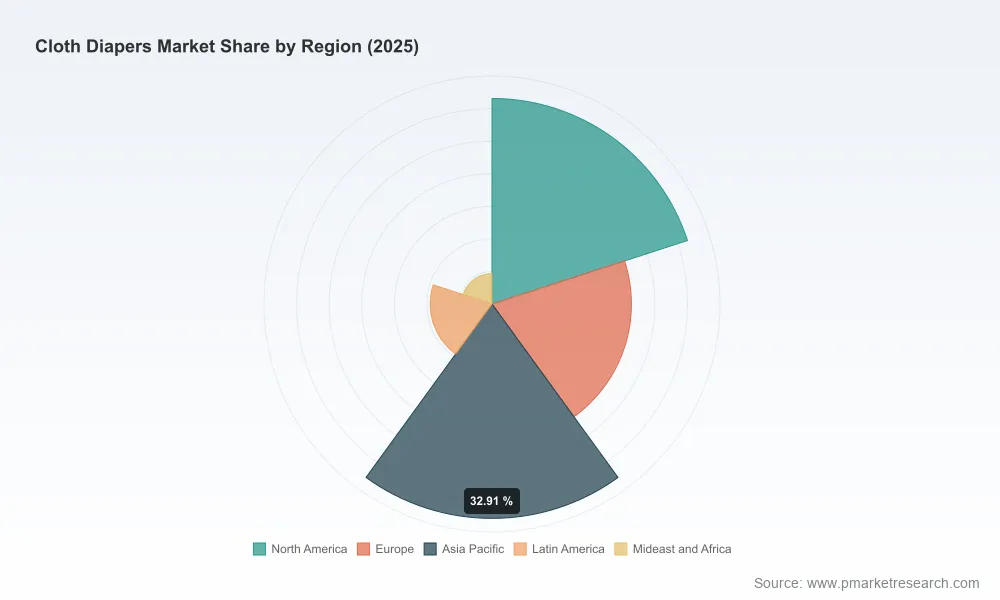
Despite the headline growth figures, the competitive field is not a free-for-all. Concentration metrics indicate a relatively modest cluster at the top, with the top three players commanding roughly twenty-four-point-six percent of revenue and the top five holding twenty-six-point-two percent. This distribution signals a market that is broad enough to accommodate multiple regional and material-based players, yet narrow enough that strategic moves by leading brands can reshape category expectations quickly. The revenue base is heavily anchored in infant applications, which absorb the majority of unit volume and repeat purchases, while adult and specialty segments contribute smaller but increasingly steady contributions as reusable hygiene gains traction beyond early childhood. Geographically, the market is balanced across developed and emerging economies, with North America, Europe, and Asia Pacific each sustaining meaningful revenue contributions, while Latin America and the Middle East and Africa provide growing penetration pathways. Importantly, the category is not monolithic. Material composition, closure systems, absorbency engineering, and care convenience form the real axes of competition, and brands that treat cloth diapers as a commodity face immediate margin pressure.
Structural Challenges and Inflection Points
Three interlocking challenges define the current strategic inflection point. First, supply chain volatility for premium raw materials continues to pressure gross margins across North American and European distributors. Imported organic cotton and bamboo components remain subject to freight fluctuations, port delays, and pricing variability, which makes cost predictability a persistent operational concern. Second, regulatory tightening is raising the compliance floor. Permanent tracking labels and specific testing and certification standards are now required for cloth diapers, adding operational complexity for manufacturers and importers while simultaneously raising barriers for low-quality entrants. Third, consumer adoption is expanding for legitimate reasons, but the category still wrestles with a perception gap. Reusable systems are gaining favor among households motivated by environmental impact and long-term cost savings, especially in multi-child families, yet convenience expectations have risen in parallel. Parents and adult users no longer accept a trade-off between sustainability and performance; they expect modern fit, dry-touch surfaces, and straightforward laundering routines. Brands that fail to close that gap will see slower repeat purchase rates, even as category awareness rises.
Key Drivers Reshaping the Category
Material Science and Product Architecture
The most visible catalyst for structural growth is material and design innovation. Premium organic cotton and hemp have become foundational for brands positioning themselves in the sustainable tier, commanding higher consumer prices while supporting durability and skin compatibility. Bamboo continues to gain traction for its softness and absorbency profile, while microfibre and hybrid constructions address specific fit and drying-speed needs. The commercial impact of this shift is twofold. Manufacturers that control material sourcing and textile performance can segment into higher-margin tiers, while brands relying on generic constructions face commoditization pressure. The trend is also pushing engineering beyond the fabric itself. Dual-gusset designs, stay-dry inner layers, and modular pocket architectures are reducing leak events and simplifying changes, directly influencing user satisfaction and repurchase behavior.
Policy and Safety Standards as a Competitive Filter
Regulatory dynamics are increasingly functioning as a filter rather than a mere compliance cost. Requirements for permanent tracking labels and standardized safety testing are reshaping product documentation, quality assurance workflows, and import clearance processes. For established players, these standards create an opportunity to differentiate through verifiable quality and transparent sourcing. For new entrants, they raise the capital and operational threshold required to scale credibly. The net effect is a market where trust, traceability, and consistent performance are becoming part of the value proposition, not just back-office obligations. Companies that invest early in certification readiness and labeling infrastructure will be better positioned to maintain shelf access and retailer confidence as oversight becomes more systematic.
Demand-side behavior is evolving in tandem. The growing parental preference for reusable cloth diapers is being reinforced by environmental concern and the economic logic of multi-child households, where the per-use cost advantage becomes more pronounced over time. At the same time, adult care users and specialty applications are contributing incremental volume as reusable hygiene concepts expand into broader wellness and care ecosystems. This broadens the addressable base beyond infancy and creates cross-segment learning opportunities, especially around fit, absorbency management, and cleaning convenience.
Diapers Market
Supply Chain and Margin Architecture
Cost structure remains the third major driver. Global supply chain factors for imported organic cotton and bamboo components continue to influence margin stability for distributors and brand owners in North America and Europe. This environment favors operators that either localize critical production steps, secure long-term material agreements, or design product lines that buffer material cost variability through modular systems and efficient inventory planning. Companies that treat freight and input volatility as a strategic variable, rather than a temporary disruption, are able to protect pricing and maintain service levels even when input conditions shift. The implication is clear: resilience in sourcing and logistics is now as important as product design in preserving category profitability.
PW Consulting Health Care Research Center
Competitive Positioning and the Reconfiguration of the Field
Incumbent Strategies and Differentiation Levers
The leading companies in this space illustrate how product architecture, material choice, and brand trust combine into defensible positions. Kanga Care has focused on pocket cloth diapers and all-in-one systems, using recognizable product families to address a wide range of user preferences. GroVia has built a reputation around modern all-in-one cloth diapers that balance absorbency and convenience for consumers seeking a more streamlined experience. Charlie Banana emphasizes eco-friendly reusable cloth diapers, aligning its brand closely with sustainability messaging and parent appeal. Thirsties offers a broader portfolio spanning pocket, fitted, and all-in-one formats, which gives it flexibility across user segments and care routines. BumGenius continues to advance fitted and pocket designs, maintaining a strong presence in the reusable category through fit and functional reliability. Blueberry distinguishes itself through organic hemp and bamboo cloth diapers, directly targeting consumers who prioritize material quality and environmental attributes. Flip and Rumparooz both concentrate on pocket and fitted solutions, competing heavily on ease of use and leakage control. Ecoable contributes an eco-friendly positioning from Canada, while Alvababy serves wholesale channels from China, reflecting the importance of distribution breadth and price-accessible supply in certain market segments.
This portfolio diversity matters because the category is not won on a single attribute. Fit, absorbency, washing convenience, material credibility, and price architecture all influence purchasing decisions, and the strongest brands tend to own a clear point of difference rather than attempt to cover every parameter equally.
Consolidation, Launch Cadence, and New Entrant Pressure
Recent developments highlight a market maturing through strategic integration and targeted product introductions. The acquisition of GroVia by Kanga Care illustrates a deliberate effort to expand product lines and consolidate reusable diaper categories under a broader umbrella, a move that signals both confidence in category growth and a desire to reduce fragmentation among complementary brands. In parallel, product launches with clear functional claims continue to raise consumer expectations. The introduction of a luxe pocket diaper featuring patented dual inner gusset technology demonstrates how performance innovation in leak protection can reframe category standards and force competitors to respond with comparable engineering. These moves indicate that the market is moving toward a phase where scale, portfolio breadth, and patented functional features carry increasing weight.
At the same time, new entrants remain active, particularly in segments where sustainability claims, price points, or regional distribution access offer a faster path to initial adoption. The overall effect is a competitive environment that is simultaneously consolidating at the top and remaining porous at the edges. Brands that can combine credible materials, reliable performance, and efficient supply chains are best positioned to convert early trial into sustained repeat usage.
Forward Outlook: Three Trends Shaping the Next Three to Five Years
From Trial to Routine Adoption
One of the most consequential trends is the shift from trial purchases to habitual use. As parents and adult users gain confidence that reusable systems can deliver convenience, fit, and reliable absorbency, the category’s growth will increasingly depend on repeat purchase rate, not just initial awareness. This favors companies that invest in user education, care simplification, and product consistency across batches. It also creates opportunities for subscription-like replenishment models, accessory ecosystems, and care support services that reduce friction in the ongoing ownership experience.
Premiumization Supported by Material and Design Credibility
A second trend is the continued premiumization of the category, underpinned by organic cotton, hemp, and bamboo-based offerings. Consumers are willing to pay more when material integrity and functional performance are clearly communicated and consistently delivered. This opens space for tiered portfolios in which core lines address accessibility and premium lines capture margin through superior materials, specialized construction, and stronger sustainability claims. The commercial opportunity lies in designing product architecture that supports both segments without cannibalizing brand trust or diluting perceived quality.
Regional Rebalancing and Supply Chain Strategy
The third trend concerns regional dynamics and supply chain strategy. As freight conditions and input pricing continue to influence margins, operators are likely to pursue more deliberate sourcing structures, sometimes localizing key production steps or securing longer-duration material contracts. North America and Europe will remain important revenue bases, while Asia Pacific and Latin America offer expanding adoption pathways for well-positioned brands. Companies that can manage cross-region logistics while preserving product quality and delivery reliability will be better equipped to scale without sacrificing margin integrity.
These trends carry inherent uncertainties. Regulatory requirements may evolve further, particularly around labeling, testing, and safety documentation, which could increase operating costs for some players. Material cost volatility may persist, especially for organic and specialty fibers, requiring agile procurement and pricing strategies. Consumer expectations are also rising quickly; a category that today rewards sustainability and cost logic may tomorrow be judged primarily on convenience and performance durability. Brands that assume static demand or static margins risk being surprised by these shifts.
Strategic Actions for Decision Makers
For Manufacturers and Brand Owners
Product architecture should be treated as a margin strategy, not just a design exercise. Invest in constructions that reduce leaks, improve dry-touch comfort, and simplify laundering, because these attributes directly influence repurchase behavior and word-of-mouth adoption. Secure material supply through long-term agreements or diversified sourcing, especially for organic cotton and bamboo, to protect gross margins from freight and input volatility. Build certification and labeling readiness into the product development cycle so that regulatory compliance becomes a differentiator rather than a late-stage bottleneck. Where possible, create tiered portfolios that pair accessible core products with premium material or design-led lines, preserving both volume and margin.
Baby Diapers Market
For Investors and Strategic Partners
Evaluate category exposure through the lens of repeat purchase economics, brand trust, and supply chain control. Companies that hold credible material positioning, patented functional features, and efficient distribution pathways are more likely to sustain growth through changing consumer expectations and input conditions. Watch for consolidation signals, since strategic acquisitions and portfolio expansions can accelerate category standards and reshape competitive positioning quickly. In parallel, assess whether target operators have the operational discipline to meet evolving safety and labeling requirements without eroding speed to market or margin structure.
For Procurement and Channel Decision Makers
Prioritize suppliers that offer both performance consistency and transparent material sourcing. In a category where user satisfaction depends heavily on fit, absorbency, and care convenience, batch-to-batch reliability and clear product claims reduce downstream returns and brand friction. Where import reliance remains significant, consider multi-source strategies or nearshore options to mitigate freight exposure and improve margin predictability. Align product selection with the end user’s routine, since convenience-driven features increasingly determine whether a reusable system becomes a long-term solution rather than a short-term experiment.
The cloth diapers market is moving from a period of category education into one of product maturity, competitive consolidation, and margin discipline. Growth will continue, but the winners will be those who translate demand momentum into durable product advantage, resilient supply chains, and clear regulatory readiness. Detailed segmentation, regional revenue splits, material-level demand patterns, and company-specific market shares can sharpen these decisions considerably, and the full research report provides that level of granularity for teams preparing near-term planning cycles and investment theses.
For detailed analysis of this topic, please visit the official page: Cloth Diapers Market
Lacy Lee
Senior Marketing Manager
[email protected]
PW Consulting: www.pmarketresearch.com




























Sign in to leave a comment.