Imagine you are managing a growing shipping operation. Your order volumes are increasing, more carriers are joining your network, customers expect real-time updates, and your logistics team needs access to transportation data from multiple locations. At first, your existing transportation management system may seem sufficient. But as your operation grows, limitations in infrastructure, accessibility, integrations, and maintenance can become difficult to ignore. compare cloud TMS vs on-premises TMS for mid-size shippers and understand cost, scalability, security, integration, and maintenance differences.
This is where the choice between a cloud-based Transportation Management System (TMS) and an on-premises TMS becomes important. A TMS helps businesses manage transportation planning, carrier coordination, shipment tracking, dispatch, freight data, and other logistics activities. However, the way that software is deployed can have a major impact on operating costs, scalability, IT responsibilities, security, and long-term flexibility.
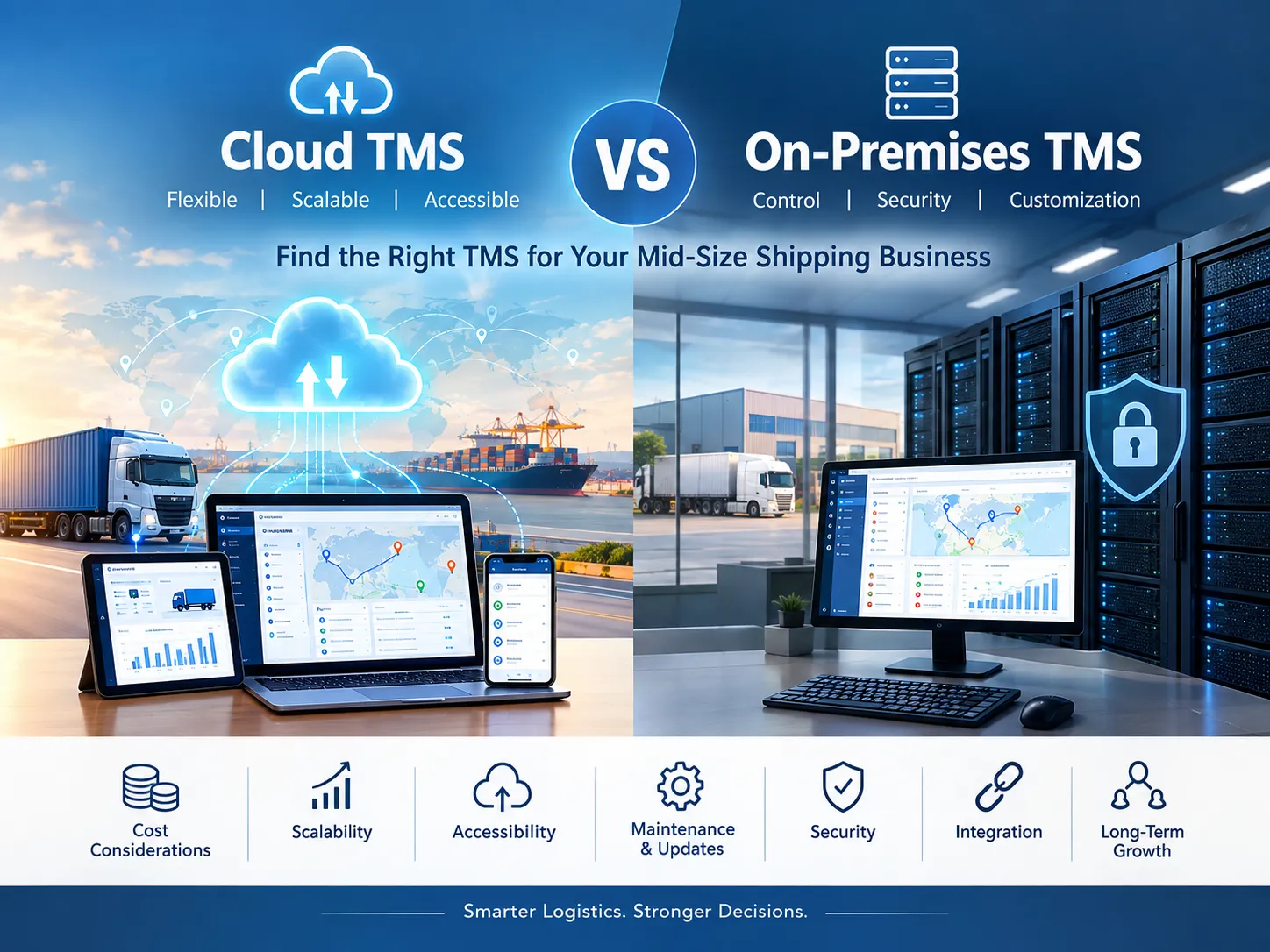
Cloud TMS and On-Premises TMS
A cloud TMS is hosted on cloud infrastructure and accessed through the internet. Instead of maintaining dedicated TMS servers within your organization, the infrastructure is managed by the cloud or software provider. Many cloud TMS platforms follow a subscription-based model and support remote access.
An on-premises TMS, in contrast, is installed within your organization's own IT infrastructure. Your business is responsible for the servers, network environment, software maintenance, upgrades, backups, and much of the security management.
Cloud TMS vs. On-Premises TMS: Key Differences
The most important difference is who manages the underlying technology.
With cloud TMS, the provider generally handles infrastructure, updates, and system maintenance. Your team can access the platform through authorized devices and focus more on transportation operations.
With an on-premises TMS, your organization has greater direct control over its infrastructure but also takes on more responsibility for maintaining that environment.
Here are several areas you should consider:
1. Infrastructure and Initial Investment
On-premises deployment generally requires investment in servers, networking equipment, software licenses, security infrastructure, and IT resources.
Cloud TMS reduces the need for dedicated physical infrastructure. Instead, businesses typically pay recurring subscription or usage-related costs.
2. Scalability
Transportation operations can change quickly. Shipment volumes may increase, new warehouses may open, additional carriers may be added, and more employees may need system access.
Cloud platforms are designed to scale resources more easily as requirements change. This can be particularly useful for mid-size businesses that expect continued growth.
An on-premises system can also be expanded, but growth may require additional hardware, infrastructure capacity, configuration, and IT planning.
3. Accessibility
Modern logistics teams are rarely confined to one office.
Operations managers may work from different locations, while drivers, warehouse teams, customer service representatives, and transportation planners may need access to relevant information.
A cloud TMS can provide authorized users with access through an internet connection, making remote collaboration easier. On-premises systems can also provide remote access, but this may require additional network configuration and security measures.
4. Maintenance and Updates
Software maintenance can become a significant responsibility when your organization manages its own infrastructure.
With an on-premises TMS, your IT team may need to manage software updates, server maintenance, backups, security patches, troubleshooting, and hardware replacement.
Cloud-based systems generally shift much of this responsibility to the provider. This can reduce internal IT workload and allow employees to spend more time on transportation operations and business priorities.
How Cloud TMS Can Improve Logistics Operations
Moving transportation management to the cloud is not simply about eliminating physical servers. It can also create a more connected environment for logistics operations.
A cloud TMS can help businesses centralize transportation information and connect systems such as ERP, WMS, carrier platforms, accounting software, and other business applications.
This can improve visibility across areas such as:
- Shipment status
- Carrier performance
- Transportation costs
- Delivery schedules
- Dispatch activities
- Freight information
- Transportation planning
Better connectivity can also reduce the need for employees to switch between disconnected systems when gathering transportation information.
Security and Data Control
Security is often one of the biggest concerns when businesses consider moving transportation software to the cloud.
Cloud platforms can provide security controls, access management, backups, monitoring, and other protective measures. However, security depends on the provider's architecture, policies, controls, and implementation.
An on-premises TMS provides greater direct control over the physical infrastructure and data environment. But having servers inside your organization does not automatically guarantee stronger security.
Your team still needs to manage access permissions, monitoring, backups, patching, network security, and other controls.
Therefore, rather than assuming that one deployment model is automatically more secure, evaluate the actual security capabilities, compliance requirements, access controls, and responsibilities associated with each solution.
Integration Is Becoming More Important
Modern transportation operations may depend on ERP systems for business data, WMS platforms for warehouse information, carrier APIs for transportation connectivity, accounting systems for financial processes, and customer-facing platforms for shipment visibility.
Cloud TMS platforms commonly support APIs, EDI, and other integration methods that allow transportation information to move between systems.
When On-Premises TMS May Still Be Appropriate
Cloud technology is increasingly common, but on-premises TMS still has a place in certain business environments.
Organizations with strict infrastructure requirements, established legacy systems, significant internal IT resources, or specific data-control policies may prefer an on-premises approach.
For these businesses, maintaining direct control over infrastructure may be an important consideration. However, the decision should include the long-term responsibilities associated with hardware, maintenance, upgrades, backups, security, and technical support.
What Should Mid-Size Shippers Consider?
There is no single deployment model that works for every logistics company. Your decision should begin with your operational requirements rather than simply following a technology trend.
How quickly is your business growing?
If shipment volumes, users, locations, and carrier relationships are expanding, scalability should be a major consideration.
How much IT support do you have?
If your internal IT team is small, managing servers and infrastructure may consume resources that could otherwise support business initiatives.
How important is remote access?
If transportation teams operate across multiple locations, accessible cloud software may simplify collaboration.
What integrations do you need?
Evaluate whether your TMS can connect with ERP, WMS, carrier, accounting, CRM, and other logistics systems.
What is your long-term budget?
Compare subscription costs, infrastructure expenses, maintenance, upgrades, staffing, security, and other ownership costs over the expected life of the system.
How much infrastructure control do you require?
Businesses with specific internal technology policies may place greater value on direct infrastructure control.
Preparing for the Future of Transportation Management
Transportation management is becoming increasingly connected. Logistics businesses are using digital platforms to improve shipment visibility, automate processes, coordinate carriers, manage fleets, and make faster operational decisions.
Cloud infrastructure can support this evolution by providing a flexible foundation for integrations and new digital capabilities.
Businesses can also combine TMS platforms with technologies such as artificial intelligence, IoT, automation, route optimization, and real-time tracking. These technologies can help create a more connected logistics ecosystem rather than keeping transportation data isolated in individual systems.
Making a Practical TMS Deployment Decision
Start by documenting your current transportation workflows. Identify where data is stored, how orders move through your systems, how carriers are managed, and where employees experience delays or manual work.
Next, evaluate your infrastructure, integration requirements, security policies, IT capabilities, and expected growth.
If flexibility, remote access, scalability, and reduced infrastructure responsibility are important, a cloud TMS may align well with your operational model.
If direct infrastructure control, existing legacy environments, or specific internal technology requirements are priorities, an on-premises approach may remain relevant.
Final Thoughts
The Cloud TMS vs. On-Premises TMS discussion is ultimately about more than where software is hosted. It affects how your logistics team works, how quickly your transportation system can adapt, how much infrastructure your business must manage, and how easily different systems can connect.
Cloud TMS can offer scalable infrastructure, remote accessibility, simplified maintenance, and easier integration. On-premises TMS can provide greater direct control over infrastructure and may fit organizations with established internal technology environments.
Before making a decision, evaluate your shipment volumes, growth plans, IT resources, security requirements, integration needs, customization expectations, and total cost of ownership. A transportation management platform should support where your business is today while giving you the flexibility to respond to where your logistics operation is going next.
























Sign in to leave a comment.