
Strategic Trends and Commercial Opportunities in the Global CMP Slurry for Substrate Market
The worldwide market for chemical mechanical planarization (CMP) slurries applied to substrate materials has entered a robust expansion phase, underpinned by sustained semiconductor upturns and the accelerating shift toward wide-bandgap power devices. Valued at approximately 385.1 million USD in 2020, the market has grown to an estimated 565.0 million USD in 2025 and is projected to extend to 981.8 million USD by 2032, implying a compound annual growth rate of roughly 8.2 percent across the forecast period. This trajectory reflects a structural demand environment rather than a cyclical peak, with substrate-level planarization increasingly positioned as a gating step for device yield, wafer thinning, and epitaxial readiness across power, RF, and advanced packaging workflows.
Regional and Material Architecture
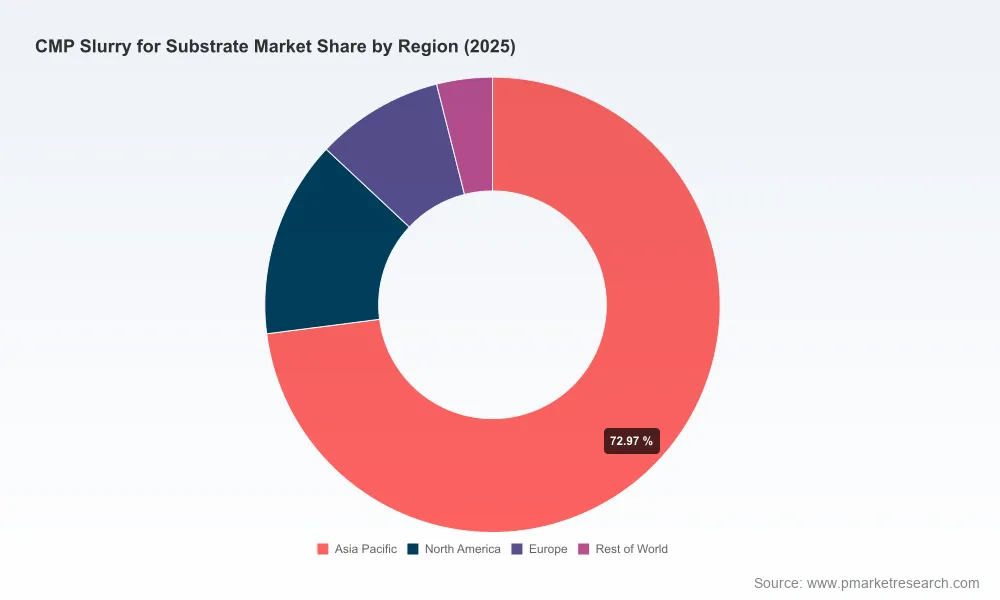
The demand footprint for substrate CMP slurries is highly concentrated geographically yet diversifying in technological composition. Asia Pacific commands the largest share of activity, reflecting the density of wafer fabrication, epitaxial substrate processing, and advanced packaging capacity, while North America and Europe sustain meaningful volumes driven by power electronics, defense, and photonics supply chains. Material-wise, silicon substrates remain the volume anchor, with silicon carbide substrates representing the fastest-growing value driver as EV traction inverters, fast chargers, and industrial power modules migrate from silicon platforms. Gallium nitride substrates and sapphire-and-other hard crystalline substrates occupy specialized but strategically critical niches where defect control, surface roughness targets, and epitaxial compatibility outweigh volume considerations. On the chemistry side, silica-based and alumina-based slurries dominate application breadth, with ceria-based chemistries maintaining premium positioning for demanding oxide and dielectric step removal due to their selectivity profile.
Key Challenges and Inflection Points
Despite the favorable headline growth, three structural pressures are reshaping execution risk and go-to-market dynamics across the substrate slurry segment. First, the supply base for critical abrasives and precursors is exposed to concentration and geopolitical sensitivity. Rare earth elements such as cerium—central to ceria-based slurry performance—are produced overwhelmingly in China, which manufactures more than 85 percent of global rare earth output. This concentration creates exposure to export controls, policy-driven allocation, and freight volatility, complicating long-term capacity planning for ceria-dependent formulations. Second, the regulatory envelope around chemical handling, waste management, and discharge of abrasive-laden CMP waste is tightening globally. Compliance costs for containment, wastewater treatment, and solvent/byproduct disposition are rising, particularly for high-removal and high-selectivity slurries used in epi-ready substrate finishing, where process residues must meet increasingly stringent environmental and worker-safety standards. Third, landed cost volatility from policy measures on imported precursors and nano-abrasives is forcing reevaluation of sourcing footprints. Tariff actions on certain chemicals and engineered abrasives have increased effective input costs for some segments, prompting manufacturers and buyers to revisit dual-sourcing, local blending, and inventory buffering strategies.
Drivers of Demand and Performance
The growth environment is not merely a function of broader semiconductor cycles; it is anchored by specific technology, policy, and supply-chain dynamics that tilt demand toward substrate-level CMP.
Performance Requirements in Wide-Bandgap and Hard-Crystal Substrates
SiC and GaN substrates impose demanding surface specifications. For power applications, epi-ready polishing must control subsurface damage, achieve target roughness, and expose uniform flatness to enable subsequent epitaxial layers with low defect densities. In RF and high-frequency devices, sapphire and other hard substrates require gentle yet effective removal profiles that preserve crystallographic integrity while delivering the smoothness needed for subsequent film deposition or device stacking. The technical complexity of these workflows increases the premium on tailored slurry formulations—particle size distribution control, dispersant chemistry, pH management, and passivation logic—elevating the value of suppliers that can co-develop process solutions with substrate makers and fabs. Recent product introductions targeting sub-5nm node shallow trench isolation and ultraclean defect control reflect a broader industry push toward selectivity and defect suppression that also benefits substrate-adjacent processes, where pattern fidelity and surface cleanliness directly affect downstream yield.
Policy Tailwinds for Power Electronics and Advanced Packaging
Industrial policy in multiple regions is accelerating deployment of wide-bandgap devices and advanced packaging. EV drivetrain electrification, renewable-grid power converters, and energy-efficient industrial drives are all expanding the addressable base for SiC and GaN devices, while advanced packaging creates additional substrate prep and thinning steps that rely on CMP. Environmental and chemical-wastespecific regulation is simultaneously raising the bar for process stewardship, which tends to reward suppliers with mature quality systems, validated waste-handling protocols, and localized material stewardship. As fabs and substrate manufacturers scale throughput, consistency of slurry performance across lots and tool generations becomes a procurement differentiator, favoring suppliers with stable formulations and strong technical support.
CMP Slurries Market
Supply-Side Restructuring and Proximity Economics
Capacity additions and proximity to advanced-node fabs have become strategic levers. Several leading suppliers have expanded production footprints to reduce taper-related response times, support localized qualification, and align with the geography of leading foundries and substrate manufacturers. In parallel, the cost structure for key raw materials—cerium oxide, colloidal silica, and alumina—has shown periodic fluctuation, influencing margin planning and prompting formulation teams to optimize particle utilization and slurry kinetics to maintain cost efficiency without sacrificing removal rate selectivity. Together, proximity expansion and input-cost management are reshaping how supply is organized, moving toward regionalized production nodes with strong formulation IP and local technical service.
One recent example illustrates how these drivers interact in practice: a major materials supplier launched an advanced packaging copper interconnect CMP slurry engineered for high polishing efficiency and planarization performance, while simultaneously bringing a new CMP slurry production line online at its Kumamoto site after a late-2024 capacity expansion announcement. A separate capacity move in Taiwan expanded production for substrate-related CMP applications, anchored to proximity with leading foundries. These actions signal two concurrent priorities—advanced-node chemistry performance and regional supply readiness—both of which are directly relevant to substrate slurry demand that depends on tight coupling between formulation quality and fab-substrate integration.
PW Consulting
Competitive Landscape and Strategic Postures
The market exhibits moderate-to-high concentration, with the top players holding a substantial share of revenue. The competitive profile is shaped by a blend of integrated abrasive manufacturers, specialty slurry formulators, and regional specialists that combine chemical know-how with tool-integration and application engineering. Leadership tends to be earned through formulation IP, process consistency, and the ability to qualify with leading substrate manufacturers and foundry customers.
Integrated Abrasive-to-Slurry Platforms
Firms that produce abrasives in-house and extend into slurry optimization can manage the full value chain from particle engineering to final dispersion. This vertical integration supports tighter control over particle size distribution, surface chemistry, and batch consistency—attributes that become decisive in epi-ready and high-selectivity substrate polishing. Integrated players often pair high-removal ceria slurries with colloidal silica families to cover dielectric, oxide, and metal-adjacent polish steps, enabling them to address multiple substrate classes through differentiated chemistries. A notable strength here is the ability to optimize slurry performance against substrate-specific removal rates and defect thresholds, reducing trial-and-error in customer qualification cycles.
Specialty Formulators and Application Engineering
Several competitors have built differentiation through application engineering depth, offering tailored slurry families for SiC, sapphire, diamond-like hard films, and metals. These players emphasize ultrathin-film polish readiness, surface roughness control, and defect mitigation for power and semi-insulating substrates, often pairing chemistry with process advice on pad selection, dressing frequency, and in-situ monitoring. Their strategic posture rests on solving the downstream integration problem: a slurry that performs in isolation is less valuable than one that meets specification across tool set-ups, load variations, and substrate batches. Recent activity in the sub-5nm node space—focused on shallow trench isolation selectivity and defect control—demonstrates an expanded scope that can spill into substrate processes where selectivity and cleanliness remain paramount.
Regional Specialists and Emerging Players
The field also includes regional specialists that anchor strong local customer relationships and tailor formulations to specific manufacturing environments. In East Asia, domestic substrate manufacturers and fabs benefit from suppliers that provide stock-polish and fine-polish formulations tuned for silicon and substrate planarization, plus dielectric removal slurries for IC manufacturing. In North America and across global operations, certain manufacturers maintain broad portfolios spanning oxide, copper, tungsten, and hard-material substrates, often supporting multiple end markets through shared formulation platforms. New entries and portfolio expansions continue to test incumbents, especially where formulation agility, faster qualification support, and localized capacity can differentiate on responsiveness. At the same time, the scale economics of consistent batch quality and global technical support favor larger, established players and push smaller entrants to compete on niche substrate classes or specific process steps.
Market Evolution and Consolidation Signals
The competitive field is likely to evolve through selective consolidation and capability specialization. Integrated competitors may pursue bolt-on acquisitions to add substrate-specific chemistries or hard-materials expertise, while regional leaders may seek to broaden globally through licensing, joint development, or localized production. At the same time, the sector is fragmenting in the sense that customer needs vary sharply by substrate class—silicon, SiC, GaN, sapphire—so no single formulation set dominates all applications. This duality—consolidation at the top and differentiation within—suggests a future where scale players and specialty formulators coexist, with value shifting toward those that can co-optimize chemistry, pad, and process monitoring for each substrate class. Recent expansion moves and advanced product introductions in advanced packaging and high-selectivity dielectric polish illustrate how incumbents are hardening their moats through both capacity and performance innovation.
Outlook for 2026-2032: Trends and Commercial Implications
Trend 1: SiC and GaN Substrate Demand Will Reweight the Portfolio
As power and RF device roadmaps advance, substrate CMP demand will tilt further toward SiC and GaN classes, with sapphire retaining relevance in photonics, RF, and specialized optoelectronic contexts. This shift rewards formulators capable of delivering epi-ready surface specifications and consistent removal across wafer batches, and it supports premium pricing for solutions that demonstrably reduce downstream defect density and enable thinner, higher-quality substrates. Commercial opportunity lies in building substrate-class-specific qualification dossiers, expanding technical field support, and aligning capacity to regional fab and substrate clusters. Risk arises if substrate makers standardize on fewer vendors or if wide-bandgap adoption cadence softens relative to expectations.
Trend 2: Supply Resilience and Regulatory Compliance Become Purchasing Criteria
With rare-earth exposure, tightening environmental controls, and periodic input-cost volatility, buyers will increasingly treat supply resilience and compliance readiness as decision criteria alongside performance. Suppliers that can demonstrate dual-sourcing options for critical abrasives, validated waste-handling pathways, and transparent lot consistency will capture larger share in enterprise RFPs. Commercial opportunity includes building regional blending and packaging footprints, formalizing material stewardship programs, and offering documentation and audit support that shortens qualification for regulated environments. The risk is that compliance and sourcing complexity raise total cost of ownership for smaller players and compress margins if formulation optimizations cannot fully offset input-cost spikes.
Trend 3: Proximity, Co-Development, and Digital Process Support Will Separate Leaders
The combination of proximity-driven capacity additions and the need to qualify slurries across diverse tool and substrate configurations favors companies that can co-develop with customers and support via digital process feedback. Suppliers that integrate slurry performance data with pad behavior, load monitoring, and surface metrology will shorten tuning cycles and improve reproducibility, which is especially valuable for substrate processing where surface quality directly conditions downstream epitaxy or film deposition. Commercial opportunity lies in service-oriented value propositions—on-site application engineering, formulation tuning, and data-enabled feedback loops—that convert chemistry into a process outcome. Uncertainty stems from the pace at which fabs adopt closed-loop monitoring and from the variability in customer willingness to share process data across suppliers.
Decision-Making Guidance by Stakeholder
For Manufacturers and Substrate Producers
Begin qualifying slurry families on substrate-class-specific criteria, not only universal removal rate. Prioritize vendors with documented epi-ready surface outcomes, low subsurface damage, and consistent roughness control, and use pilot runs to assess defect behavior and pad wear. Strengthen supply resilience by mapping critical abrasives and precursors to supplier locations and considering dual-sourcing for ceria-based chemistries given rare-earth concentration risk. Incorporate environmental compliance readiness into supplier selection, since ongoing chemical handling and waste rules are increasing the hidden cost of non-standardized processes. Finally, treat slurry selection as a process engineering partnership, engaging vendors early in specification setting to reduce trial-and-error and accelerate line stability.
Worldwide Polishing Slurry Market
For Investors and Capital Allocators
Focus on competitive moats that are hard to replicate: vertical integration into abrasives, formulation IP for wide-bandgap and hard-material substrates, and the ability to support qualification across regional fab and substrate clusters. Evaluate exposure to SiC and GaN substrate demand alongside more cyclical silicon volumes, and consider balance-sheet capacity to sustain regional production expansion without overcommitting to a single node. Watch for moves that indicate either consolidation of capability (acquisitions that add substrate-specific chemistry) or fragmentation into niche leaders (regional specialists gaining share through responsiveness). Where possible, stress-test assumptions around rare-earth input costs, environmental compliance spend, and tariff effects on landed cost, since these factors can shift margins and sourcing economics materially over the forecast horizon.
For Procurement and Supply-Strategy Teams
Use total cost of ownership as the anchor metric, accounting for not only price per liter but qualification cycle time, defect-related yield impact, pad and dressing economics, and compliance readiness. Build buffer strategies for critical abrasives, particularly ceria-based materials, and align procurement cadence with regional production expansions to reduce lead-time variability. Engage suppliers on formulation stability across lots and tools, and request documentation that supports environmental audits and waste-handling obligations. Where substrate roadmaps indicate a shift from silicon to SiC or GaN volumes, negotiate transition provisions and multi-year frameworks that preserve flex capacity for advanced-node or high-value substrate classes while controlling base-cost exposure.
Closing Perspective
The substrate CMP slurry market is expanding on the back of wide-bandgap and advanced-packaging momentum, but the shape of future leadership is being defined now by formulation strength, supply resilience, and the ability to turn chemistry into repeatable process outcomes. The combination of rare-earth concentration, tighter environmental rules, and localized capacity strategies is reshaping sourcing and competitive differentiation. With detailed segmentation data, company-level profiles, and scenario analysis available in the full research report, stakeholders can convert these trends into concrete sourcing, investment, and qualification actions tailored to their substrate portfolios and regional footprints.
For detailed analysis of this topic, please visit the official page: Worldwide CMP Slurry for Substrate Market
Lacy Lee
Senior Marketing Manager
[email protected]
PW Consulting: www.pmarketresearch.com

























Sign in to leave a comment.