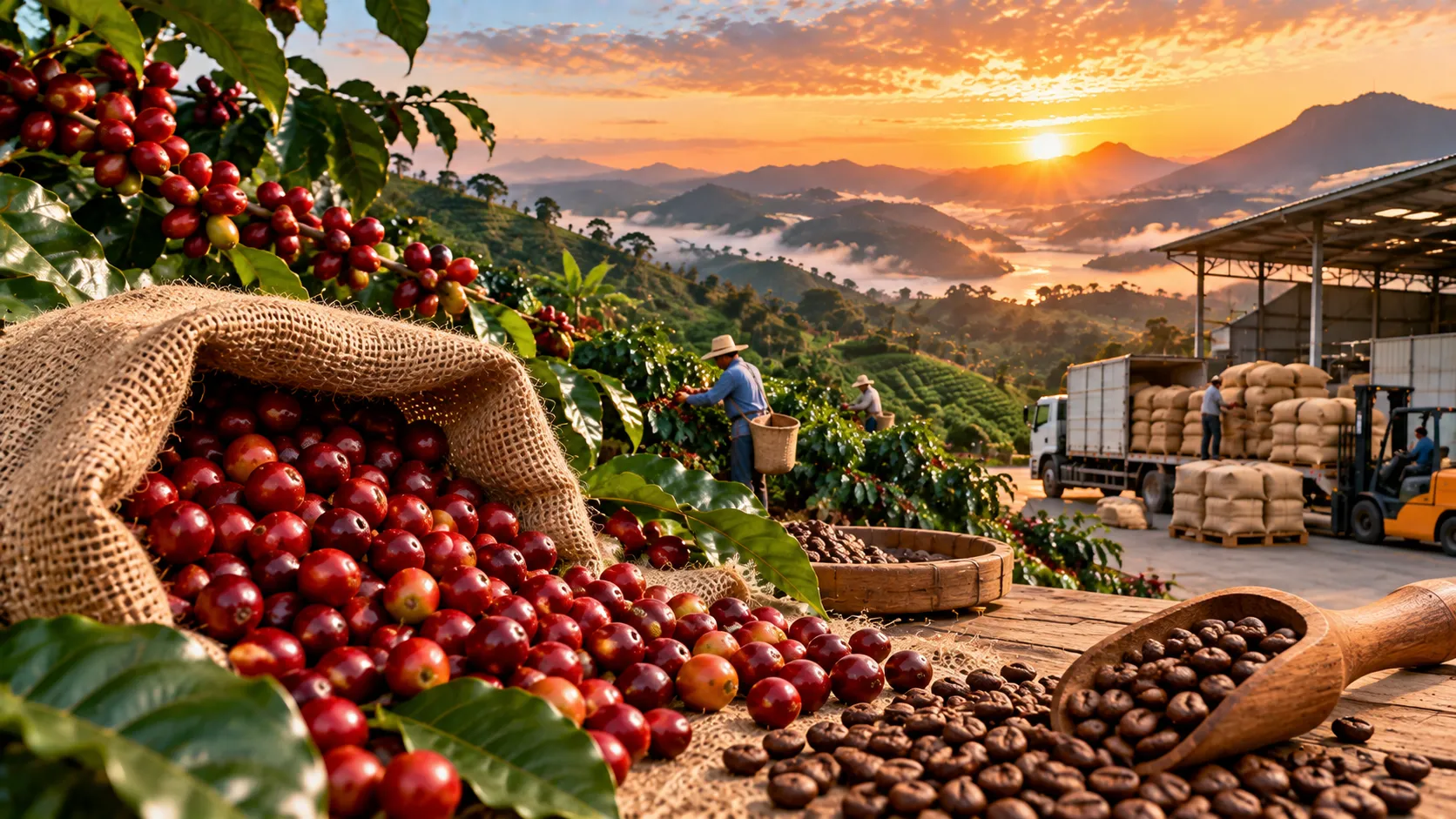

Two of the world’s biggest coffee producers. Same month. Wildly different numbers. That’s the headline here, and it’s worth unpacking before anyone assumes coffee pricing moves as one global block.
As of August 2026, Colombian coffee is priced at USD 8,539.96 per kilogram on an FOB basis. Brazil sits at USD 7,107.36 per kilogram, also FOB. Run the subtraction and you get a gap north of USD 1,400 per kilogram. In a commodity market, that’s not a rounding error. Something structural is going on.
Buyers, roasters, and anyone sourcing green coffee at scale need this coffee price trend on their radar going into Q3 2026. Not as background noise. As a number that directly hits procurement budgets.
The Numbers, Straight Up
| Product | Region | Incoterm Basis | Price | Last Updated |
|---|---|---|---|---|
| Coffee | Colombia | FOB | USD 8,539.96/KG | August 2026 |
| Coffee | Brazil | FOB | USD 7,107.36/KG | August 2026 |
Both quotes share the same incoterm. FOB means the exporter covers cost up to loading on the ship, buyer takes it from there. So this isn’t a CFR versus CIF situation like you’d see comparing other commodities. The gap is real, not an artifact of how the price was quoted.
A few quick reads on this:
- Colombian coffee is running roughly 20% above Brazil’s price on a per-kilogram basis.
- Both figures reflect August 2026 and can shift fast given how reactive coffee markets tend to be.
- Same incoterm basis means the comparison holds up cleanly, unlike mismatched CFR/CIF data.
Quick Q&A: Why Is Colombian Coffee So Much Pricier?
Someone’s going to ask this, so let’s get it out of the way early.
Isn’t Brazil the bigger coffee producer? Yes, by volume Brazil dominates global output. But volume and price don’t move together. Brazil grows mostly at scale across flatter terrain, which keeps production costs lower.
So why does Colombia cost more? Altitude, mostly. Colombian arabica grows in mountainous regions, hand-picked in many cases, with a reputation for quality that commands premium pricing. Lower yields per hectare too. That pushes the price up.
Does quality explain the whole gap? Not entirely. Currency strength, local harvest conditions, and export demand all play a role. Quality perception is a big piece of it, but not the only piece.
What’s Actually Driving This Gap
Coffee pricing rarely comes down to one factor. Here’s what’s likely in play for August 2026.
Harvest timing matters more than people realize. Brazil’s main harvest typically runs earlier in the year, which means by August, fresh supply has already hit the market and softened prices somewhat. Colombia’s harvest cycle runs differently, often producing two smaller crops rather than one large one, which keeps supply tighter and prices firmer.
Weather plays its usual unpredictable role. Frost risk in Brazil, rainfall patterns in Colombia’s growing regions, both factor into yield expectations that traders price in well before the beans actually ship.
Currency matters a lot too. Coffee trades in dollars, but production costs are local. A weaker Colombian peso against the dollar can actually make Colombian exports more price competitive in theory, yet quality premiums often outweigh that effect for specialty-grade beans.
Demand from specialty roasters deserves a mention. Colombian arabica has built a reputation in the specialty coffee segment that Brazilian beans, often used more in blends and commercial-grade products, haven’t chased as aggressively. That demand split shows up directly in the price.
What This Means If You’re Buying or Investing
Procurement teams sourcing green coffee face a real decision here, not a trivial one.
Brazil’s lower FOB price looks like the obvious choice for cost-sensitive buying, and for blend-heavy or commercial coffee products, it probably is. But bean quality, flavor profile, and brand positioning matter just as much as landed cost for roasters building a premium product line.
Investors watching the broader commodity space should note something else. A persistent 20% price gap between two major producers signals the market isn’t treating coffee as interchangeable anymore. Origin matters. That’s a trend with legs, not a one-month blip.
Hedging strategies get more complicated with gaps this wide too. Locking in a Brazil-based forward contract doesn’t protect against Colombia-specific supply shocks, and vice versa. Diversified sourcing across both origins is looking more attractive than betting on one region alone.
Where This Goes in Q3 2026
Hard to call this one with total confidence. Nobody can, honestly.
What seems likely: the Colombia-Brazil spread holds through most of Q3 unless there’s a major weather disruption on either side. Brazil’s harvest cycle doesn’t flip overnight, and Colombia’s quality premium isn’t going anywhere either.
Watch for frost reports out of Brazil’s main growing regions. That’s historically been the single biggest wildcard for Brazilian coffee pricing, and even a modest frost event can spike prices within days.
Buyers locking in long-term contracts right now should treat August 2026 figures as a snapshot, nothing more. Coffee is one of the more volatile soft commodities out there. Prices from even a few weeks back can already be stale by the time a contract gets signed.
Bottom Line
The coffee price trend for Q3 2026 shows a clear and persistent gap between origins. Colombia at USD 8,539.96/KG FOB, Brazil at USD 7,107.36/KG FOB, both as of August 2026. That spread reflects genuine differences in growing conditions, harvest timing, and market positioning, not pricing noise. Anyone sourcing coffee at scale should be building that gap into procurement planning now, not reacting to it later.
FAQ Section
What is the current coffee price trend for Colombia and Brazil?
As of August 2026, Colombian coffee is priced at USD 8,539.96/KG FOB, while Brazilian coffee sits at USD 7,107.36/KG FOB. The gap runs roughly 20%, driven mainly by altitude-grown quality, harvest timing, and demand from specialty roasters favoring Colombian arabica.
Why is Colombian coffee more expensive than Brazilian coffee?
Colombia’s beans grow at higher altitudes, often hand-picked with lower yields per hectare, which raises production costs. Add a strong reputation in the specialty coffee segment, and buyers are willing to pay more. Brazil’s flatter terrain and larger-scale farming keep costs down.
How often do coffee prices change?
Coffee is one of the more volatile soft commodities, and prices can shift weekly based on weather, harvest reports, and currency movement. Frost events in Brazil especially tend to cause sudden spikes. Treat any monthly snapshot as a reference point, not a locked-in number.
Should buyers source from Colombia or Brazil?
Depends on the product. Brazil works well for cost-sensitive, blend-heavy coffee. Colombia fits premium or specialty-grade lines where flavor and origin story matter. Many procurement teams split sourcing across both to balance cost against quality positioning.
What’s the outlook for coffee prices heading into Q3 2026?
The Colombia-Brazil gap looks likely to hold through most of Q3, barring a major weather disruption. Watch Brazil’s frost risk closely, since that’s historically been the biggest single driver of sudden price swings in this market.



















Sign in to leave a comment.