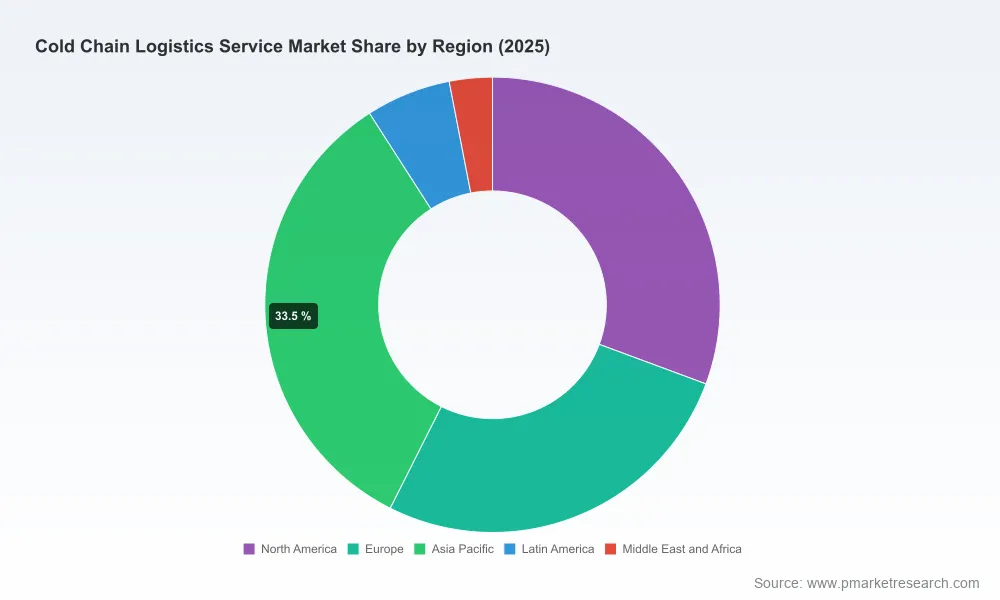

Global Cold Chain Logistics: Strategic Trends and Commercial Opportunities Shaping the Decade Ahead
The worldwide cold chain logistics service market has entered a phase of accelerated commercialization, driven by converging forces in pharmaceutical innovation, food safety demands, and supply chain resilience mandates. With a compound annual growth rate of 14.5 percent through 2032 and total market value crossing into nine-digit territory, the sector is no longer defined solely by refrigeration and transportation. It has become a strategic infrastructure layer where temperature integrity, regulatory compliance, and real-time visibility directly translate into brand trust, product efficacy, and operational margin. For executives and investors, this evolution signals a shift from cost-center logistics to value-creating network orchestration. Understanding where the market is heading requires more than tracking volume growth; it demands examining technological inflection points, regulatory tightening, and the strategic positioning of players who are redefining what cold chain capability means in practice.
Market Landscape and Core Challenges
The temperature-controlled logistics sector has expanded rapidly over the past five years, with market size growing from approximately 215 billion dollars in 2020 to over 417 billion in 2025. Forecasts indicate continued acceleration through 2032, reflecting sustained investment in infrastructure, cross-border pharmaceutical trade, and perishable supply chain modernization. This trajectory is not merely a function of population growth or e-commerce expansion; it reflects structural changes in how temperature-sensitive products move from production to end user, with increasing emphasis on traceability, compliance, and service integration.
Despite the momentum, several structural challenges are reshaping competitive dynamics. Energy dependency remains a critical pressure point, as refrigeration systems can account for up to 60 percent of total energy consumption in cold storage warehouses. Operators face mounting scrutiny over carbon intensity, utility volatility, and the operational cost of maintaining precise thermal environments across large facilities. The second major challenge lies in regulatory fragmentation and tightening compliance expectations. New refrigerant phase-down requirements in the European Union, for example, mandate a 95 percent reduction in hydrofluorocarbons by 2050, compelling equipment upgrades and refrigerant transitions across new and existing infrastructure. Similar standards are emerging in air cargo, where real-time temperature monitoring is now required for the vast majority of cold chain shipments, raising the bar for monitoring integration and data management.
A third challenge is the skilled labor premium required to operate temperature-controlled environments. Cold chain handlers typically command wage premiums of 20 to 30 percent above standard logistics roles, reflecting the specialized training needed for hygiene protocols, thermal handling, and compliance documentation. As throughput scales and facilities modernize, labor availability and training pipelines become constraints on expansion speed, particularly in regions where logistics labor markets are already tight. Geopolitical and trade dynamics add further complexity, with tariff adjustments on refrigerated shipping equipment having already impacted transpacific cold chain costs. These pressures do not halt growth, but they reshape where and how capital is deployed, forcing operators to prioritize efficiency, compliance readiness, and regional capacity alignment over simple volume expansion.
Pharmaceutical Logistics Market
Key Drivers Reshaping the Cold Chain Sector
Technological Innovation and Monitoring Integration
The most visible transformation in cold chain logistics comes from technology integration that turns temperature management from a passive infrastructure function into an active data-driven service. Artificial intelligence-powered monitoring platforms, real-time sensor networks, and predictive analytics are becoming standard expectations in pharmaceutical and high-value perishable supply chains. Recent deployments illustrate this shift clearly: a major logistics provider launched an AI-enabled temperature monitoring platform across European pharmaceutical operations, enabling continuous visibility and anomaly detection across distributed cold chain nodes. Parallel advancements in ultra-low temperature logistics are expanding the boundaries of what can be transported safely, particularly for cell and gene therapies that require precise thermal control and chain-of-compliance documentation. These innovations are not merely operational improvements; they create new service tiers that differentiate providers on reliability, compliance assurance, and response speed.
Regulatory and Compliance Realignment
Regulatory evolution is accelerating investment in compliant equipment, monitoring infrastructure, and documentation systems. Refrigerant transition mandates, air cargo temperature management regulations, and pharmaceutical good-distribution-practice expectations are converging to raise the baseline for market participation. The phase-down of high-global-warming-potential refrigerants is pushing equipment procurement toward low-impact alternatives, while air cargo standards now require real-time monitoring for the majority of temperature-sensitive shipments. For operators, compliance is no longer a checklist item; it is a competitive filter. Companies that integrate monitoring, documentation, and compliant equipment into their service design are better positioned to win pharmaceutical contracts, secure airline and customs approvals, and reduce risk exposure across borders. This regulatory drift favors providers that can offer end-to-end compliance assurance rather than fragmented temperature-controlled movement.
Demand-Side Shifts in Food, Pharma, and Perishables
Demand patterns are reshaping service requirements across both food and life sciences sectors. Consumer expectations for freshness, extended shelf life, and food safety are pushing retailers and manufacturers to demand more resilient temperature-controlled distribution. At the same time, pharmaceutical innovation is driving growth in biologics, vaccines, and advanced therapies that require stringent cold and ultra-cold logistics. The result is a dual demand environment: one side emphasizes high-throughput perishable distribution with flexible inventory management, while the other demands specialized handling, validated packaging, and rigorous chain-of-custody monitoring. These diverging requirements are prompting service providers to specialize or build modular capabilities that can serve both segments without compromising compliance or cost structure.
Supply Chain Structure and Cost Dynamics
Cold chain economics are being recalibrated by energy costs, labor premiums, and shifting trade routes. Refrigeration intensity makes energy management a core strategic issue rather than a utility concern, pushing investment in high-efficiency equipment, thermal insulation upgrades, and smarter operational controls. Labor cost differentials further influence facility location decisions and automation adoption, as temperature-controlled environments require trained personnel and precise handling protocols. Meanwhile, shifts in trade policy and freight dynamics have introduced cost variability on key international lanes, encouraging companies to reconsider network design, nearshore storage options, and regional capacity buffers. These structural changes favor operators that can balance service reliability with cost control, especially as customers increasingly view cold chain performance as a determinant of total supply chain cost rather than an isolated logistics expense.
Competitive Landscape and Leading Strategies
Established Leaders and Strategic Positioning
The competitive field blends global logistics integrators, specialized cold storage operators, and niche ultra-temperature specialists, each pursuing distinct strategic positioning. Large temperature-controlled warehousing and logistics operators are expanding facility networks and deepening service integration in key protein and perishable corridors. One global leader recently opened a major cold storage facility in the U.S. Gulf Coast region, reinforcing capacity for protein products and regional distribution density. Another major provider expanded a frozen distribution partnership with a prominent grocery chain across Midwest facilities, illustrating how service providers are embedding themselves deeper into retail and foodservice supply networks. These moves reflect a strategy centered on scale, regional density, and proximity to high-volume perishable demand.
In the pharmaceutical and integrated logistics segment, global integrators are emphasizing compliance-ready infrastructure, multimodal transport, and monitoring technology. One provider launched AI-powered monitoring for pharmaceutical cold chain operations in Europe, signaling a shift toward data-enabled service differentiation. Another major integrator secured an end-to-end cold chain contract for a leading vaccine manufacturer in Asia-Pacific, demonstrating the importance of validated handling, cross-border coordination, and trusted distribution in life sciences. Ultra-low temperature specialists continue to carve out a distinct position by focusing on advanced therapies and chain-of-compliance logistics, where precision and documentation often outweigh volume considerations. Together, these players illustrate a market where differentiation is increasingly built on compliance assurance, monitoring capability, and segment-specific expertise rather than refrigeration alone.
Market Structure Evolution
The competitive landscape is moving through a phase of selective consolidation alongside targeted specialization. Large operators are expanding footprint and integrating services to capture more value across storage, transportation, and monitoring, while mid-tier and regional players are often differentiating through local market knowledge, specialized product handling, or niche compliance capabilities. New entry barriers are rising in pharmaceutical cold chain due to regulatory expectations, monitoring infrastructure requirements, and validation demands, which tend to favor established networks and well-capitalized operators. At the same time, technology-enabled service models are lowering barriers in monitoring and value-added services, allowing providers to layer digital capabilities onto existing physical networks. The overall trend points toward a bifurcated market: one segment competing on scale, integration, and regional density, and another competing on specialized handling, compliance depth, and high-precision temperature control.
Future Trends and Commercial Implications
Digital-Enabled Cold Chain as a Standard Service Layer
Over the next three to five years, real-time monitoring, predictive analytics, and compliance data integration are likely to become baseline expectations rather than premium features. As regulatory standards tighten and customer expectations rise, providers that can deliver continuous visibility, anomaly alerts, and documented chain-of-custody will gain preferential access to high-value pharmaceutical contracts and premium perishable distribution agreements. The commercial opportunity lies in converting monitoring capability into service differentiation, risk reduction, and pricing power. Providers that treat data infrastructure as a core product rather than a support function will be better positioned to capture value from service-tier upgrades and long-term contractual relationships.
Energy-Efficient and Low-Impact Cold Infrastructure
Sustainability and energy cost pressures will accelerate investment in high-efficiency refrigeration, low-global-warming-potential refrigerants, and smarter thermal management. Operators that proactively modernize equipment and optimize energy use will gain advantages in operating cost, regulatory readiness, and customer alignment, particularly as corporate sustainability commitments influence sourcing decisions. The commercial implication is twofold: reduced exposure to energy volatility and stronger positioning in procurement processes where compliance and environmental performance increasingly influence vendor selection. Companies that delay infrastructure modernization may face higher retrofit costs and growing compliance risk as standards tighten.
Regionalization and Network Resilience
Trade dynamics, cost variability, and the need for faster response times are likely to encourage more regionalized cold chain networks, with increased emphasis on nearshore storage, regional distribution hubs, and flexible capacity allocation. This shift creates opportunities for operators that can design networks balancing efficiency with resilience, particularly in regions experiencing rapid demand growth or supply chain reconfiguration. For customers, regionalized networks can reduce transit risk, improve responsiveness, and lower exposure to long-haul disruptions. For investors and operators, the opportunity lies in identifying where regional demand intensity, regulatory alignment, and infrastructure gaps intersect to justify targeted capacity expansion and service integration.
Risk Considerations
The outlook is favorable, but not without uncertainty. Energy price volatility, refrigerant transition costs, labor availability, and geopolitical trade shifts can alter regional competitiveness and expansion timing. Regulatory complexity may create short-term compliance burdens even as it strengthens long-term market standards. In addition, rapid technology adoption can widen the gap between digitally mature operators and those dependent on legacy monitoring and manual processes, potentially accelerating competitive divergence. Stakeholders should treat these risks as planning variables rather than fixed constraints, building flexibility into network design, equipment procurement, and service commitments.
Strategic Actions for Decision Makers
For Manufacturers and Product Owners
Temperature-sensitive product companies should treat cold chain selection as a strategic partnership decision rather than a transactional logistics purchase. Prioritize providers with demonstrated compliance readiness, monitoring integration, and segment-specific experience relevant to your product profile. For pharmaceutical and advanced therapy manufacturers, validated handling, documentation rigor, and chain-of-compliance capability should weigh heavily in supplier selection. For food and beverage companies, distribution density, inventory flexibility, and energy-efficient facility design can materially affect total cost and service reliability. Building longer-term collaboration models with clear performance metrics often yields better outcomes than short-term price-based sourcing, especially when temperature integrity directly affects product quality and brand reputation.
Cold Chain Logistics Market
For Investors and Capital Allocators
Investment attention should focus on operators with credible pathways to energy efficiency, digital monitoring integration, and compliance-driven service expansion. Scale and regional density matter, but they are increasingly insufficient without technology-enabled visibility and regulatory readiness. Ultra-low temperature and specialized pharmaceutical logistics represent higher-barrier segments with strong demand alignment, though they require disciplined operational execution and compliance infrastructure. When evaluating opportunities, consider how well a company's network design matches regional demand intensity, how prepared it is for refrigerant and monitoring standards, and whether its service model can capture value beyond basic storage and transportation.
For Procurement and Supply Chain Leaders
Procurement teams should incorporate compliance, monitoring capability, and energy performance into evaluation criteria alongside cost and capacity. Request evidence of real-time monitoring integration, documentation practices, and contingency handling for temperature deviations. Where possible, align sourcing decisions with supplier roadmaps for equipment modernization and digital service upgrades, since these factors influence long-term reliability and risk exposure. Multi-provider strategies can be useful where regional coverage or product specialization requires flexibility, but they should be managed with clear performance expectations and data-sharing arrangements to maintain end-to-end visibility.
PW Consulting
The cold chain logistics market is expanding within a landscape shaped by technology adoption, regulatory tightening, demand specialization, and cost structure evolution. Success in this environment depends on seeing temperature-controlled logistics as a strategic capability that links compliance, efficiency, and customer trust. For leaders seeking detailed segmentation data, regional nuance, and customized recommendations aligned to specific product portfolios or investment theses, the full PW Consulting research report provides a deeper, structured view of the market and the strategic choices it presents.
For detailed analysis of this topic, please visit the official page: Worldwide Cold Chain Logistics Service Market
Lacy Lee
Senior Marketing Manager
[email protected]
PW Consulting: www.pmarketresearch.com




























Sign in to leave a comment.