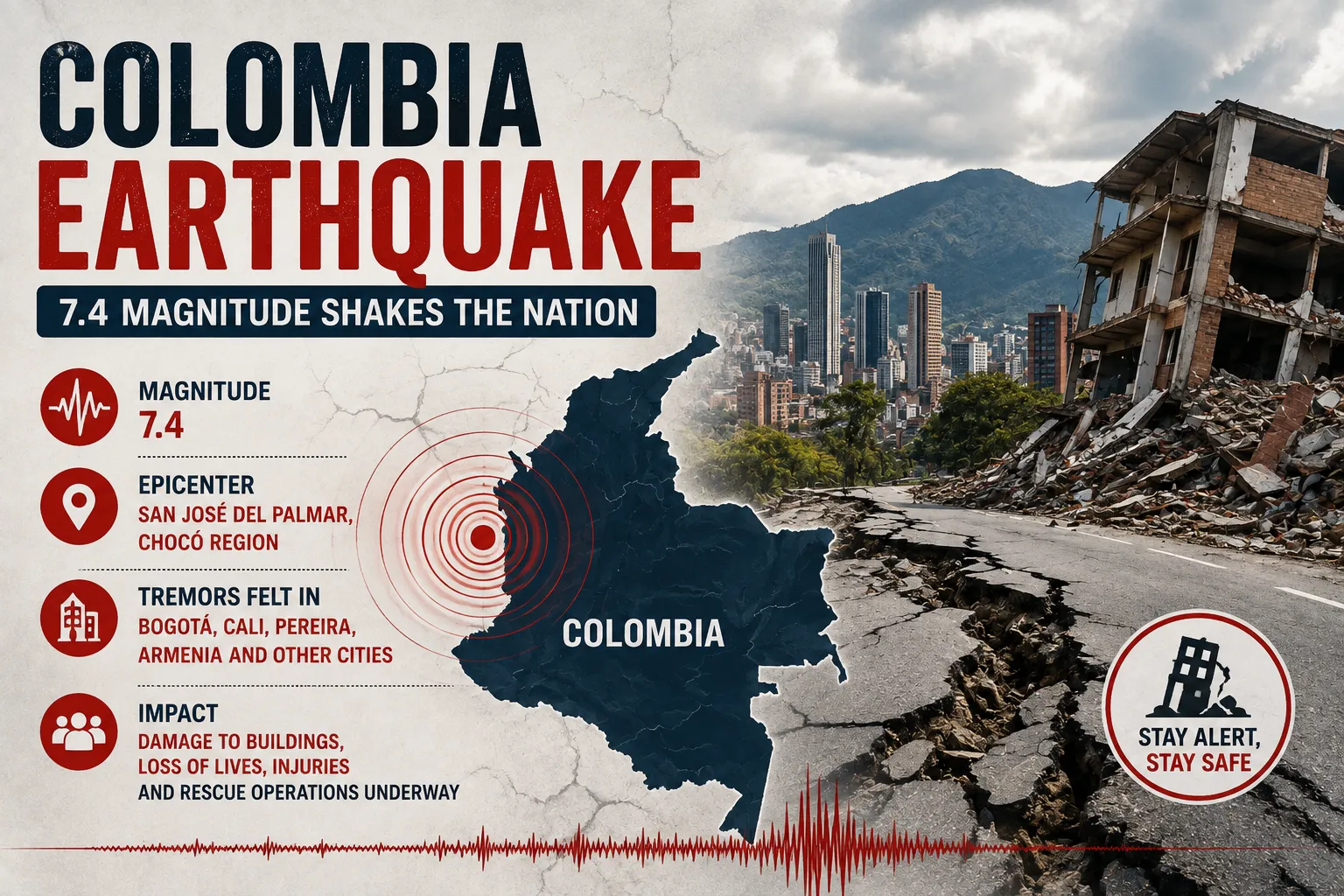


A powerful 7.4-magnitude earthquake struck western Colombia on August 10, 2026, with strong tremors felt across several cities, including Bogotá, Cali, Pereira, Armenia and Manizales. The epicenter was reported near San José del Palmar in the Chocó region. The earthquake caused damage to buildings and infrastructure, while rescue teams worked to help people trapped in affected areas. Breaking international news today in Hindi has highlighted the event because of its significant impact and the wide area where shaking was felt.
What Caused the Colombia Earthquake?
An earthquake occurs when energy stored inside the Earth's crust is suddenly released. Earth's outer layer is divided into large tectonic plates that move slowly over time. When pressure builds along a fault, rocks can suddenly slip and release energy in the form of seismic waves.
The underground point where an earthquake starts is called the focus, or hypocenter. The location directly above it on Earth's surface is known as the epicenter. The depth of the earthquake is important because shallow earthquakes can produce strong shaking near the surface. International News in Hindi can help readers understand these scientific aspects behind major natural disasters.
Understanding a 7.4-Magnitude Earthquake
Magnitude measures the size of an earthquake and the energy released during the event. A magnitude of 7.4 is considered a major earthquake and can cause serious damage, particularly when it occurs near populated areas or where buildings are not designed to withstand strong shaking.
Magnitude should not be confused with intensity. Magnitude describes the earthquake itself, while intensity describes how strongly people and structures experience the earthquake at a particular location. World News in Hindi coverage of such events can therefore provide both the latest developments and useful scientific context.
Why Do Earthquakes Cause Damage?
The amount of damage does not depend only on magnitude. Several factors influence the impact, including the earthquake's depth, distance from populated areas, local soil conditions, population density and the quality of buildings.
Strong shaking can damage buildings, roads, bridges, power networks and water systems. Earthquakes can also trigger landslides and ground liquefaction. This is why two earthquakes with similar magnitudes can produce very different levels of destruction.
What Are Aftershocks?
Aftershocks are smaller earthquakes that occur after a major earthquake in the same general region. They happen as the Earth's crust adjusts to changes caused by the main earthquake. Aftershocks can continue for days, weeks or sometimes longer, and some can still cause additional damage to already weakened structures.
People in affected areas should therefore remain cautious after the main shaking stops. Latest International News in Hindi can be useful for following official updates about rescue operations, aftershocks and safety instructions.
Earthquake Safety: What Should You Do?
The simplest safety rule during an earthquake is Drop, Cover and Hold On. If you are indoors, drop to the ground, take cover under a sturdy table or desk if possible, and hold on until the shaking stops. Stay away from windows, glass and heavy objects, and avoid using elevators.
If you are outside, move away from buildings, trees, power lines and other objects that could fall. After the shaking, avoid damaged buildings and remain alert for aftershocks. International Hindi News Today can provide updates, but emergency instructions from local authorities should always be followed first.
Educational Takeaway
The Colombia earthquake shows why understanding earthquakes is important even for people living far from active earthquake zones. Earthquakes cannot currently be predicted with exact time and location, but their risks can be reduced through earthquake-resistant construction, emergency planning, public awareness and quick response systems.
Learning how earthquakes occur, what magnitude means and how to react during shaking can help people make safer decisions when a natural disaster occurs.























Sign in to leave a comment.