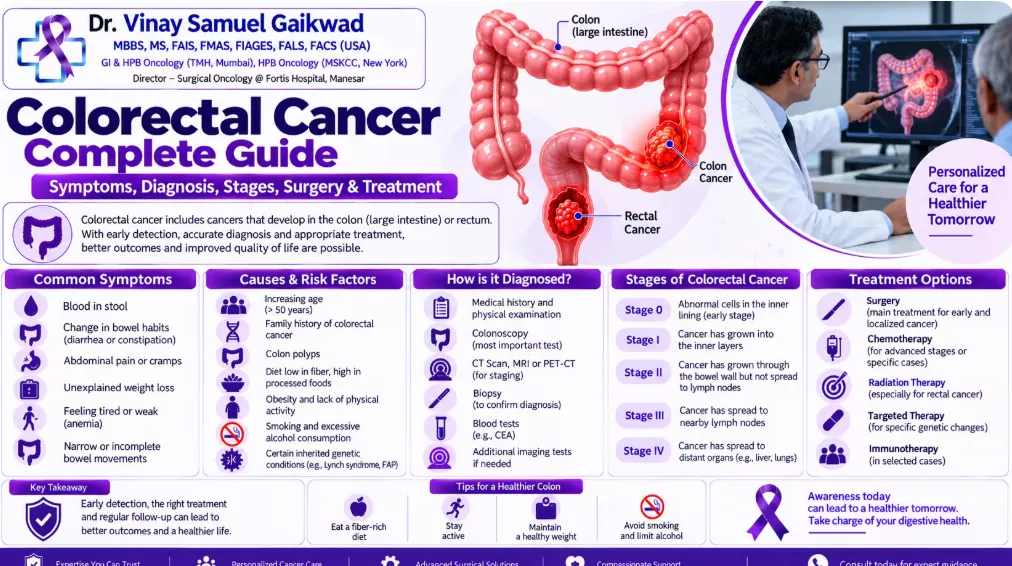

Colorectal cancer develops in the colon or rectum and is one of the commonly diagnosed cancers affecting the digestive system. Early detection can make a significant difference in treatment planning and outcomes. This complete guide covers colorectal cancer symptoms, diagnosis, stages, surgery, and treatment options.
What Is Colorectal Cancer?
Colorectal cancer begins when abnormal cells develop in the lining of the colon or rectum and grow uncontrollably. In many cases, it can develop from certain types of polyps over time. Regular screening can help detect precancerous changes or cancer at an earlier stage.
The treatment approach depends on factors such as the location of the cancer, stage, tumor characteristics, and the patient's overall health.
Symptoms of Colorectal Cancer
Some people may not have noticeable symptoms in the early stages. Possible symptoms include:
- Changes in bowel habits, including constipation or diarrhea
- Blood in the stool or rectal bleeding
- Persistent abdominal discomfort or cramps
- Unexplained weight loss
- Increased tiredness or weakness
- A feeling that the bowel does not empty completely
- Narrower-than-usual stools
- Iron-deficiency anemia without an obvious cause
These symptoms can also occur with non-cancerous conditions. Persistent or unusual symptoms should be medically evaluated.
How Is Colorectal Cancer Diagnosed?
Diagnosis generally involves a combination of clinical assessment and investigations, which may include:
Colonoscopy
A colonoscopy allows the doctor to examine the inside of the colon and rectum and take a biopsy or remove certain polyps when appropriate.
Biopsy
A tissue sample is examined under a microscope to confirm cancer and determine its characteristics.
Imaging Tests
CT scans, MRI, PET scans, or other imaging studies may be recommended to assess the extent of disease and check for spread to other organs.
Blood Tests
Blood tests may help assess general health and, in selected patients, tumor markers such as CEA may be used for treatment planning and follow-up.
Stages of Colorectal Cancer
Colorectal cancer is generally staged from Stage 0 to Stage IV:
- Stage 0: Abnormal or cancerous cells are limited to the innermost lining.
- Stage I: Cancer has grown into deeper layers of the bowel wall but has not spread to nearby lymph nodes.
- Stage II: Cancer has grown further through the bowel wall without involving nearby lymph nodes.
- Stage III: Cancer has spread to nearby lymph nodes.
- Stage IV: Cancer has spread to distant organs, such as the liver or lungs.
The exact stage is determined through pathology and appropriate imaging and helps guide treatment.
Colorectal Cancer Surgery
Surgery is an important part of treatment for many patients, particularly when the cancer is localized or can be removed safely.
Depending on the tumor's location, surgery may involve removing the affected portion of the colon or rectum along with nearby lymph nodes. Procedures may include:
- Colectomy: Removal of part or all of the colon.
- Low anterior resection: Removal of part of the rectum while preserving the anal sphincter when appropriate.
- Abdominoperineal resection: Removal of the rectum and anus in selected cases.
- Laparoscopic or robotic surgery: Minimally invasive approaches that may be suitable for selected patients.
The choice of surgery depends on tumor location, stage, anatomy, and other individual factors.
Other Colorectal Cancer Treatments
Surgery may be combined with other treatments depending on the stage and characteristics of the cancer.
Chemotherapy
Chemotherapy may be recommended before or after surgery or for advanced disease.
Radiation Therapy
Radiation is commonly considered for selected rectal cancers, particularly when there is a risk of local recurrence.
Targeted Therapy
Certain advanced colorectal cancers may benefit from targeted medicines based on specific molecular characteristics.
Immunotherapy
Immunotherapy can be useful for selected patients whose tumors have particular biomarkers, such as mismatch repair deficiency or microsatellite instability.
Importance of Timely Treatment
Colorectal cancer treatment is most effective when the disease is accurately diagnosed and managed according to its stage and biological characteristics. A multidisciplinary approach may involve surgical oncologists, medical oncologists, radiation oncologists, radiologists, and pathologists.
Patients may benefit from discussing all suitable treatment options with an experienced cancer team before making treatment decisions.
Colorectal Cancer Surgery with Dr. Vinay Samuel Gaikwad
Dr. Vinay Samuel Gaikwad is a surgical oncologist who provides surgical care for patients with colorectal and other gastrointestinal cancers. Treatment planning is individualized based on the tumor's location, stage, and the patient's overall condition.
For patients seeking specialized surgical cancer care, consulting a Best Surgical Oncologist in India can help them understand the available surgical approaches and develop an appropriate treatment plan.
Conclusion
Colorectal cancer can present with changes in bowel habits, bleeding, abdominal symptoms, anemia, or unexplained weight loss, although some patients have no symptoms in the early stages. Colonoscopy, biopsy, imaging, and other investigations help establish the diagnosis and stage.
Treatment may include surgery, chemotherapy, radiation therapy, targeted therapy, immunotherapy, or a combination of these approaches. Early evaluation and stage-appropriate treatment are important for achieving the best possible clinical outcome. Patients can consult Dr. Vinay Samuel Gaikwad, a Best Surgical Oncologist in India, for expert evaluation and surgical treatment planning.





























Sign in to leave a comment.