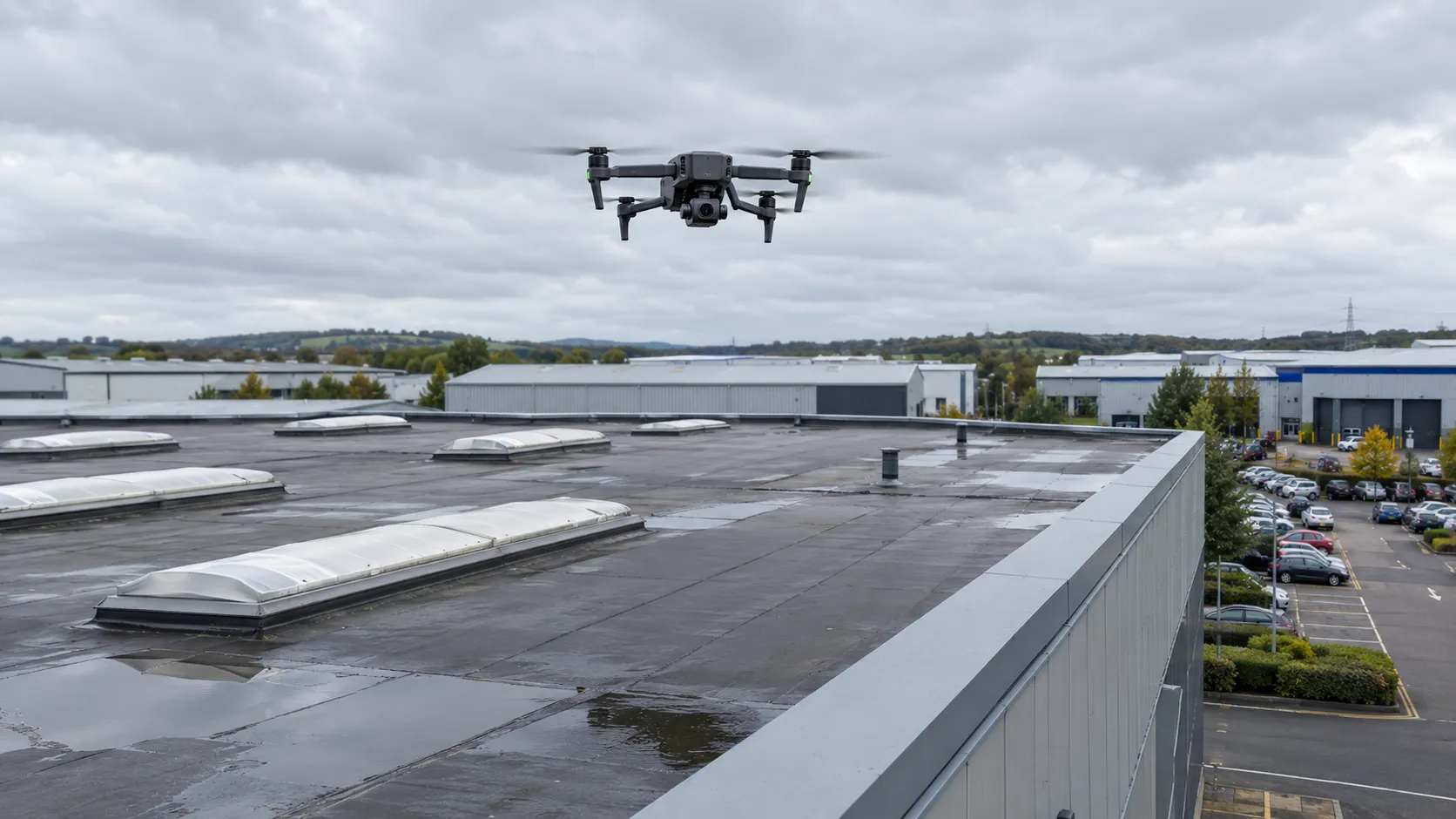

Most commercial roofs get looked at twice. Once when they're built, and once when they leak. That's the shocking truth, honestly. A drone roof inspection changes it, and it takes about as long as a slow coffee.
Picture a warehouse roof that looks fine from the car park. Then one wet Tuesday, water's running down an internal wall and nobody saw it coming. The frustrating part isn't the damage. It's how cheap it would've been to catch.
The Problem With Skipping a Drone Roof Inspection
Commercial roofs are big, flat or low pitched, and awkward to reach. Walking one properly means harnesses, edge protection, a crew and often a day of disruption. So owners wait. Then a leak forces the issue, and a small repair turns into a big one.
Here's a number worth knowing. Just 25 mm of standing water across a 1,000 square metre roof weighs about 25 tonnes. A blocked outlet can do that quietly, week after week. A drone roof inspection spots ponding like that long before it becomes an insurance claim or a structural conversation.
And the ground level look? It misses most of it. You can't see seams, flashing or blocked gutters from the pavement.

What Is Commercial Drone Roof Inspection?
A drone roof inspection is a roof survey flown from the air by a qualified pilot, using a camera drone that's often fitted with a thermal sensor. On commercial sites that means warehouses, retail units, schools, blocks of flats and industrial estates. The pilot flies a set pattern so nothing gets missed, and the images feed straight into your report.
It's the same aerial survey drone technology we use on high level drone surveying projects, just pointed at your roof.
Thermal Imaging That Shows What Your Eyes Can't
Thermal cameras read surface temperature. Wet insulation holds heat differently from dry, so it shows up as a patch. We fly these early morning or after sunset, when the roof's cooling and the differences are sharpest.
It won't tell you why an area is wet. But it'll tell you exactly where to look, which saves a surprising amount of guesswork (and money).
Safe Access to Roofs Nobody Wants to Walk
Falls from height remain one of the biggest causes of workplace deaths in the UK, and fragile roof lights are a classic culprit. Older cement sheet roofs on industrial units are another. Why send someone across them when a drone can look from three metres above?
Surveying drones don't get vertigo. They also don't fall through anything.
How a Drone Roof Inspection Solves the Access and Cost Problem
The real win is what you don't have to do. No scaffolding. No closing the unit. No tenants losing a trading day.
- The whole roof gets covered in one pass, including corners a person couldn't safely reach.
- Dated images give you evidence for insurers, lenders and landlords.
- Fast.
- You get a written summary in plain English, with each issue rated urgent, monitor or fine, so your contractor knows where to start.
Drone surveying also makes repeat checks realistic. A yearly look at a roof costs far less than a one off emergency, and you build a photo history of how it's ageing.
Real World Use Case: A Warehouse Roof in Merseyside
Here's a scenario we see often, so I'll keep the details general. An owner's refinancing an industrial unit of roughly 5,000 square metres, and the lender wants a roof condition report. Access equipment gets quoted at several thousand pounds before anyone's written a word.
Instead, a pilot flies a drone roof inspection one morning. Total time on site is about two hours. The images show three areas of ponding, two failed seams around roof lights, lifted flashing at the parapet and a blocked outlet. The thermal pass flags one damp section under the membrane.
The result? A targeted repair list rather than a scary replacement quote. Honestly, that's the outcome I'd want if it were my building.
Things to Consider Before You Book
A drone isn't magic. Here's the fair comparison.
- Drone survey: fast, low disruption, great for visual defects and thermal moisture patterns. It can't touch, test or open anything up.
- Rope access or a cherry picker: closer contact, but slower and pricier, and it needs more planning.
- Walking the roof: fine for solid, safe roofs. Not for fragile ones.
A few practical points. Wind and rain can delay a flight. Airspace matters too, and Liverpool's airport means some sites need extra checks before a pilot can fly. Ask any provider whether they're CAA registered, insured and willing to show you a sample report.
For a rough idea of budget, this breakdown of Merseyside drone survey pricing is a decent starting point. Got a house or a small portfolio instead of a commercial unit? Our guide to drone roof inspection for landlords and homebuyers covers that side.
FAQs
How Long Does a Drone Roof Inspection Take on a Commercial Building?
Most commercial roofs take one to three hours to fly, depending on size and whether thermal scanning's included. Your report usually follows within [24 to 72 hours].
Is a Drone Roof Survey as Good as a Walking Survey?
Partly. A drone roof survey is excellent for visible defects and moisture patterns, but it can't test materials or check what's beneath the covering. For a full picture, pair it with a follow up visit where something looks suspect.
Can Drones Find Roof Leaks?
Not directly. Thermal imaging shows where insulation looks wet or cold, which points you to the likely source. Confirming the actual leak path may still need someone on the roof or in the loft.
Is Drone Surveying Legal in the UK?
Yes, as long as the pilot follows CAA rules, holds the right registrations and gets permission where airspace is restricted. That's why it pays to hire a qualified operator rather than buying a drone for surveying and having a go yourself.
Final Thoughts: Book a Drone Roof Inspection Before the Leak Does It for You
I'm not saying every roof needs a drone above it every year. (A brand new roof with a warranty probably doesn't.) But if yours is more than ten years old and nobody's given it a proper look, a drone roof inspection is the cheapest way to find out where you stand.
You'll know what's failing, what's fine and what can wait. That beats finding out from a wet ceiling.
Want a straight answer on your building? Get in touch with ASG Consulting and tell us the address, the roof type and what's worrying you.
About the Author
This article comes from the team at ASG Consulting, trusted building surveyors that Liverpool homeowners, landlords and investors rely on, providing residential, commercial and specialist surveying services across Merseyside and the wider North West.


























Sign in to leave a comment.