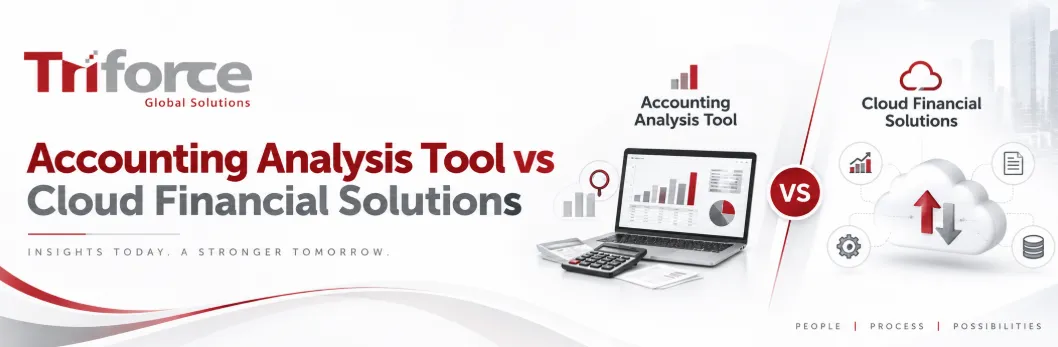


Ask any finance manager in Singapore what keeps them up at night, and chances are the answer has nothing to do with strategy. It's the basics. Reports that take too long. Numbers that don't match across two files. A spreadsheet that someone forgot to update before the meeting.
This is the reality for a lot of growing businesses. The company scales, transactions pile up, and the systems that used to work fine start showing cracks. That's usually the point where a business starts looking seriously at an accounting analysis tool paired with cloud financial solutions, not because it's trendy, but because the old way stopped being sustainable.
If any of this sounds familiar, keep reading. We'll walk through why this happens, what actually changes when you fix it, and how to go about it without turning your finance department upside down in the process.
Why Do Businesses Outgrow Their Accounting Systems?
Here's something worth saying clearly: businesses don't usually run into financial reporting problems because their staff are bad at their jobs. It's almost always a systems issue. The tools were built for a smaller, simpler operation, and nobody updated them as the business grew.
You'll usually notice a few warning signs before things get bad. Reports lag a week or two behind what's actually happening. The same figures get typed into three different places by three different people. Small mistakes slip through unnoticed, until they surface somewhere much more expensive later. And when someone asks "what's our cash position right now," the honest answer is give me an hour to check.
None of this is unusual. It's what happens when growth outpaces infrastructure. An accounting analysis tool exists to close that gap. It pulls data from across the business into one place and turns it into something you can actually act on, not just a wall of numbers waiting to be sorted through manually.
What Do Cloud Financial Solutions Actually Change?
Cloud financial solutions take your financial systems off a single office desktop or a local server sitting in a back room, and move them onto secure infrastructure that authorized staff can access from wherever they're working. For a business with a regional office, remote finance staff, or more than one branch, this isn't a nice extra. It changes how fast the business can actually respond to what's going on financially.
Think about how this plays out day to day. Instead of waiting on an email with an attached spreadsheet, a manager logs in and sees the current numbers right there. When a transaction gets entered anywhere in the system, everyone connected to it sees the update, so no one's stuck working off a version that's already out of date.
What Actually Improves After the Switch?
This part matters, because it's easy to talk about efficiency in the abstract without saying what changes on the ground. Here's what businesses tend to notice. Month end closing speeds up. Work that used to eat an entire week can often be wrapped up in a couple of days once reconciliation and reporting stop being manual. Mistakes become less common. When there's one system handling the data instead of five separate spreadsheets passed around by email, there's simply less room for something to be entered wrong or overlooked.
Decision makers get a clearer view. Rather than waiting for the next scheduled report, an owner or manager can check performance whenever it's actually needed. Security tends to improve too. A properly managed cloud platform usually comes with backup systems, encryption, and access controls that would be costly and complicated for a smaller business to build on its own. And the system grows with you. As transaction volume increases, the platform scales alongside it, instead of forcing a painful full replacement every few years.
How Does Implementation Actually Work?
Changing financial systems sounds disruptive, and it can be, if it's done carelessly. Done properly, it doesn't have to interrupt day to day operations at all.
It usually starts with a review. Someone looks closely at the current setup to find where data gets stuck, duplicated, or lost between departments. From there, a system gets selected or configured to match the actual size and complexity of the business, not a one size fits all package pulled off a shelf.
Next comes the part that requires the most care: migrating existing financial data, with checks built in at every stage so errors get caught before they become permanent. After that, the finance team gets properly trained, because even the best system is only as good as the people using it. And finally, ongoing support gets put in place, so small issues get resolved quickly instead of turning into something bigger down the line.
Why Work With Triforce Global Solutions
Triforce Global Solutions works directly with businesses across Singapore to plan and deliver financial systems that actually fit how each company operates. We're not in the business of forcing companies into a generic template that was never built for them in the first place.
Here's what we offer, from the ground up.
- System Implementation covers the setup and configuration of the right accounting analysis tool and cloud financial solutions for your specific business, not a one size fits all rollout.
- Training Services make sure your team actually understands how to use the system with confidence, rather than just following a manual step by step.
- Business Consulting takes a close look at your current financial processes and points out where a smarter system will genuinely save time and cut cost, not just where it sounds good on paper.
- Technical & Software Development Services come into play when off the shelf software doesn't quite fit, letting us build or adjust something around your actual needs instead of forcing a workaround.
- Maintenance and Support Services keep things running well after the initial setup is done, so you're never left figuring out a problem on your own.
Learn more about how we work at visit us my website
Frequently Asked Questions
1. What does an accounting analysis tool actually do?
It gathers financial data from across the business, invoicing, payroll, banking, and turns it into clear reports that help owners and managers make sense of performance instead of guessing at it.
2. Is it actually safe to store financial data with cloud financial solutions?
Established cloud platforms generally include strong encryption, restricted access for authorized users, and automatic backups. For most small and mid sized businesses, this ends up being more secure than a local server managed in house.
3. How long does setting up a new financial system usually take?
It depends on the size of the business and how much data needs to move over, but a good implementation is broken into stages so daily work doesn't grind to a halt.
4. Is this only worth it for large companies?
Not really. Small and mid sized businesses often see the biggest difference, since these tools take over the manual grind that would otherwise fall entirely on a small finance team.
5. Does Triforce Global Solutions stick around after the system goes live?
Yes. Our Maintenance and Support Services are there for the ongoing questions, updates, and issues that come up as the business keeps growing and changing.
Ready to Fix What's Slowing Your Finance Team Down?
If your current system is costing you more time than it's saving, it's probably time for a real accounting analysis tool built on dependable cloud financial solutions. Get in touch with Triforce Global Solutions through Visit us and let's talk about what your business actually needs.




















Sign in to leave a comment.