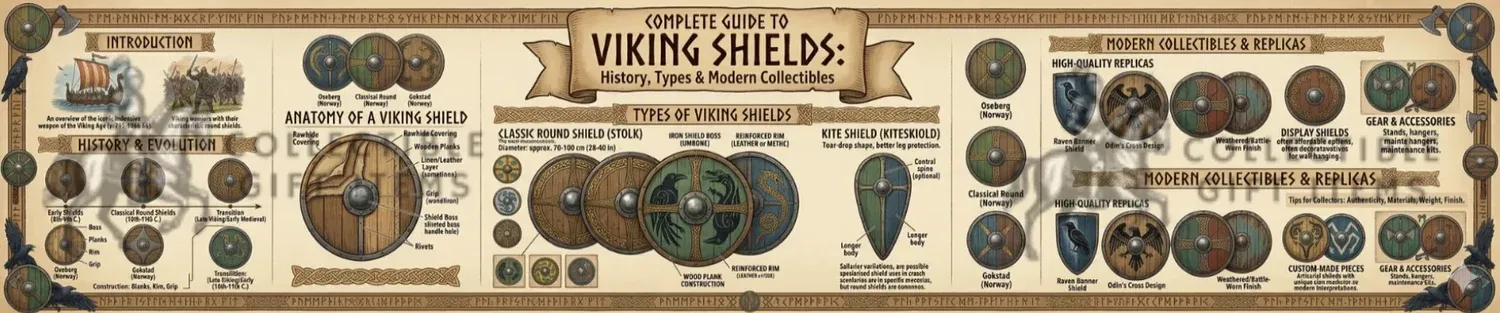

Among historical objects that can ignite people's imagination, there are Viking shields. The shields were notable due to their round form, wood construction, and metal boss in their center. Viking shields played a significant role in the equipment of people during the period when Vikings existed. They were used as protection tools; however, their design was also characterized by the features of the communities producing them.
Viking shields continue to be in demand now among history lovers, collectors, reenactors, museums, historical interiors, and other people who need unusual historical decorations. Nowadays, there are various types of shields: historically accurate Viking shields and decorative ones. Studying their history, construction, types, and applications can help to find out why the shields are popular today despite the end of the period when Vikings existed.
Background of Viking Shields
The Viking Age is commonly identified as the era stretching from the late eighth century to the eleventh century, characterized by significant expansion of activities of the Scandinavian communities through trading, exploring, settling, and conducting military campaigns in different regions of Europe and the North Atlantic region. In this era, shields were the most critical defensive arms of the warriors.
A shield could offer defense against many dangers, while at the same time making it possible for the warrior to move freely. In comparison to heavy armor that could limit movement of the warrior, a fairly light wooden shield could be carried and handled in the process of fighting. It is evident that the construction of shields would differ according to the material that was available as well as the period.
Round shields had become synonymous with the Viking warriors. This is due to the fact that they had a wide surface that made them easy to carry and handle.
Viking Shield Construction
Wooden boards were traditionally used to make Viking shields. The type of wood varied depending on what was available, and the shields have been linked to a number of different wood types.
The wooden boards tended to be fairly thin so that the shield did not become too heavy. In the middle was a hole where the hand could go and this was covered with a metal shield boss, which was made out of iron and protruded from the shield.
The edge of the shield could have had additional reinforcement in some cases. Other materials such as leather could have been used. This meant that the construction process was not consistent and so different shields could vary.
This use of wood and metal made it a practical implement but also allowed for decoration.
Understanding the Viking Shield Boss
The shield boss is arguably the most distinctive part of a typical Viking shield. Located in the center of the shield, this metal part would serve as an additional layer of protection for the warrior’s hand.
Viking shield bosses were available in various designs. They could be either simple or elaborate. The design can help historians gain some information about Viking shields from the archaeological records.
Today, any Viking shield replica would feature a distinct metal boss because this part makes the shield look traditional. Collectors can also benefit from having an elegant boss on their decorative shields.
Various Types of Viking Shields
If you decide to learn about different types of Viking shields, it should be noted that there was no one standard model of a Viking shield. It varied in size, thickness, materials, design, and decoration.
The round Viking shield is probably the most typical one. This shape helped to create a good compromise between protecting people and ease of handling. There could be different diameters depending on specific functions and manufacturing.
Some of them were rather simple, but others had decorated surfaces or even painting. Nowadays, such decorations may involve Norse-themed design or geometrical elements. This feature makes modern shields rather beautiful to collect and display.
Modern Viking shields may be classified by their functions. Reenactment shields were made considering active handling, whereas decorative shields were made just to be displayed and collected.
Shield Designs of the Vikings and Norse Design
The design of Viking shields is another aspect of the study that offers great fascination for shield collectors. The decoration designs in historical Scandinavian art featured interlacing designs, animal designs, geometrical designs, among others. Today's manufacturers of Viking artifacts tend to borrow from these designs.
It is crucial to make a distinction between historical information and contemporary design interpretation. All decorative designs seen on contemporary shields do not necessarily appear on the authentic shields of the Vikings.
Collectors of such shields will be able to differentiate between these two by looking at the description of the product in the descriptions provided, and also through historical reference.
Shields from the Era of Vikings in Historical Performances and Museums
The rising trend of historical performance is one of the reasons behind the popularity of Viking equipment. Performers usually study ancient costumes, devices, weapons, armor, and shields to recreate their images of Vikings.
The shield used by Vikings may become an important element of this presentation because of its unique look and historical value. Reenactment shields may be made using contemporary technologies but still have some features typical for their archaeological counterparts.
Replicas may also be used in museums to show visitors what ancient equipment looked like. Such replicas allow making historical exhibitions more interesting and giving information about the craftsmanship and daily life.
Viking Shields As Modern Collectibles
Apart from being used for reenactments and educational purposes, Viking shields are gaining more popularity as decorative collectibles, because of their wood and metalwork components and designs that are inspired by history and thus can be used in special thematic rooms, personal collections, museums, offices, etc.
The decorative Viking shield can be used either as a decorative piece itself or a part of a bigger collection of items inspired by history. Collectors would base their choice on the quality, design, material, size, and similarity to historical specimens.
For individuals who look for historical-themed gifts, Viking-related products can also be used as special gifts. Collectible Gift Items would be appropriate for customers looking for hand-crafted and historically inspired decorative items.
Factors to Think About While Purchasing Viking Shield
The choice of the correct Viking shield mainly depends on what the buyer wants to use it for. For example, if someone is buying the shield for decoration, then he may be mainly concerned about its looks, quality of work, size, and decorations.
Quality of material used is yet another factor that matters. Wood must be properly finished, and any metal parts must match well with the rest of the shield. The quality of painting, carvings, finishing and other elements will matter a lot in the looks of the shield.
People who are buying collectibles and are looking for historical items need to check how the particular product is being advertised. Is it a replica, a historically based reconstruction or something else?
Care for a Viking Shield Collectible
Proper care might help retain the look of a Viking shield collectible. For instance, wooden parts must typically be safeguarded against moisture and drastic change in environmental conditions. Gentle dusting may also help prevent accumulation on the surface.
Metals may also need proper maintenance depending on their finishes. Careful cleaning to avoid damaging any decoration or coating may be necessary.
If it will be mounted on a wall, proper mounting is essential. Appropriate display should also include proper protection from excessive moisture and sun exposure.
Reasons Behind the Popularity of Viking Shields Among Collectors
The charm of Viking shields is not limited to their history alone. These shields embody an amalgamation of practicality, traditional material, artistry, and cultural heritage.
In today’s times, collectors find these shields appealing on various grounds. Some may be drawn to Scandinavian history, others by the Norse inspired artworks, and for some, the unique aesthetic quality of handmade historical artifacts will suffice.
With increasing interest in Viking history through various mediums like museums, literature, entertainment, and collectibles, the Viking inspired products have continued to make a mark.
There is a very interesting relationship between the craftsmanship of the past and the collecting hobbies of the present in the case of the Viking shields. The distinctive circular shape, wooden material, metal boss and decorative options have contributed greatly to their longevity in popularity despite the end of the Viking Age.
Regardless of whether one buys the Viking shield for the purposes of historical exhibitions, reenactments, decoration of the home or private collection, one can select a product which will be both beautiful and inspired by history and culture. In order to do that, it is necessary to understand all the various construction types, materials and uses of the shields.

























Sign in to leave a comment.