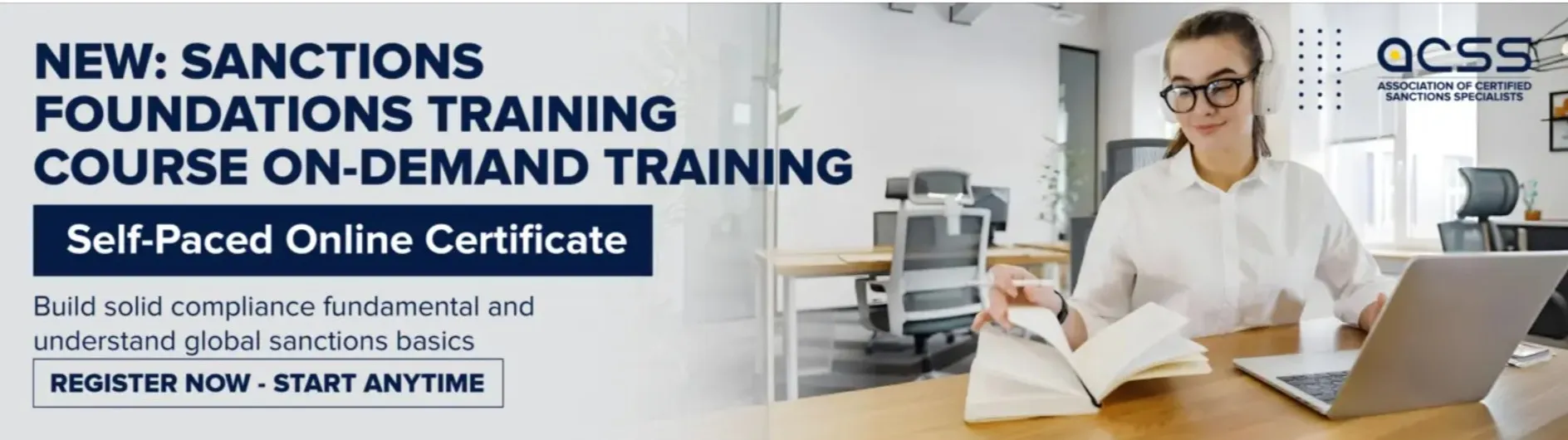
Compliance is no longer a narrow responsibility reserved for legal or compliance departments. Organisations operating across borders increasingly need employees who understand sanctions, export controls, trade restrictions, anti-money laundering (AML) obligations and financial crime risks. At the same time, professionals are looking for credible ways to build specialist knowledge and demonstrate their commitment to continuing professional development.
That is where compliance training online can be useful. Online learning can make specialist education more accessible, but the quality and purpose of programmes vary considerably. A short awareness course, a certificate of completion and a professional certification are not interchangeable.
The right choice depends on what you need to learn, the responsibilities of your role and whether your goal is knowledge-building, professional development or a formal credential.
What Is Compliance Training Online?
Compliance training is structured education designed to help people understand relevant laws, regulations, policies, controls and responsibilities.
When delivered online, the training may include recorded lessons, interactive modules, virtual classrooms, assessments, case studies, webinars or examination preparation. This format can be particularly practical for working professionals who cannot attend regular classroom sessions.
However, online delivery does not automatically make a programme comprehensive or professionally recognised. A useful course should connect regulatory concepts with practical decisions employees may encounter.
For example, a sanctions course might examine screening, risk assessment, due diligence, ownership and control, sanctions evasion indicators and escalation procedures. An export-control programme may address classification, licensing, screening, recordkeeping and the organisation's export compliance programme.
The regulatory framework also matters. OFAC, for example, recommends a risk-based approach to sanctions compliance, with risk assessment informing policies, internal controls and training.
What Should a Good Online Compliance Programme Cover?
There is no universal syllabus because compliance responsibilities differ by industry, jurisdiction and role.
A programme should nevertheless have a clearly defined scope. Depending on the learner's objectives, relevant subjects may include:
- Sanctions compliance: sanctions regimes, screening, due diligence, risk assessment and escalation.
- Export controls: classification, licensing, end-use and end-user considerations, recordkeeping and controls.
- Trade compliance: customs, international trade restrictions and controls relevant to particular transactions.
- AML and financial crime compliance: risk-based approaches, customer due diligence, suspicious activity and financial crime risks.
- Compliance technology: screening systems, transaction monitoring and other tools used to support controls.
- Regulatory change: understanding how changing laws and enforcement priorities affect compliance processes.
These areas overlap, but they should not be treated as identical. Sanctions primarily concern restrictions imposed on specified countries, individuals, entities, sectors or activities. Export controls regulate the movement or transfer of controlled goods, technology and software under applicable regimes. AML focuses on preventing and detecting money laundering and related financial crime.
For export controls, the US Bureau of Industry and Security (BIS) specifically identifies training as one element of an effective Export Compliance Programme, alongside management commitment, risk assessment, authorisation procedures, recordkeeping, audits and corrective actions.
Training vs Certification: What's the Difference?
One of the most important questions to ask before enrolling is: What exactly will I receive at the end?
Training
Training is primarily about acquiring knowledge or skills. It may be short and focused on a particular regulation, process or role.
Certificate of completion
A certificate of completion generally confirms that someone completed a particular educational course or met its stated assessment requirements. It does not necessarily represent an independently assessed professional qualification.
Professional certification
Professional certification programmes normally involve a defined body of knowledge and an assessment or examination intended to demonstrate professional competence against specified criteria. The requirements vary between certification organisations.
For example, ACSS's Certified Sanctions Specialist (CSS) is a professional credential that requires candidates to satisfy eligibility criteria and successfully pass its certification examination.
Regulatory licence or authorisation
A professional certification should not be confused with a government-issued licence, regulatory authorisation or legal permission to perform a regulated activity.
Similarly, completing an online course does not automatically make an individual—or their employer—legally compliant.
Who Can Benefit From Online Compliance Training?
The potential audience is broader than dedicated compliance teams. Relevant professionals can include:
- Compliance officers and sanctions analysts
- AML and financial crime specialists
- Legal professionals
- Risk-management professionals
- Trade compliance and export-control specialists
- Banking and financial-services employees
- Employees working for multinational organisations
- Professionals moving into a compliance-focused career
Training can also be useful for employees outside the compliance function. Sales, procurement, logistics, finance and technical teams may encounter compliance issues through customers, suppliers, transactions, products or international operations.
BIS recommends that organisations provide export compliance training to employees whose responsibilities relate to exports, including relevant support staff.
How Can Compliance Training Support Career Development?
Professional development in compliance is rarely about collecting certificates simply for the sake of having them. The more useful question is whether the education improves your ability to understand and respond to real compliance issues.
Well-selected training can help professionals:
- Build specialist knowledge in an unfamiliar area
- Strengthen existing technical competence
- Understand different international regulatory frameworks
- Make more informed compliance decisions
- Communicate compliance risks more effectively
- Demonstrate an ongoing commitment to professional development
For someone working primarily in AML, for example, sanctions or trade-controls education could broaden their understanding of financial crime risk. For a trade compliance professional, deeper knowledge of export controls may be more directly relevant.
A credential such as compliance certification may also provide a structured way to demonstrate knowledge, but it should be viewed as one part of a professional profile rather than a guarantee of employment, promotion or higher earnings.
How Can Compliance Training Benefit an Organisation?
Training works best when it is connected to the organisation's actual risk profile and compliance programme.
Effective education can help employees recognise issues earlier, follow procedures more consistently and know when to escalate a concern. It may also support:
- Better risk identification
- Stronger internal controls
- More consistent procedures
- Improved employee awareness
- Better escalation and decision-making
- Greater understanding of compliance responsibilities
This does not mean training alone creates an effective compliance programme. OFAC's framework, for example, treats training as one component of a broader sanctions compliance programme that also includes management commitment, risk assessment, internal controls, testing and auditing.
For AML, FATF guidance similarly emphasises training that is relevant, effective and ongoing rather than treating it as a one-off exercise.
How to Choose the Right Online Compliance Programme
Before enrolling, consider these practical questions:
- Does the content match your role? A sanctions analyst needs different depth from a general employee completing awareness training.
- Which jurisdictions are covered? Check whether the programme addresses the regulatory frameworks relevant to your work.
- Is the provider credible? Look at the organisation's experience, governance, instructors and professional standing.
- Who teaches the programme? Practical experience can add useful context to regulatory theory.
- How are you assessed? A quiz, practical assessment and formal professional examination demonstrate different things.
- What credential do you actually receive? Check whether it is a completion certificate, qualification or professional certification.
- What is the learning format? Consider self-paced study, live sessions, recorded content and interaction.
- How much time will it require? A realistic estimate helps avoid choosing a programme you cannot complete effectively.
- What is the total cost? Consider examination, membership, renewal or additional learning costs where applicable.
- Does it support continuing development? Compliance knowledge becomes outdated when regulations and enforcement priorities change.
- Will you use the knowledge at work? The best programme is usually one that connects directly with your responsibilities.
The Importance of Continuing Professional Development
Compliance is a moving field. Sanctions regimes change, regulatory expectations develop, enforcement actions reveal new risks and technology changes how organisations screen transactions and counterparties.
That makes continuing education more valuable than treating training as a one-time event.
A good development plan might combine foundational learning, specialist courses, regulatory updates, professional events and practical experience. BIS, for instance, advises organisations to keep export compliance programmes current and relevant as their activities and regulatory circumstances change.
Where ACSS May Fit
The Association of Certified Sanctions Specialists (ACSS) is a professional organisation focused on sanctions and export-controls professionals. It offers professional credentials including the Certified Sanctions Specialist (CSS) and Certified Export Controls Specialist (CXS).
For professionals specifically pursuing sanctions expertise, the CSS provides a formal certification route rather than simply a course-completion certificate. ACSS currently states that CSS examination eligibility is based on a minimum points threshold covering areas such as education, professional experience and relevant training, together with professional references.
ACSS also requires continuing education for CSS recertification, illustrating an important principle in specialist compliance: professional knowledge needs to be maintained rather than acquired once and left unchanged.
Whether ACSS is appropriate depends on the individual's career objectives, existing experience and interest in sanctions or export controls. It should be evaluated alongside other relevant educational and professional options.
FAQs
What is compliance training online?
It is compliance education delivered through digital formats such as online modules, virtual classrooms, recorded lessons, assessments and webinars. The subject may range from general workplace compliance to specialist sanctions, AML, trade compliance or export controls.
Is online compliance training worth it?
It can be valuable when the programme matches your responsibilities and provides credible, applicable knowledge. The value depends more on content, quality and relevance than simply on whether the course is online.
What is the difference between training and compliance certification?
Training is designed to develop knowledge or skills. Certification normally involves a defined professional standard and assessment process. A certificate of course completion should not automatically be interpreted as a professional certification.
Who should consider specialist sanctions training?
Compliance professionals, sanctions analysts, legal and risk specialists, financial-services employees and others whose roles involve international transactions or sanctions exposure may benefit from specialist sanctions training.
Can compliance training make an organisation legally compliant?
No. Training is an important supporting element, but effective compliance also requires appropriate policies, risk assessment, controls, monitoring, governance, recordkeeping and other measures relevant to the organisation and applicable laws.
How can compliance training support career development?
It can strengthen specialist knowledge, improve professional competence and demonstrate commitment to ongoing development. Its career value depends on the individual's experience, responsibilities, qualifications and the relevance and credibility of the training.
Final Takeaway
Choosing compliance training online should begin with the professional problem you are trying to solve—not the certificate you hope to receive.
Start by identifying your role, regulatory exposure and knowledge gaps. Then compare the programme's content, instructors, assessment process, credential, jurisdictional coverage and ongoing development requirements.
For professionals working in sanctions, trade compliance, export controls, AML or financial crime, targeted education can provide a structured way to strengthen expertise. But training is most valuable when it becomes part of continuous professional development and is connected to sound compliance practices.
In a field where regulations and risks continually evolve, the goal is not simply to complete another course. It is to build knowledge that helps you make better, more defensible compliance decisions.

























Sign in to leave a comment.