
For years, using software has meant clicking buttons, navigating menus, filling out forms, and learning how different tools work. Although digital experiences have become faster and more convenient, users still need to adapt to the way software is designed. What if software could adapt to the way people naturally communicate instead?
That is the idea behind a conversational voice AI platform. By combining speech technology, artificial intelligence, and conversational design, software can move beyond traditional commands and enable people to interact through everyday language.
This shift is at the heart of Voice First, the upcoming book by Howard Tiersky. It explores how voice-native software can transform digital experiences and offers practical guidance for leaders, designers, and product teams preparing for the next stage of software innovation.
What Is a Conversational Voice AI Platform?
A conversational voice AI platform allows users to communicate with software by speaking naturally. Instead of navigating several screens to complete a task, users can explain what they need and receive a relevant response.
For example, imagine asking a business application to schedule a meeting, summarize a report, or retrieve customer information. Rather than searching through menus, you could make a request using your voice and let the application guide you through the process.
These experiences typically combine several technologies:
- Speech recognition: Converts spoken language into information the system can process.
- Natural language understanding: Helps interpret the user's intent rather than relying only on exact commands.
- AI reasoning: Uses context and available information to determine an appropriate response or action.
- Text-to-speech: Converts generated responses into spoken language.
- System integrations: Allow the application to retrieve information or perform authorized tasks in connected software.
Together, these capabilities can create more natural interactions. However, a genuinely conversational experience requires more than adding a microphone to an existing application. The software must understand context, handle uncertainty, and help users reach their goals.
Why Voice AI Is Changing the Future of Software
Traditional interfaces require users to learn where information is located and which actions to take. Voice can reduce some of this effort by allowing people to express their goals directly.
Here are three important ways conversational software can improve digital experiences.
1. Reducing Interface Complexity
Complex software often requires multiple steps to complete even simple tasks. Users may need to open different sections, apply filters, and search for the right controls.
Voice interaction offers another approach. A user might say, "Show me the most recent customer feedback and summarize the main concerns." If the application has the necessary access and capabilities, it could retrieve the relevant information and present a summary.
This reduces the need to navigate every step manually. The goal is not simply to make software speak, but to make completing tasks easier.
2. Making Digital Experiences More Accessible
Not everyone finds traditional interfaces equally convenient. People may struggle with small screens, complicated navigation, typing, or unfamiliar software.
Well-designed voice interfaces can provide an alternative way to access digital services. They may be especially useful when users are driving, working with their hands, or interacting with technology on the move.
Voice is not always the best solution, though. Some tasks require visual precision, private communication, or detailed information. The strongest experiences combine voice with visual controls when appropriate.
3. Creating More Natural Customer Interactions
Customers increasingly expect digital services to understand their needs without making them repeat information unnecessarily.
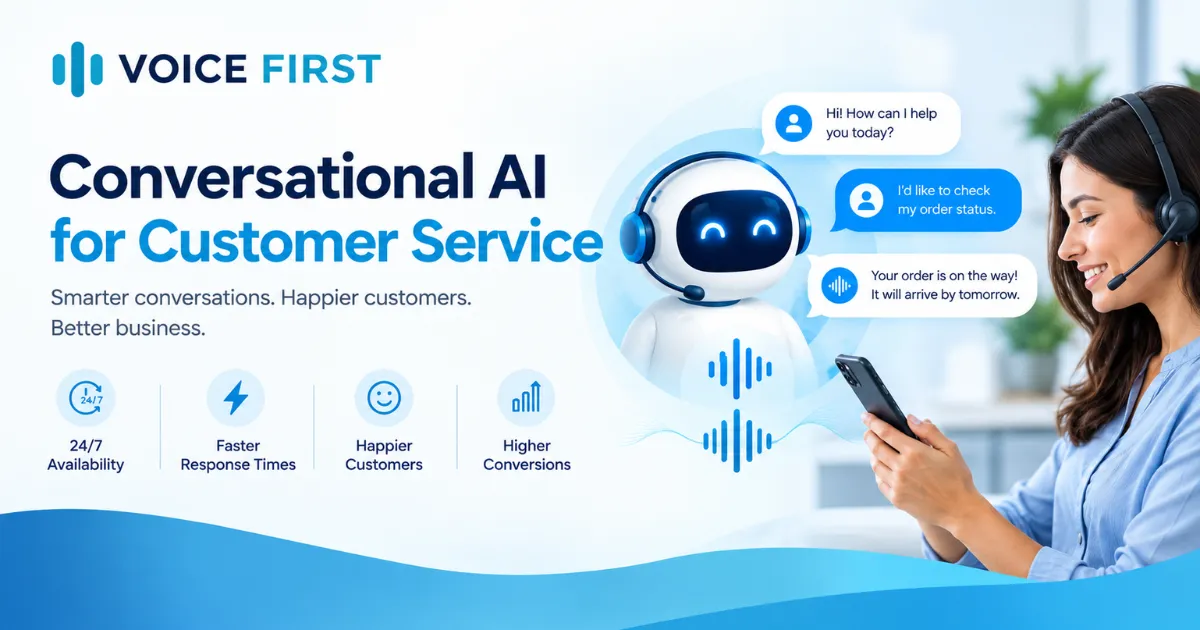
A conversational AI platform can help businesses build experiences that respond to questions, guide customers through processes, and support common service requests.
For instance, an AI-powered assistant could help a customer understand an order status or explain the next steps in a service process. When a request is complex or requires human judgment, the system should be able to transfer the conversation to a person.
The result depends on how well the experience is designed, the quality of its information, and the actions it is authorized to perform.
Voice Application Development: Beyond Adding Voice Commands
Voice Application Development involves creating software experiences in which speech plays a meaningful role in how users interact with a product.
A basic voice feature might recognize a limited set of commands. A more advanced application can interpret different ways of expressing the same request, ask follow-up questions, and respond when a user changes their mind.
Consider a travel application. A user might ask, "Find me a hotel near the beach." The application could ask about dates, budget, and preferences before presenting suitable options.
If the user then says, "Actually, somewhere quieter," the system should use that additional information to refine the results rather than restarting the conversation.
This requires careful coordination between AI models, application logic, user permissions, and the interface. Developers must also consider response speed, interruptions, errors, and the handling of sensitive information.
Voice First Design: Designing for Conversation
Voice First Design means treating conversation as a primary interaction method rather than adding voice as an afterthought.
A well-designed voice experience should help users understand what the application can do, communicate uncertainty clearly, and recover from mistakes without frustration.
Important design principles include:
- Understand intent: Recognize what the user wants to accomplish, even when the request is phrased differently.
- Maintain context: Use relevant details from the current conversation to handle follow-up questions.
- Ask for clarification: Confirm important details when a request is ambiguous.
- Support corrections: Let users interrupt, revise instructions, or undo actions where possible.
- Manage expectations: Explain when a task is taking longer or requires additional input.
- Respect user control: Request appropriate permission before sensitive or consequential actions.
These principles help distinguish a useful conversational application from a traditional interface with voice commands attached.
Howard Tiersky explores these challenges in Voice First, including how teams can design natural interactions, manage responses, handle corrections, and test voice-native applications.
How to Build an AI Voice Agent
If you are exploring how to build an AI voice agent, start with a specific user problem rather than choosing technology first.
An AI voice agent is a system that can listen, interpret requests, respond, and potentially perform tasks through connected tools.
A practical development process includes the following steps.
Step 1: Define the use case. Decide whether the agent will answer customer questions, help users navigate an application, schedule appointments, or support another clearly defined task.
Step 2: Choose the technology. Select suitable speech recognition, AI reasoning, and speech-generation components. Consider language support, response speed, reliability, and cost.
Step 3: Connect relevant information and tools. Provide access to approved knowledge sources, APIs, or business systems. Set clear boundaries around what the agent can access and change.
Step 4: Design the conversation. Map common requests, follow-up questions, misunderstandings, corrections, and situations requiring human assistance.
Step 5: Test real-world scenarios. Evaluate different accents, speaking styles, background noise, ambiguous requests, interruptions, and incorrect responses.
Step 6: Monitor and improve. Review task completion, user feedback, response quality, and failure cases. Improve the experience based on evidence rather than assuming that a more human-sounding voice automatically produces better results.
A successful agent combines technical capability with thoughtful design, clear permissions, and reliable ways to recover from errors.
Choosing a Conversational AI Platform for Your Business
When evaluating a conversational AI platform, consider more than the quality of its generated voice. Look at how effectively it understands intent, maintains context, integrates with existing systems, protects information, and handles requests it cannot complete.
It is also important to identify where voice genuinely improves the user experience. Some workflows benefit from hands-free conversation, while others work better with a combination of voice, text, and visual interfaces.
Start with a small, measurable use case, test it with real users, and expand only when the results justify the investment.
The Future Is Voice-Native Software
Conversational voice AI represents a broader change in how people may interact with digital products. Instead of expecting users to learn every menu and workflow, software can increasingly respond to natural requests and guide people toward meaningful outcomes.
That future will require more than powerful AI models. It will depend on thoughtful Voice Application Development, intentional Voice First Design, reliable integrations, and a clear understanding of human needs.
For leaders, designers, entrepreneurs, and product teams, Voice First by Howard Tiersky offers a practical perspective on this emerging shift. Visit VoiceFirst.ai to explore the book, preview its chapters, and discover how voice-native thinking can help shape the next generation of digital experiences.
The next interface is already here. The opportunity is to build software that people can talk to naturally—and that genuinely helps them get things done.
Frequently Asked Questions
What is a conversational voice AI platform?
It is a technology platform that enables software to understand spoken requests, interpret user intent, and respond through natural-sounding conversation.
What is the difference between a voice assistant and an AI voice agent?
A voice assistant may answer questions or perform simple commands. An AI voice agent can also manage multi-step interactions and use connected tools to complete authorized tasks.
Is Voice First Design suitable for every application?
No. Voice is most useful when it makes interaction easier or more accessible. Visual interfaces remain valuable for tasks involving detailed comparisons, precise selections, and private information.
Where can I learn more about voice-native software?
Visit VoiceFirst.ai to explore Howard Tiersky's upcoming book, Voice First, and its practical guidance for designing and building conversational software.

















Sign in to leave a comment.