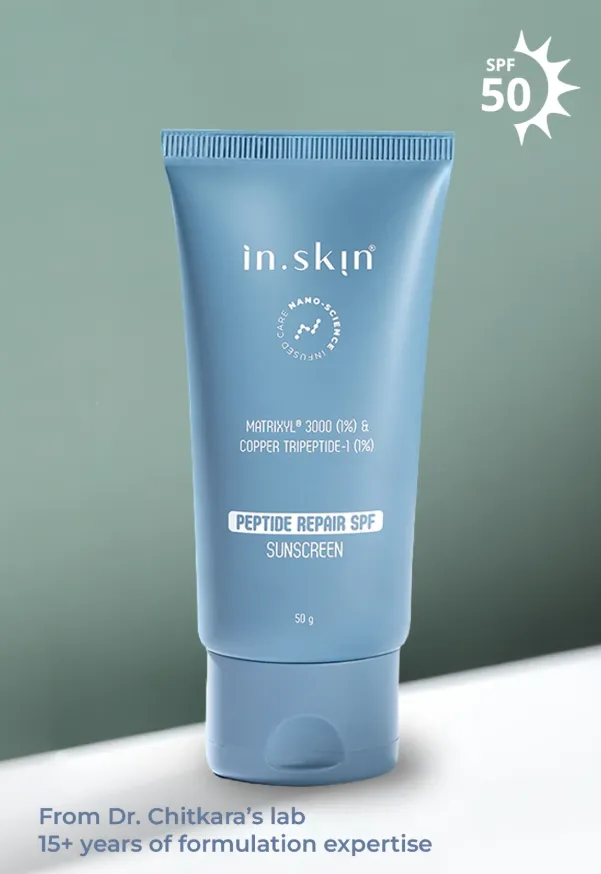

There is a reason copper peptides keep appearing in conversations about skin repair. They are not the newest “miracle” ingredient, and they are not simply another version of a moisturising peptide. Copper Tripeptide-1, commonly called GHK-Cu, sits at an interesting point between skin repair, inflammation and the processes that help skin maintain its structure.
But there is also a lot of confusion around copper peptides. Some people treat them as an alternative to every other active. Others assume that because an ingredient is described as a peptide, it must automatically be gentle or suitable for everyone.
The reality is more useful than either extreme.
So, what exactly is GHK-Cu?
GHK-Cu is a copper-binding tripeptide. In simple terms, it is a small peptide associated with copper and has been studied for its role in processes involved in skin repair.
Peptides are short chains of amino acids. In skincare, different peptides can have very different roles, so it is worth looking at the individual peptide rather than treating all peptides as one category.
Copper Tripeptide-1 has been studied in relation to collagen and extracellular matrix processes, wound healing and inflammatory responses. That makes it particularly interesting when the goal is not just to make skin look smoother temporarily, but to support the conditions involved in skin recovery.
That does not mean applying a copper peptide to the skin is equivalent to a medical wound-healing treatment. Skincare claims need to stay within the evidence available for the finished formulation and its intended use.
Why is it interesting for acne-prone skin?
Acne creates a slightly awkward skincare problem.
You want an ingredient that can help deal with clogged pores and breakouts. But aggressive acne routines can leave the skin feeling dry, tight or irritated, particularly when several strong products are used at the same time.
This is where combining different types of actives becomes interesting.
Salicylic acid is commonly used in acne skincare because of its ability to work within pore-clogging buildup. Copper Tripeptide-1, meanwhile, is used for a very different reason: supporting the skin's repair processes and helping calm the appearance of redness.
The two therefore do not need to be thought of as competing ingredients.
They can have different jobs within the same formula.
That is exactly the logic behind Inskin's Acne Defence Serum, which contains Salicylic Acid (1%) and Copper Tripeptide-1 (1%). The current product page describes the serum as helping control breakouts and reduce the appearance of post-acne marks, calming the look of redness and inflammation, supporting the skin's natural healing process, and helping maintain hydration and strengthen the skin barrier.
That is a much more sensible way to look at the combination than calling it a “miracle acne cure.”
What else is in the Inskin formula?
The Acne Defence Serum is not just a two-ingredient formula.
The current ingredient list also includes niacinamide, alpha arbutin, green tea, saffron, mulberry, ceramide complex, sodium hyaluronate and allantoin.
That matters because real skincare products rarely work as a single-ingredient experiment. The finished formula determines the overall experience.
The product is also described by Inskin as lightweight and non-greasy, with a focus on maintaining hydration and barrier balance. Its stated use is 2–3 drops over cleansed, dry skin, followed by moisturiser or sunscreen in the morning.
Is copper peptide suitable for everyone?
Not necessarily.
“Peptide” does not automatically mean “zero chance of irritation.” Skin can react to complete formulations for many reasons, including the concentration of individual actives and what else is being used in the routine.
If you already use several exfoliating acids, retinoids or prescription acne treatments, adding another active product simply because it is trending may not be the smartest move.
A simpler routine is often easier to understand and easier to troubleshoot.
Patch testing is also sensible when introducing a new skincare product, particularly if your skin is reactive.
What should you avoid combining?
There is a lot of conflicting advice online about copper peptides and ingredient combinations. Blanket rules are often less useful than looking at the actual formulation.
Rather than assuming that every copper peptide product must never be used with acids, vitamin C or retinoids, consider the strength and purpose of each product in your routine.
If several products are already targeting exfoliation, acne or pigmentation, adding another active can increase the overall irritation load even when the individual products are well formulated.
For acne-prone skin, the better question is not:
“How many actives can I fit into one routine?”
It is:
“What does my skin actually need right now?”
That shift usually leads to a much more manageable routine.
The bigger reason copper peptides are interesting
Copper Tripeptide-1 is worth paying attention to because it represents a broader change in skincare thinking.
Instead of treating acne, pigmentation, texture and skin recovery as completely separate problems, modern formulations increasingly try to address the active concern while also respecting the skin barrier.
Inskin's Acne Defence Serum is an example of that approach: Salicylic Acid is used for acne and pore-related concerns, while Copper Tripeptide-1 is included for calming and skin-repair support.
That does not make copper peptides a replacement for every acne ingredient. It simply makes them an interesting part of a more balanced approach to active skincare.
And that is probably where GHK-Cu makes the most sense: not as a miracle ingredient, but as a peptide with a specific role in a well-designed formula.























Sign in to leave a comment.