
Coenzyme Q10 (CoQ10) is a naturally occurring compound involved in cellular energy production and antioxidant defense. Because CoQ10 levels can change with age and certain medications, supplementation has become a common topic in discussions about energy, heart health, healthy aging, fertility, and more.
But how much CoQ10 should you take each day? Is ubiquinol better than ubiquinone? Should CoQ10 be taken with food? And how long does it take to notice a difference?
There is no single dose that works for everyone. The amount studied depends on the health goal, age, form of CoQ10, and individual circumstances.
This guide explains commonly studied CoQ10 doses, the differences between ubiquinol and ubiquinone, when to take CoQ10, and important safety considerations.
What Is CoQ10?
CoQ10, short for coenzyme Q10, is a fat-soluble compound found naturally throughout the body.
It has two major biological roles:
- Cellular energy production: CoQ10 participates in the mitochondrial electron transport chain, which helps cells produce ATP, the main energy-carrying molecule in the body.
- Antioxidant activity: CoQ10 helps protect cellular structures and mitochondrial membranes from oxidative stress.
The heart, muscles, and other tissues with high energy demands contain substantial amounts of CoQ10.
Although the body can produce CoQ10 on its own, levels may change with age. Certain medications, including statins, can also affect the body's CoQ10 production pathway.
How Much CoQ10 Should You Take?
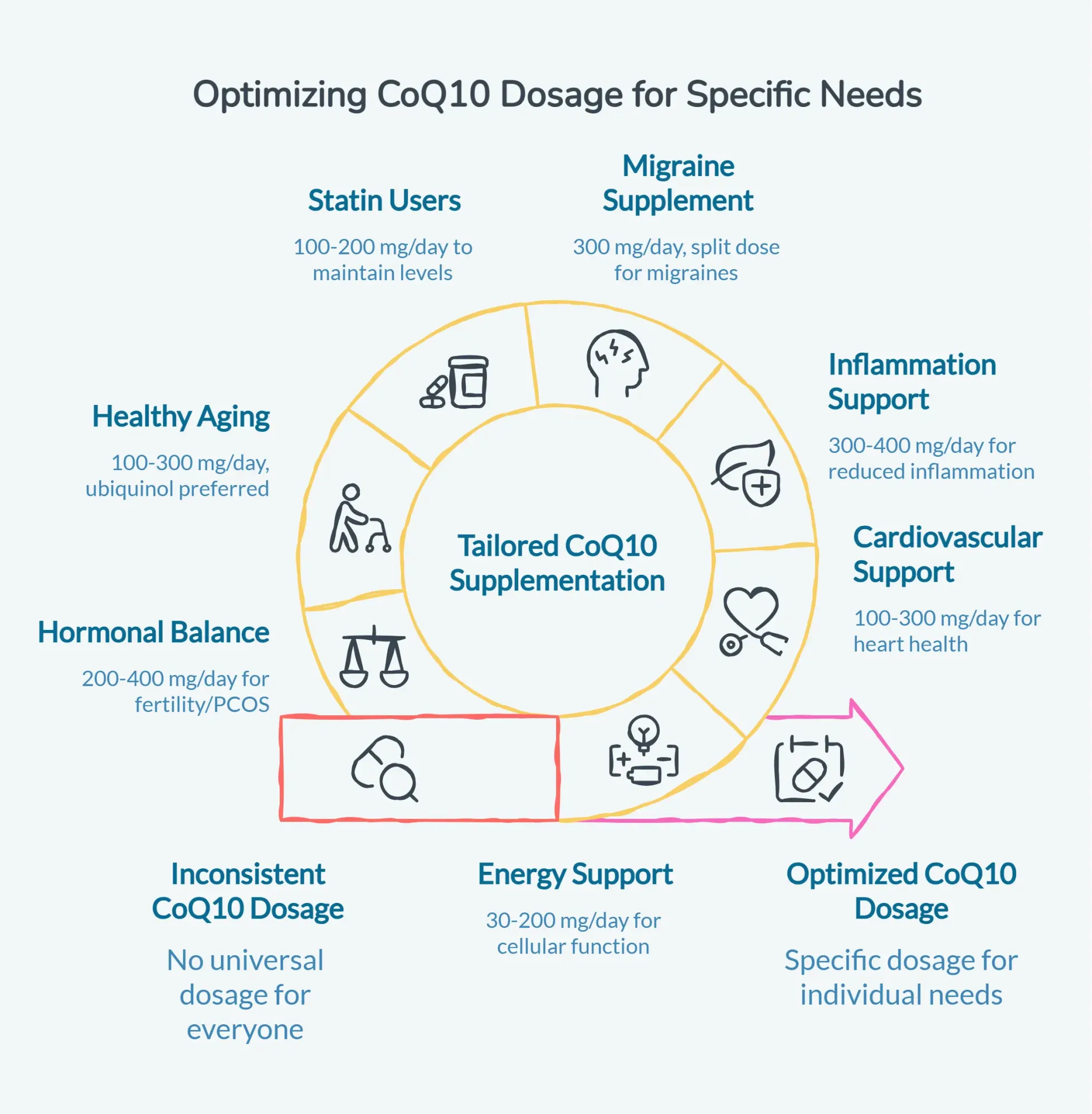
There is no universal CoQ10 dosage. Research has used different amounts depending on the intended purpose.
For general supplementation, 100–200 mg per day is commonly studied. Some research involving specific health goals has used doses of 300 mg per day or more.
The following sections explain the amounts used in different areas of research.
CoQ10 Dosage by Health Goal
1. CoQ10 for Energy and Mitochondrial Support
Because CoQ10 participates in mitochondrial energy production, it is often used in supplements intended to support normal cellular energy.
Research has examined approximately 30–90 mg per day for maintaining CoQ10 levels in healthy adults, while doses of up to 200 mg per day have also been discussed depending on factors such as age and metabolic needs.
CoQ10 is not generally expected to produce an immediate change in energy. Studies evaluating supplementation typically involve consistent use over several weeks.
2. CoQ10 for Cardiovascular Support
The heart has a high energy requirement and contains relatively high concentrations of CoQ10.
Research involving cardiovascular health has used doses ranging from 100–300 mg per day, depending on the population and study design.
For example, the Q-SYMBIO trial used 300 mg daily, divided into three 100 mg doses, in people with heart failure.
Other research has investigated CoQ10 supplementation in relation to blood pressure, with some findings suggesting effects on systolic blood pressure at doses below 200 mg per day.
CoQ10 should not be considered a replacement for prescribed cardiovascular medication or medical treatment.
3. CoQ10 for Inflammation Support
CoQ10 has antioxidant properties and has also been studied for its effects on markers associated with inflammation.
A systematic review and meta-analysis involving randomized controlled trials and a total of 1,517 participants found that CoQ10 supplementation was associated with reductions in several inflammatory biomarkers, including:
- C-reactive protein (CRP)
- Interleukin-6 (IL-6)
- Tumor necrosis factor-alpha (TNF-α)
Studies included in the analysis used doses around 300–400 mg per day for 12 weeks.
These amounts come from research protocols and should not automatically be treated as a personal supplementation recommendation.
4. CoQ10 for Migraine Support
CoQ10 has been investigated as a nutritional supplement for migraine, partly because mitochondrial function and oxidative stress have been explored in migraine research.
A 2025 review discussed CoQ10 as a potential component of migraine management and described 300 mg per day as a commonly studied amount.
Higher daily doses are sometimes divided into multiple servings to make them easier to take.
Research evaluating migraine-related outcomes generally looks at supplementation over a period of months rather than expecting an immediate effect.
5. CoQ10 for People Taking Statins
Statins such as atorvastatin, simvastatin, and rosuvastatin work through the HMG-CoA reductase pathway. This pathway is also involved in the body's production of CoQ10.
Because of this relationship, researchers have investigated whether statin therapy can influence CoQ10 levels and whether supplementation may be useful for people experiencing statin-associated muscle symptoms.
Research has commonly examined 100–200 mg of CoQ10 per day in this context.
If you take a statin, discuss CoQ10 supplementation and its timing with your healthcare provider rather than changing your medication or supplement routine independently.
6. CoQ10 for Healthy Aging
CoQ10 concentrations can change substantially with age. One review reports that tissue levels may decline by as much as 50% between early adulthood and age 60.
Lower CoQ10 availability has been studied in relation to oxidative stress and age-related changes in tissues with high energy requirements.
Research on healthy aging has investigated approximately 100–300 mg per day. Ubiquinol is often preferred in this population because it can produce higher blood levels than an equivalent amount of ubiquinone.
Some studies have followed older adults for much longer periods, so the appropriate duration depends on the purpose of supplementation.
CoQ10 and Reproductive Health
CoQ10 has also been investigated in both male fertility and conditions involving female hormonal and metabolic health.
CoQ10 for Male Fertility
Sperm cells require substantial energy for movement and function, making mitochondrial activity and oxidative stress relevant areas of fertility research.
A systematic review of CoQ10 and male infertility found research showing potential improvements in measures such as:
- Sperm motility
- Sperm concentration
- Antioxidant capacity of seminal fluid
Many studies used approximately 200 mg per day, while some compared 200 mg with 400 mg per day.
The research generally involved men with idiopathic infertility or evidence of oxidative stress rather than the general male population.
Changes in fertility-related measures typically require months rather than days. Studies have evaluated CoQ10 for approximately 3–6 months or longer.
CoQ10 and PCOS
CoQ10 has also been studied in women with polycystic ovary syndrome (PCOS), a condition associated with hormonal and metabolic changes.
PCOS affects approximately 10–13% of women of reproductive age, according to the source cited in the original article.
One randomized, double-blind, placebo-controlled study involving 86 women with PCOS examined 200 mg of CoQ10 per day for eight weeks.
The study reported:
- Lower total testosterone compared with placebo
- Improvements in fasting blood glucose
- Improvements in measures of insulin resistance
The study also examined CoQ10 combined with vitamin E, with the combination showing additional effects on some measured outcomes.
These findings are specific to a research population and should not be interpreted as a general treatment recommendation for PCOS.
CoQ10 Dosage: Quick Reference
| Health goal | CoQ10 amount studied | Typical study duration |
|---|---|---|
| General energy / mitochondrial support | 30–200 mg/day | 8+ weeks |
| Cardiovascular support | Up to 300 mg/day | Varies; some studies lasted years |
| Inflammation support | 300–400 mg/day | 12 weeks |
| Migraine support | 300 mg/day | About 3 months |
| Statin users / muscle symptoms | 100–200 mg/day | 8–12 weeks |
| Male fertility | 200–400 mg/day | Up to 6 months |
| Healthy aging | 100–300 mg/day | Long term |
| PCOS-related research | 200 mg/day | 8 weeks |
Important: These are amounts investigated in research, not individualized dosing instructions. Your appropriate dose can depend on your health history, medications, age, and reason for taking CoQ10.
Ubiquinol vs. Ubiquinone: Which Form Is Better?
CoQ10 supplements generally contain one of two forms:
Ubiquinone
Ubiquinone is the oxidized form of CoQ10 and has traditionally been used in many supplements.
The body converts ubiquinone into the reduced form, ubiquinol, as part of its normal metabolism.
Ubiquinol
Ubiquinol is the reduced form of CoQ10.
Research comparing the two forms has found that ubiquinol can produce higher plasma CoQ10 concentrations than ubiquinone at equivalent doses, particularly in older adults.
This has made ubiquinol a popular choice for people who may have concerns about absorption or who are older.
Which CoQ10 Form Should You Choose?
A practical way to think about the two forms is:
| Situation | Form commonly preferred |
|---|---|
| Healthy adults under 30 | Ubiquinone or ubiquinol |
| Adults over 40 | Ubiquinol may be preferred |
| Absorption concerns | Ubiquinol may be preferred |
| Statin users | Ubiquinol is commonly used in research |
| Adults over 60 | Ubiquinol is often preferred |
The European Medicines Agency has also recognized ubiquinol in the context of certain rare CoQ10 deficiency disorders.
When Is the Best Time to Take CoQ10?
Timing can affect how comfortably and consistently you take CoQ10.
Take CoQ10 With a Meal Containing Fat
CoQ10 is fat-soluble, so taking it with food that contains dietary fat can support absorption.
Suitable meals may include foods such as:
- Avocado
- Olive oil
- Nuts and seeds
- Fatty fish
Taking CoQ10 with a meal may also help reduce digestive discomfort for some people.
Consider Splitting Higher Daily Amounts
When a daily amount is above 200 mg, the original research-based guidance suggests dividing it between two meals, such as breakfast and an early-afternoon meal.
This can make a larger daily amount easier to tolerate and may help maintain more consistent blood levels.
Avoid Taking It Close to Bedtime
Some people report feeling more alert after taking CoQ10, particularly at higher amounts.
For that reason, morning or early-afternoon use may be preferable if you notice that taking it later affects your sleep.
Be Consistent
CoQ10 is not typically a supplement where results are expected after one or two doses.
Research has evaluated supplementation over periods ranging from approximately 8 weeks to 6 months, depending on the goal.
Is CoQ10 Safe for Daily Use?
CoQ10 is generally well tolerated in studies, including at relatively high doses. The original source notes that toxicity is considered unlikely at intakes of up to 1,200 mg per day, although that does not mean such a dose is appropriate for routine use.
Possible side effects can include:
- Nausea
- Stomach discomfort
- Loose stools
- Other mild digestive symptoms
These effects may be more noticeable at higher doses, and taking CoQ10 with food may improve tolerance.
Can CoQ10 Interact With Medications?
CoQ10 may interact with certain medications, including some blood thinners and medications such as statins.
If you regularly take prescription medication, discuss CoQ10 with your healthcare provider before adding it to your routine.
Pregnant or breastfeeding individuals should also consult a healthcare professional before starting a new CoQ10 supplement.
Key Takeaways About CoQ10 Dosage
The appropriate CoQ10 amount depends largely on the reason for supplementation and the individual taking it.
The main points to remember are:
- 100–200 mg per day is commonly studied for general CoQ10 supplementation.
- Research involving specific health goals may use 300 mg per day or more.
- CoQ10 is fat-soluble, so taking it with a meal containing healthy fats can support absorption.
- Ubiquinol may produce higher blood CoQ10 levels than ubiquinone at equivalent doses, particularly in older adults.
- Morning or early-afternoon use may be preferable if CoQ10 affects your sleep.
- Research outcomes often take 8–12 weeks or longer to evaluate.
- Higher research doses should not automatically be interpreted as appropriate personal doses.
- People taking prescription medications should discuss CoQ10 supplementation with their healthcare provider.
Frequently Asked Questions About CoQ10 Dosage
How much CoQ10 should I take per day?
For general cellular energy and mitochondrial support, research commonly uses 100–200 mg per day in healthy adults. The appropriate amount can differ depending on your age, health goals, medications, and other factors.
Is ubiquinol better than ubiquinone?
Ubiquinol may produce higher plasma CoQ10 concentrations than ubiquinone when the two are compared at equivalent doses. This difference may be particularly relevant for older adults and people with absorption concerns.
How long does CoQ10 take to work?
The timeframe depends on what you are taking it for. Many clinical studies evaluate outcomes after 8–12 weeks, while research involving fertility may continue for several months.
Can CoQ10 be taken with other supplements?
CoQ10 has been studied alongside ingredients such as geranylgeraniol (GG), selenium, magnesium, vitamin B2, vitamin E tocotrienols, and omega-3 fatty acids.
However, combining supplements is not automatically appropriate for everyone. If you take medications or have an existing health condition, discuss combinations with your healthcare provider.
How should I choose a CoQ10 supplement?
Look at the form of CoQ10, dosage, ingredient quality, and manufacturing standards.
Ubiquinol may be worth considering, particularly for adults over 40. Softgels containing CoQ10 in an oil-based formulation are commonly used because CoQ10 is fat-soluble.
Third-party testing can also provide additional information about product purity and whether the contents match the label.
Can I take CoQ10 every day?
CoQ10 is commonly used daily in research and is generally well tolerated. However, the appropriate daily amount depends on the individual and the purpose of supplementation.
If you are taking medication, pregnant, breastfeeding, or considering a high dose, consult a healthcare professional first.
Final Takeaway
CoQ10 plays an important role in mitochondrial energy production and antioxidant defense, but the ideal CoQ10 dosage depends on why you are taking it.
For general supplementation, 100–200 mg daily is a commonly studied range. Research involving cardiovascular health, inflammation, migraine, fertility, and healthy aging has used different amounts, sometimes reaching 300–400 mg per day or higher.
The form also matters. Ubiquinol may provide greater blood levels than ubiquinone at equivalent doses, particularly in older adults.
For best absorption, take CoQ10 with a meal containing dietary fat, and consider taking it earlier in the day if you find that evening use affects your sleep. Most importantly, research doses are not the same as individualized medical recommendations. If you have a health condition or take prescription medication, discuss your CoQ10 routine with a qualified healthcare professional.
Disclaimer: This article is for informational purposes only and is not intended to replace professional medical advice, diagnosis, or treatment. Always consult a qualified healthcare provider regarding medical conditions, medications, or questions about CoQ10 supplementation.

























Sign in to leave a comment.