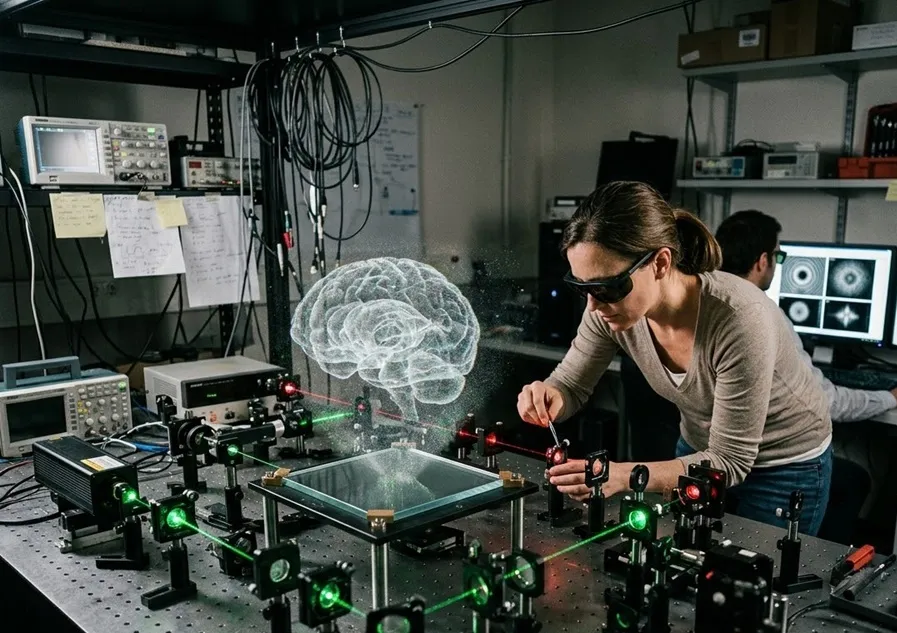

A 3D hologram is a physical light structure that recreates a three-dimensional visual field without requiring wearable optical glasses. Dennis Gabor established the foundations of physical holography in 1947 by recording interference patterns from split coherent light beams. In 2026, modern display engineers combine solid-state laser diodes, spatial light modulators, and diffractive optical elements to project true volumetric light fields. Viewers perceive genuine geometric depth, motion parallax, and accurate perspective changes as they move around the display area.
However, many commercial displays marketed as holograms are optical reflections rather than genuine holograms. For instance, the common Pepper's Ghost method reflects a bright 2D monitor against a sheet of glass or clear foil angled at 45 degrees. This setup produces a translucent flat graphic that floats within an enclosure, yet it contains no spatial depth. In contrast, an authentic 3D Hologram records both phase and amplitude values of light waves, providing genuine binocular depth perception.
Human depth perception relies on four specific physiological depth cues: binocular disparity, motion parallax, convergence, and accommodation. Standard flat displays and VR headsets create visual discomfort due to vergence-accommodation conflict, where eyes focus on a flat panel while converging on virtual depth. A true holographic display prevents this problem because light rays physically originate from actual coordinates in space, allowing human eyes to focus naturally without ocular fatigue.
Wavefront Physics: How a 3D Hologram Captures and Projects Light Fields
Creating an authentic optical hologram requires splitting coherent laser light into two separate paths using an optical beam splitter. The reference beam travels directly to the recording sensor without interruption. Meanwhile, the object beam illuminates the physical subject and scatters off its surface toward the same sensor. When these two coherent light paths meet, they form a fine interference pattern of microscopic light and dark lines.
This interference pattern acts like a diffraction grating. When a matching reconstruction laser beam shines through this pattern, the microscopic structures bend the passing light waves back into their original directional paths. Human eyes receive the exact light rays that originally reflected from the physical subject, reproducing complete three-dimensional perspective.
In modern computer-generated holography, powerful processors calculate these complex light interference equations mathematically from 3D models. These digital phase maps are transmitted directly to high-resolution micro-displays, projecting the calculated wavefront into open space.
Mechanical Configurations Powering Commercial 3D Hologram Hardware
Commercial holographic installations in corporate experience centers, medical facilities, and design studios utilize specific mechanical configurations:
- Spatial Light Modulators (SLMs): Micro-display units that adjust the phase of passing laser light in real time to generate moving computer-generated holograms.
- Diffractive Optical Elements: Precision glass plates etched with microscopic patterns that direct laser light into defined volumetric shapes.
- High-Speed Rotary LED Fan Arrays: Motorized spinning blades lined with RGB LEDs that produce 360-degree floating graphics through human persistence of vision.
- Volumetric Direct-Emission Laser Projectors: High-precision infrared pulsed lasers that ionize air molecules to generate glowing physical light points.
Multi-Angle Light Field Displays: Ultra-dense micro-OLED panels paired with specialized optical lenses that transmit directional light rays across numerous viewing angles.
Enterprise Use Cases for 3D Hologram Displays Across Modern Sectors
Enterprises install spatial holographic displays to solve practical visual communication and engineering challenges:
- Surgical Planning and Medical Education: Physicians project interactive 3D anatomical models from patient CT and MRI scans to evaluate complex blood vessels before surgery.
- Automotive and Industrial Engineering: Engineering teams project true-scale engine models to review component clearances and assembly steps without building physical prototypes.
- Corporate Experience Centers: Technology companies install holographic tables to explain complex microchip designs and global supply chain logistics to clients.
Museum Curation and Historic Preservation: Curators project accurate holographic replicas of delicate historic artifacts, allowing museum visitors to study rare items without risking artifact damage.
Standard Operational Metrics for Evaluating 3D Hologram Displays in 2026
Hardware engineers evaluate holographic installations using concrete physical performance metrics:
- Field of View (FOV): The maximum viewing arc around the display enclosure where the image maintains sharp optical focus without visual distortion.
- Space-Bandwidth Product: The optical throughput metric of the display panel that determines the allowable combination of projection size and viewing angles.
- Voxel Density: The quantity of distinct rendered spatial points produced per cubic centimeter within the active projection zone.
- Refresh Rate Stability: Maintaining rendering speeds at or above sixty hertz to prevent visible visual flicker during quick head movements.
Ambient Light Tolerance: The contrast ratio delivered by the display when operating under standard five-hundred-lux office and commercial illumination.
Technical Roadblocks and the Future Outlook of 3D Hologram Systems
Widespread commercial adoption still encounters specific manufacturing and computing hurdles. Calculating synthetic wavefront equations in real time demands significant graphic processing power. Furthermore, manufacturing spatial light modulators with pixel sizes smaller than one micrometer presents major technical challenges.
Research teams in 2026 are addressing these boundaries using nanophotonic meta surfaces and dedicated neural processing hardware. As pixel dimensions continue to shrink, holographic displays will deliver wider viewing angles and larger visual formats. Organizations that adopt spatial display setups today develop valuable internal expertise, establishing a strong foundation for the future of digital visual communication.
















Sign in to leave a comment.