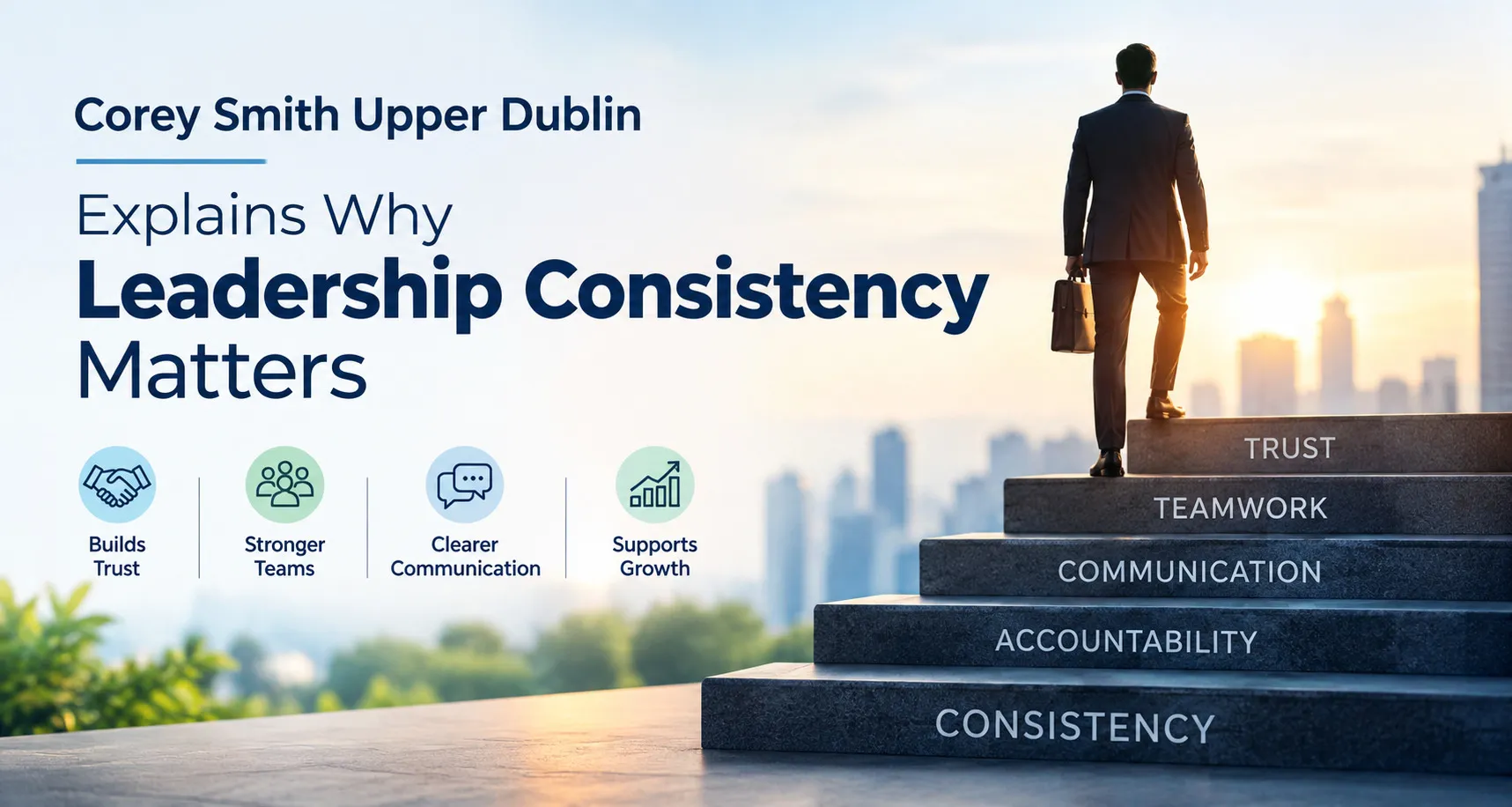

Leadership conversations usually circle around vision, bold decisions, and the ability to fire people up. Those things matter. But none of them stick without consistency. People, employees, customers, partners, need to know what they’re dealing with. When the people in charge stay steady in how they set standards, talk, and decide, teams stop second-guessing and start doing the work.
Corey Smith Upper Dublin sees consistency as one of the quieter forces that keeps a business stable and productive. For him, it isn’t about rigidity. It’s about holding clear principles while still being willing to adjust when the situation actually calls for it.
What Consistency Actually Looks Like
Consistent leadership is not doing the exact same thing every time. Conditions change. Approaches sometimes have to change with them. Consistency shows up more in how a leader communicates, sets expectations, treats people, and follows through.
You’ll usually notice it in a few practical ways:
- People know what’s expected of them
- Important information arrives on time and in plain language
- Similar situations get handled by the same principles
- Leaders own their calls, good or bad
- Commitments to the team, customers, or partners actually get kept
When these habits become normal, employees spend less energy trying to decode leadership and more energy doing their jobs.
How Consistency Builds Trust
Trust falls apart fast when the signals keep changing. One week the message is “collaborate freely.” The next week input gets shut down. Priorities shift without explanation and people stop knowing what actually matters.
Consistent leadership cuts that noise. People trust leaders whose words and actions line up more often than not. If the company claims customer service is a priority, the leaders have to back it up with training, resources, performance measures, and their own daily behavior.
Corey Smith of Upper Dublin puts weight on making leadership principles visible in ordinary decisions, not just in mission statements. Culture gets shaped less by the handbook and more by how leaders handle the everyday stuff.
Better Communication Starts with Reliability
Communication works better when people know the pattern. Leaders who show up regularly with useful updates help teams stay oriented around shifting priorities and real operational pressures.
This doesn’t mean constant meetings or endless emails. It means dependable communication:
- Regular updates on priorities and progress
- Clear reasons behind important decisions
- Space for people to give feedback
- Direct talk when problems need attention
- Follow-up after big changes
A steady rhythm reduces the rumors and guesswork that fill silence. It also helps people see how their own work connects to the larger picture.
Clear Expectations Make Performance Easier
People do better work when the standards stay reasonably steady. Trouble starts when those standards shift depending on who’s involved, what mood the manager is in, or how the wind is blowing that week.
Consistency creates a clearer frame. If punctuality, customer service, quality, and teamwork matter, those expectations should be stated clearly and applied fairly, and leaders should model them themselves.
That kind of clarity tends to produce:
- Stronger accountability
- More predictable work
- Better teamwork
- Fewer mixed signals
- Greater confidence among employees
None of this rules out flexibility. Good leaders still make room for individual circumstances. They just don’t abandon the overall standard.
Consistency as a Growth Advantage
Growth brings new people, new customers, new markets, new tools, and new problems. Without some stable leadership approach, an expanding company can lose its bearings.
Consistent leadership acts as an anchor. A business may need to change products, enter new markets, adopt new technology, or rework processes. Those shifts can be large. The underlying principles don’t have to be.
Corey Smith Upper Dublin draws a useful line here: adaptability and consistency are not opposites. A leader can change the strategy while staying consistent in the values and standards used to judge that strategy.
How It Shows Up for Customers
Leadership habits eventually reach the customer. Most people expect reliable products, clear communication, and solid support. When leaders reinforce those expectations inside the company, employees have a better sense of the experience they’re supposed to deliver.
Consistency shows up for customers through:
- Steady service standards
- Clear handling of concerns
- Consistent brand messaging
- Dependable quality
- Timely follow-up
One good interaction creates a nice moment. Repeated reliable experiences build real confidence.
Practical Ways to Become More Consistent
Consistency is mostly a habit, not a single technique. Leaders can start by looking hard at how they communicate, decide, and respond when things get messy.
A few useful moves:
- Name the real priorities. Identify what actually matters most and say it clearly. When everything is urgent, nothing is.
- Keep the small promises. Meetings, feedback, resources, decisions, following through on the little things signals reliability.
- Apply standards evenly. People notice when rules seem to bend for some and not others. Fair, transparent standards build credibility.
- Explain the shifts. Change is sometimes necessary. Confusion drops when leaders say why the direction is changing and what comes next.
- Ask for feedback. Consistency doesn’t mean ignoring input. People on the ground often spot gaps in communication or unclear expectations first.
- Review past decisions. Conditions change. Periodically check whether the current approach still makes sense.
Consistency Is Not Standing Still
A common misconception is that consistent leaders never change course. In reality, good leaders notice when a plan isn’t working and adjust. They can admit a mistake, revise the approach, and move in a new direction. What stays steady is the commitment to thoughtful decisions, clear communication, accountability, and the larger goals.
That balance matters more as companies deal with shifting customer expectations, new technology, competition, and economic pressure.
A Long Game, Not a Quick Fix
Leadership consistency is built one repeated action at a time. People watch how leaders handle success, setbacks, disagreement, and surprise. Over months and years those patterns shape how the organization feels.
Corey Smith of Upper Dublin argues that effective leadership is more than setting ambitious targets. It also means creating an environment where people understand the expectations, trust the communication, and know leaders will own their decisions.
For companies aiming at sustainable growth, consistency offers a practical foundation. It strengthens internal relationships, clarifies priorities, supports customer trust, and makes necessary change easier to absorb.
Leadership doesn’t have to be perfect to be consistent. It has to be deliberate, transparent, and dependable. When those qualities settle into daily practice, leadership leaves a deeper mark on both people and results.

























Sign in to leave a comment.