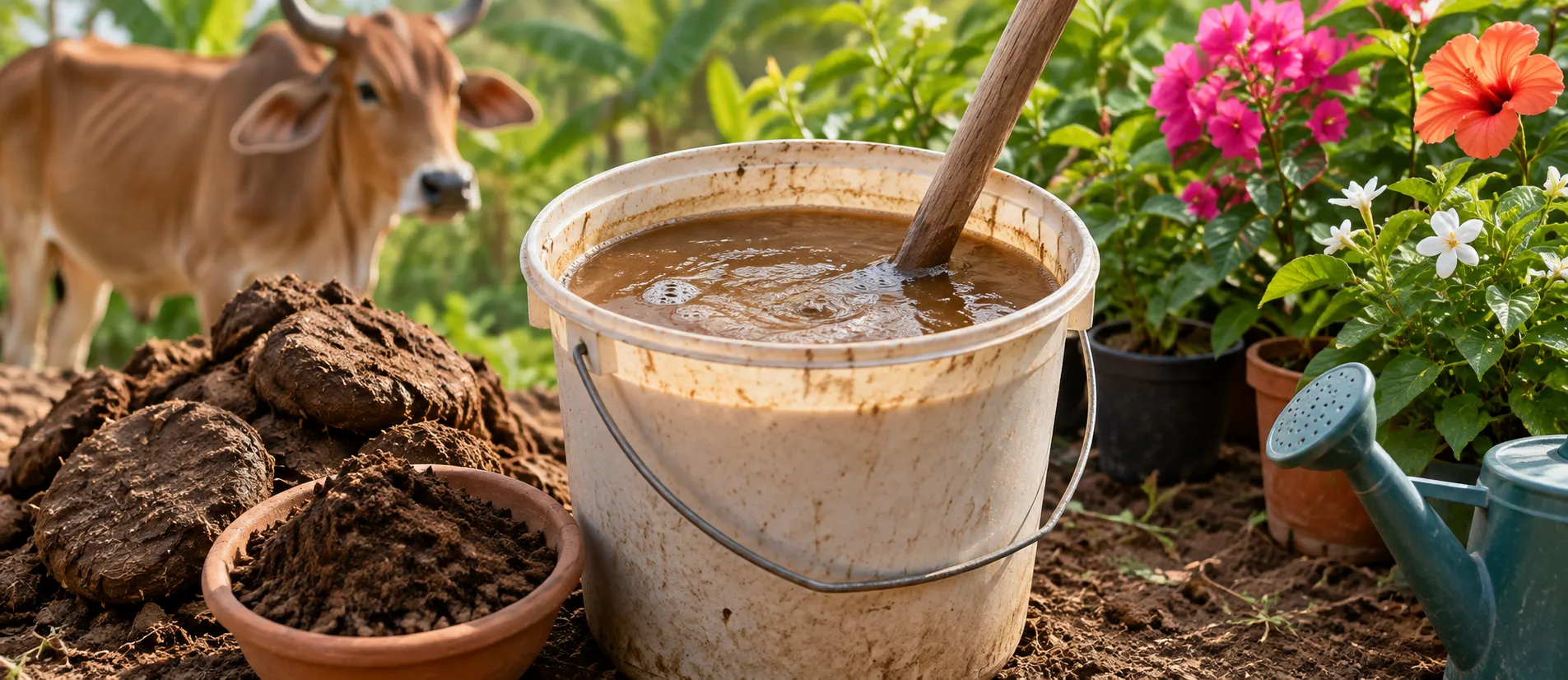

If your flowering plants have healthy leaves but produce fewer buds or flowers, the problem may not always be a lack of fertilizer. Soil condition, watering, sunlight, root health, and nutrient availability all affect flowering. Cow dung slurry can be one useful natural input when the soil needs organic matter and gentle nutrient support.
Cow dung slurry is prepared by mixing cow dung with water to create a liquid organic manure. When properly prepared and used in suitable quantities, it can support soil health and provide nutrients that plants need for steady growth.
For home gardeners, kitchen gardeners, and natural farming growers, the main advantage is that it can be incorporated into a broader soil-care routine rather than relying entirely on synthetic fertilizers.
What Is Cow Dung Slurry?
Cow dung slurry is a liquid mixture made primarily from cow dung and water. Depending on the preparation method, it may be used as a soil application around plants.
Unlike a concentrated chemical fertilizer that is formulated to provide specific nutrients quickly, organic inputs work more gradually and are generally used as part of an overall soil-management approach.
For flowering plants, the objective should not simply be to add more fertilizer. The goal is to maintain healthy soil and roots so the plant can continue producing leaves, buds, and flowers under suitable growing conditions.
If you are comparing liquid and solid organic inputs, you can also read Gauyog Kendr’s guide on [liquid fertilizer vs. solid fertilizer].
How Can Cow Dung Slurry Help Flowering Plants?
1. Supports Soil Health
Healthy flowering starts with healthy roots. Organic matter can help improve the overall condition of soil, particularly when the growing medium has become compacted or depleted.
A better soil environment can help roots access water and nutrients more effectively.
2. Provides Organic Nutrient Support
Cow dung contains naturally occurring nutrients and organic matter. When used appropriately, cow dung slurry can complement other organic fertilizers used in the garden.
The nutrient content can vary depending on the animal’s diet, manure condition, storage, and preparation, so it should not be treated as a precisely measured fertilizer like a commercial NPK product.
3. Supports Better Root Development
A flowering plant needs a functioning root system to absorb water and nutrients. Regular attention to soil structure, moisture, drainage, and organic matter can help create better growing conditions for roots.
This is particularly important for plants grown repeatedly in containers where the soil can gradually lose its quality.
4. Can Complement Natural Gardening Practices
Gardeners trying to reduce dependence on synthetic inputs may include cow-based organic products in a broader natural farming routine.
However, cow dung slurry should be considered one part of plant care. Adequate sunlight, correct watering, suitable pot size, pruning where appropriate, and good drainage are equally important.
How to Use Cow Dung Slurry for Flowering Plants
Application should be gentle rather than excessive.
For potted flowering plants, avoid pouring concentrated slurry directly against the stem. Instead, apply a properly diluted preparation to the soil around the root zone.
A practical approach is:
- Use a well-prepared cow dung slurry rather than fresh, undiluted manure.
- Dilute it appropriately before application.
- Apply it to moist soil rather than extremely dry soil.
- Keep the application away from direct contact with the stem and leaves.
- Observe the plant after application before repeating it.
The exact dilution and frequency should follow the product instructions when using a ready-to-use commercial cow dung slurry, because formulations and concentrations can differ.
For a convenient prepared option, Gauyog Kendr offers Cow Dung Slurry for natural farming and organic plant care.
When Should You Apply Cow Dung Slurry?
There is no single application schedule that works for every flowering plant.
The plant’s species, pot size, soil condition, weather, growth stage, and existing fertilizer routine all matter.
In general, organic liquid inputs are more useful when plants are actively growing, and the soil has adequate moisture. Avoid heavy applications during periods of excessive heat, waterlogging, or when a plant is already showing signs of root stress.
If your flowering plant is not producing buds, do not assume fertilizer is the only solution. Check sunlight exposure, watering, drainage, pests, pruning, and whether the plant has outgrown its container.
Gauyog Kendr also covers common reasons behind poor flowering in its guide on [why vegetable plants are not flowering and natural fixes].
Can Cow Dung Slurry Increase Flowering?
Cow dung slurry can support the soil and nutritional environment needed for healthy plant growth, but it should not be considered a guaranteed flowering booster.
Flower production depends on several factors. Too much nitrogen, for example, can encourage excessive leafy growth in some plants without necessarily improving flowering.
This is why simply adding more manure is not always the answer.
If a plant has plenty of healthy green leaves but very few flowers, examine sunlight, plant maturity, watering, nutrient balance, and pruning requirements before increasing fertilizer applications.
Common Mistakes to Avoid
Using Fresh Cow Dung Directly
Fresh manure can be too strong for direct use around delicate plants and may create unpleasant conditions or introduce unwanted organisms. Proper preparation and dilution are important.
Applying Too Much
More organic fertilizer does not automatically mean better growth. Excessive applications can disturb the growing medium and may stress plants.
Pouring Slurry on Leaves or Flowers
For soil application, keep the slurry around the root zone rather than routinely wetting foliage and flowers.
Ignoring Drainage
A flowering plant cannot compensate for constantly waterlogged soil with more fertilizer. Make sure excess water can drain properly, especially in containers.
Expecting Immediate Results
Organic soil improvement is generally a gradual process. Give the plant time and evaluate its overall growing conditions rather than repeatedly increasing the application.
Cow Dung Slurry vs. Other Organic Fertilizers
Different organic fertilizers serve different purposes. A liquid input can be convenient when you want to apply nutrients or organic matter through watering, while solid organic fertilizers may be incorporated into the growing medium.
The right choice depends on the plant, soil condition, growing stage, and your overall gardening routine.
You can learn more about choosing organic inputs in Gauyog Kendr’s guide to [the best organic fertilizer for plants] and its article on [the best organic fertilizers for vegetable farming].
For gardeners interested in improving soil fertility without relying heavily on chemical fertilizers, the broader approach explained in [how to improve soil fertility naturally] can also be useful.
Tips for Better Flowering Naturally
Cow dung slurry works best when combined with good basic plant care.
- Give flowering plants the amount of sunlight they require.
- Avoid both overwatering and prolonged dryness.
- Use pots with proper drainage holes.
- Maintain healthy, well-aerated soil.
- Remove damaged or diseased plant parts when appropriate.
- Monitor plants regularly for pests and diseases.
- Avoid applying multiple fertilizers at the same time without understanding their combined effect.
- Follow the recommended application instructions for commercial organic products.
Most importantly, identify the actual reason for poor flowering before adding more fertilizer.
Final Thoughts
Cow dung slurry can be a useful natural input for flowering plants when it is properly prepared, diluted, and applied as part of balanced plant care. Its value is not simply in adding fertilizer but in supporting a healthier growing environment for the roots and soil.
If your flowering plants are struggling, start by checking sunlight, watering, drainage, soil condition, and plant health. Once those basics are right, a suitable organic input such as cow dung slurry can complement your gardening routine.


























Sign in to leave a comment.