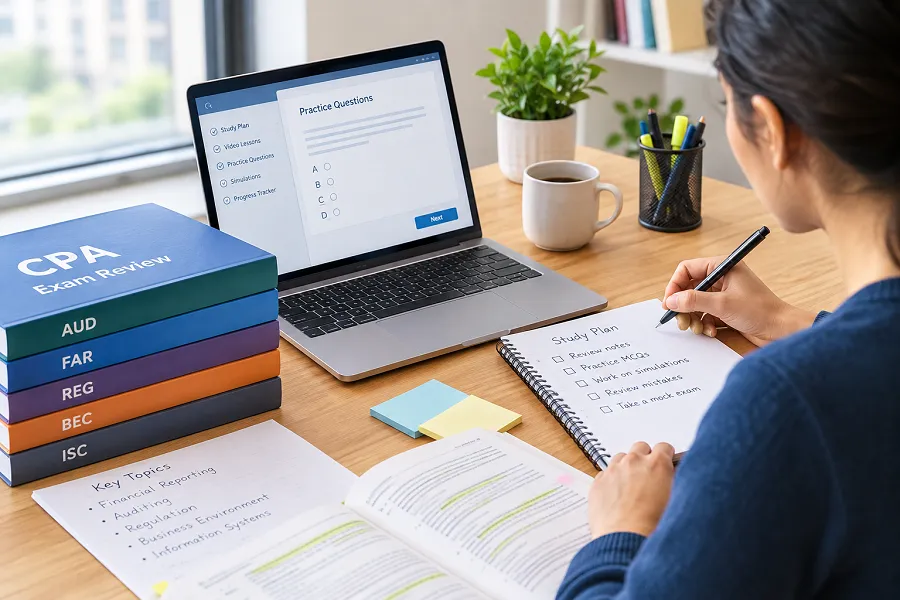

Preparing for the CPA Exam is not simply about studying more hours. It is about using the right resources in a way that matches your schedule, learning style, and exam objectives. With textbooks, video lectures, practice questions, simulations, study notes, flashcards, and online courses available, choosing CPA Exam Review Materials can sometimes feel like another exam in itself.
The key is not to collect as many resources as possible. Instead, choose materials that work together and support a clear study plan.
Start With the Current CPA Exam Structure
Before selecting review materials, understand what you are preparing for.
The current Uniform CPA Examination consists of three Core sections—Auditing and Attestation (AUD), Financial Accounting and Reporting (FAR), and Taxation and Regulation (REG)—plus one Discipline section selected by the candidate. Each section is four hours long.
The AICPA's CPA Exam Blueprints are an important starting point because they outline the content areas, topics, skill levels, and sample task statements covered by the examination.
The AICPA recommends using the Blueprints alongside other exam preparation resources.
This matters because review materials should reflect the exam you are actually taking—not an older version of it.
1. Look for Complete Coverage, Not Just Large Volumes of Content
One common mistake is assuming that the biggest review package is automatically the most useful.
A good set of CPA Exam Review Materials should help you understand the concepts tested in your section and provide opportunities to apply them. Ideally, your resources should
include several complementary formats:
- Concept explanations
- Concise study notes or outlines
- Multiple-choice questions
- Task-based simulation practice
- Practice exams or assessments
- Progress tracking
- Final-review resources
More content is not necessarily better. If you have thousands of pages but cannot determine what to study next, the material may create more confusion than clarity.
2. Match the Materials to Your Learning Style
Different candidates absorb information differently.
Some people learn best by reading detailed explanations. Others need video instruction before a difficult accounting or auditing concept becomes clear. Some candidates understand a topic only after working through several practice questions.
Consider how you naturally learn:
If you are a visual learner: Look for diagrams, charts, demonstrations, and structured video lessons.
If you prefer reading: Choose well-organized textbooks, study guides, and concise review notes.
If you learn through practice: Prioritize question banks, simulations, and explanations of incorrect answers.
If you need structure: Look for resources that can be organized into a weekly study schedule.
The goal is to find materials that make studying easier to sustain—not simply materials that look comprehensive.
3. Prioritize Practice Questions and Simulations
Understanding a concept is only one part of CPA preparation. You also need to apply that knowledge under exam-style conditions.
Practice questions can help you identify gaps in your understanding, while task-based simulations provide opportunities to work through more complex scenarios.
When evaluating a question bank, do not focus only on the number of questions. Ask:
- Are the questions relevant to the current exam content?
- Are explanations provided?
- Can you identify why an answer is correct or incorrect?
- Are there different difficulty levels?
- Can you track weak areas?
- Are task-based simulations included?
A smaller, well-explained question bank can be more useful than a large collection of questions that you simply answer and move past.
4. Make Sure the Materials Are Current
CPA Exam content changes over time, so outdated resources can create unnecessary problems.
The AICPA publishes updated Exam Blueprints and provides information about when certain changes become eligible for testing. For example, the 2026 Blueprints became effective January 1, 2026.
This makes the publication or update date an important consideration when choosing study resources.
Candidates should check whether their materials correspond with the current exam blueprint and their planned testing period. This is particularly important for subjects affected by changes in tax rules, regulations, accounting standards, or other examinable content.
5. Choose Materials That Fit Your Actual Schedule
A study resource can be excellent and still be the wrong choice if you cannot realistically use it.
For example, a full-time professional may have only a few hours available on weekdays and more time on weekends. A student may have a different schedule and more flexibility.
Before purchasing or committing to a resource, estimate:
- How many hours can you study each week?
- When do you plan to sit for the exam?
- Which section are you preparing for?
- How much of the subject do you already understand?
- Which areas are your weakest?
- How much time do you need for review and practice?
Your materials should fit into this schedule.
A realistic study plan might divide preparation into three stages:
Learn: Build an understanding of the core concepts.
Practice: Work through questions and simulations.
Review: Return to weak areas and measure readiness.
This approach helps prevent the common problem of spending most of the available study time watching lectures or reading while leaving too little time for practice.
6. Look for Clear Explanations, Not Just Correct Answers
When reviewing practice resources, pay attention to the explanations.
If you answer a question incorrectly, simply seeing the correct answer does not necessarily teach you how to solve a similar problem next time.
Strong explanations should help you understand:
- Why the correct answer is correct
- Why the other options are incorrect
- Which rule or concept is being tested
- How to recognize a similar question in the future
This turns practice into learning rather than just testing.
7. Consider Whether You Need Additional Support
Not every candidate needs the same level of assistance.
Some people are comfortable studying independently with books, videos, and practice questions. Others struggle with creating a schedule, identifying weak areas, staying accountable, or understanding difficult concepts.
If self-study is not producing consistent progress, additional support such as tutoring, structured review sessions, or a personalized study plan may be useful.
The important question is not whether you are using the most expensive or most comprehensive option. It is whether the support addresses a specific problem in your preparation.
8. Avoid Resource Overload
One of the easiest ways to make CPA preparation overwhelming is to use too many resources simultaneously.
For example, switching between several textbooks, multiple question banks, different video courses, online discussions, and unrelated study notes can make it difficult to determine what actually needs to be reviewed.
Instead, establish a primary resource and use additional materials only when they serve a clear purpose.
A simple system could look like this:
Primary resource → Practice questions → Weak-area review → Simulations → Final assessment
This creates a repeatable process and makes it easier to measure progress.
A Practical Checklist for Choosing CPA Exam Review Materials
Before committing to a resource, ask yourself:
- Does it cover the current CPA Exam content?
- Is it aligned with the relevant AICPA Exam Blueprint?
- Does it explain concepts clearly?
- Does it include sufficient practice questions?
- Does it provide task-based simulation practice?
- Can I use it consistently with my schedule?
- Can I identify and review my weak areas?
- Does it support both learning and final review?
- Is the material regularly updated?
- Will using it simplify my study process rather than make it more complicated?
If the answer is yes to most of these questions, the resource is more likely to fit into a productive study strategy.
The Right Materials Should Support the Plan—Not Replace It
The best CPA Exam Review Materials are not necessarily the ones with the longest videos, largest question banks, or most pages. Their value comes from how effectively they support your preparation.
Start with the current exam requirements and blueprint. Build a realistic schedule around your available time. Use learning resources to understand concepts, practice questions to identify weaknesses, and simulations to develop application skills. Then use your performance data to decide what needs additional attention.
TAPA Institute takes a structured approach to CPA preparation through study materials, practice resources, assessments, tutoring, and study planning. Its current CPA materials include lectures, review books, multiple-choice questions, simulation practice, study outlines, and final-review resources across the Core and Discipline sections.
Ultimately, effective CPA preparation is less about how many resources you have and more about whether those resources help you learn, practice, measure progress, and adjust your study plan.
A focused set of current, well-organized materials can give you a much clearer path through the preparation process than a collection of resources without a strategy.


























Sign in to leave a comment.