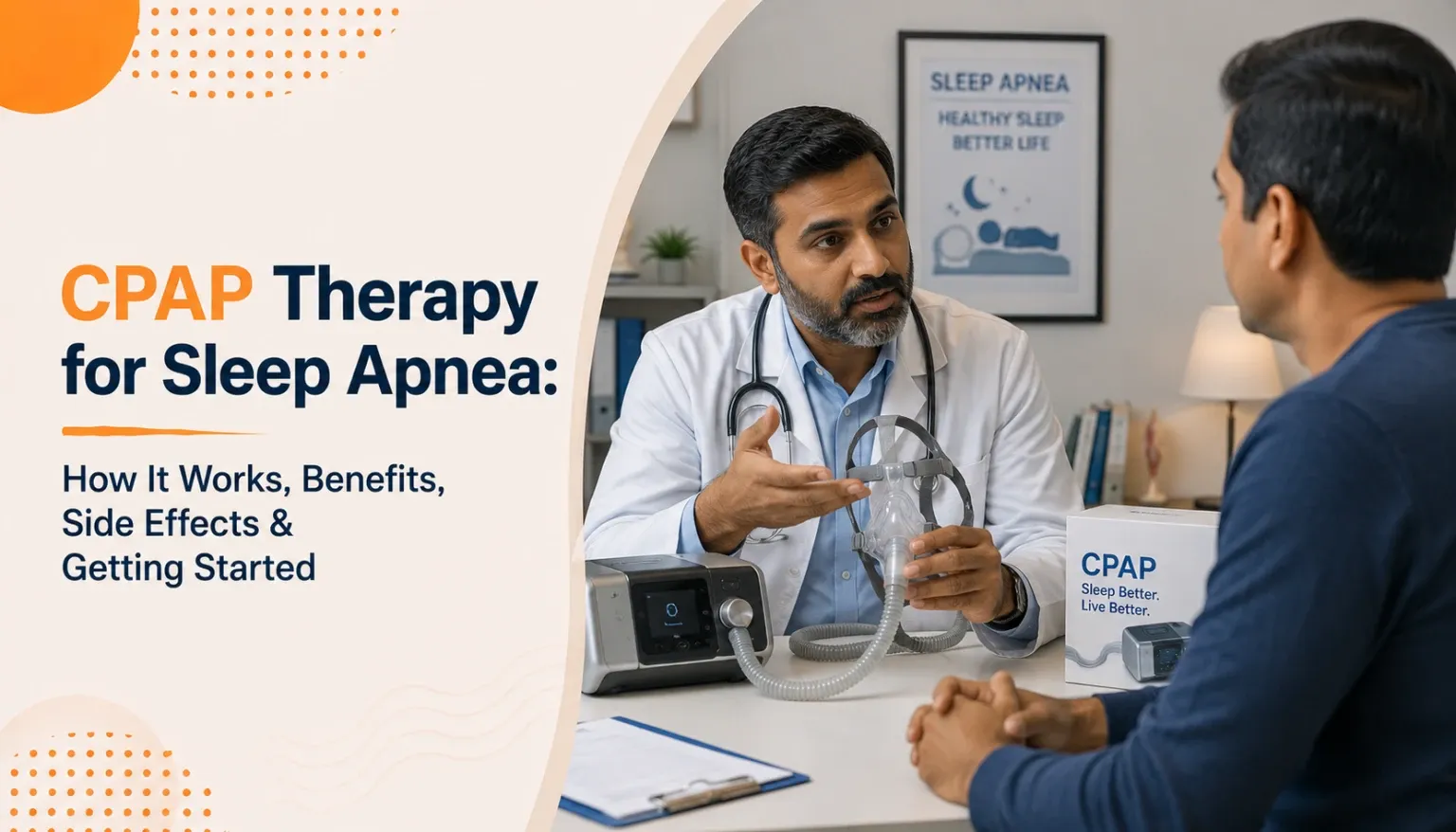

A patient sat in my exam room with his arms folded and told me he was not wearing that thing. I have heard some version of that a thousand times. You were told you have obstructive sleep apnea. Now you are being handed a machine and asked to sleep with it strapped to your face. That is a strange thing to ask of anyone, and nobody should pretend otherwise.
So here is what CPAP therapy does, what the first few weeks feel like, and how you will know it is working. The version I give my patients across the desk after thirty years of watching people go through it.
Some of it is awkward at first. Almost all of it is worth it.
What Is CPAP Therapy and How Does It Work?
What Does CPAP Stand For?
CPAP stands for continuous positive airway pressure. A small machine sends a steady stream of room air through a hose into a mask worn over your nose, or your nose and mouth. That air holds your airway open while you sleep.
That is the whole idea. Not oxygen. Not a drug. Ordinary air, under gentle pressure, doing one job all night.
How Does CPAP Keep Your Airway Open?
When you fall asleep, the muscles holding your throat open relax. In obstructive sleep apnea the airway narrows, and often closes completely. Air stops moving. Oxygen falls. Your brain pulls you into a lighter stage of sleep, and the airway snaps open again. You do not remember any of it, and it can happen hundreds of times a night.
CPAP pressure works like a splint made of air. With enough pressure inside, the walls cannot fall in. The breathing pauses can be greatly reduced or prevented, helping keep oxygen levels more stable.
I tell my patients often: the machine is not breathing for you. You are breathing for yourself. It only holds the door open.
What Is CPAP Used For?
CPAP is used mainly for obstructive sleep apnea, the common form in which the airway collapses. Related devices run on the same principle for other breathing patterns, and your sleep physician chooses between them based on your study.
For many people with obstructive sleep apnea, it is one of the most effective treatment options available. Researchers pooled thirty-four meta-analyses covering more than thirty-six thousand patients and compared every major sleep apnea treatment. CPAP reduced breathing events by the widest margin [1]. Sleep apnea is highly treatable, and this is the tool that does the most work.
Who Is CPAP Therapy For?
CPAP is for people diagnosed with sleep apnea on a sleep study, and the recommendation depends on your severity, your symptoms and the rest of your health.
One point worth making, because it keeps people from getting tested at all. An analysis of nearly thirteen thousand adults across four community studies found about one in four patients with sleep apnea is at a healthy weight, and more than half of the most severe cases are not obese [2]. The textbook heavyset snoring man is wrong a quarter of the time.
In my clinic, the patients most surprised by their results are thin women in their fifties who came in for fatigue.
What Are the Benefits of CPAP Therapy?
The measurable benefit is straightforward. Breathing events fall. Oxygen holds steady. Sleep stops fragmenting, so you reach the deep and dreaming stages untreated apnea keeps interrupting.
What patients notice is different from what the printout says. Mornings without a headache. Afternoons without the wall at two o’clock. Driving home without fighting their eyelids. Having the patience they used to have.
The research follows the same path. In one study of a hundred and twenty three men, arousal problems fell from nearly half the group to almost none after three months on CPAP [3]. In another, depression and anxiety scores improved by six months and were still improving at a year [4]. CPAP does not treat depression. It treats the broken sleep underneath it.
I cannot promise you any single one of these. What I can tell you is that people rarely come back to describe better numbers. They come back to describe their days.
Read More About CPAP Therapy for Sleep Apnea

























Sign in to leave a comment.