Cricket AI Prediction for Beginners: A Simple Guide to Your First Match


Many new fans hear about data-driven forecasts and assume they need a maths degree to follow them. They do not. Cricket ai prediction is really just a smarter way of asking a question every fan already asks: who is more likely to win today, and why? This beginner-friendly guide explains the basic terms, the data behind the numbers and a simple routine for using forecasts on your first match day.
The Big Idea in Plain Words
Imagine a friend who has watched every IPL game for years and remembers every score, pitch and toss result. Now imagine that friend can compare all of that in a few seconds. That is the core idea behind ai cricket prediction. The software reads past matches, studies current conditions and gives you a probability for each team. It will not replace your own cricket sense, but it gives that sense a strong starting point.
Terms You Will See Everywhere
New users often get stuck on vocabulary, so here is a short glossary:
- Win probability: the chance of each team winning, shown as a percentage. A 60 percent favourite still loses four times in ten.
- Confidence level: how strongly the model backs its pick. A close match usually shows lower confidence.
- Form: how a player or team has performed across the last five to ten matches.
- Pitch score: a rating of how batting-friendly or bowling-friendly the surface is expected to be.
- Dew factor: evening moisture that can make the ball slippery and help the side batting second.
- Differential: a player picked by very few fantasy users, who could give you an edge if he performs.
Once these words make sense, any cricket ai prediction page becomes much easier to read, because every number has a clear meaning.

What Data Goes In
A good forecast is built from several layers of information. Years of IPL and international results provide the base. Recent form adds current momentum. Venue records show how teams score and chase at each ground, while weather and toss patterns refine the picture. Models such as Random Forest, neural networks and support vector machines find patterns across all of this. The same inputs power ai based cricket score prediction, which estimates a likely first-innings total rather than just a winner. A high-scoring ground with a flat pitch points to a big total, while a slow surface suggests a smaller one.
A Simple Match-Day Routine
You do not need to over-think it. Follow these five steps:
- Check the pitch report. Is the surface good for batting, spin or pace?
- Look at weather and dew. Evening dew often favours the chasing team.
- Wait for the playing XI. Team news can change a forecast quickly.
- Read the win probability as a lean, not a promise. Close numbers mean a balanced contest.
- Return during the game. Live updates recalculate chances after every wicket and over, so you can see how momentum really works.
Doing this regularly will teach you more about cricket than most people expect. Over a few weeks, you start spotting patterns before the numbers even appear.
Using Forecasts for Fantasy Teams
Fantasy players often feel the benefit first. With cricket ai prediction, you can see which batters suit the venue, which bowlers gain from conditions and which low-owned players might be smart differentials. Many fans use ai for cricket prediction to save research time, since form, pitch and weather appear in one place. Others enjoy cricket predictions with ai in a chat format, asking quick questions such as whether the pitch will help spinners or which side is likely to chase well. Add your own knowledge of batting orders and fitness news, and your team choices will improve quickly.
Choosing a Platform You Can Trust
Plenty of websites claim to offer the best cricket prediction ai, so check a few basics before trusting any of them. Is accuracy tracked in public? Does it update after the toss and the playing XI? Does it explain the reasons behind each pick? A reliable cricket prediction ai platform will answer yes to all three. A transparent cricket prediction ai tool will also show the pitch and form data behind each number, so you can judge the logic yourself. Be careful with anything promising guaranteed wins, because no honest system can do that.
A Practical Example
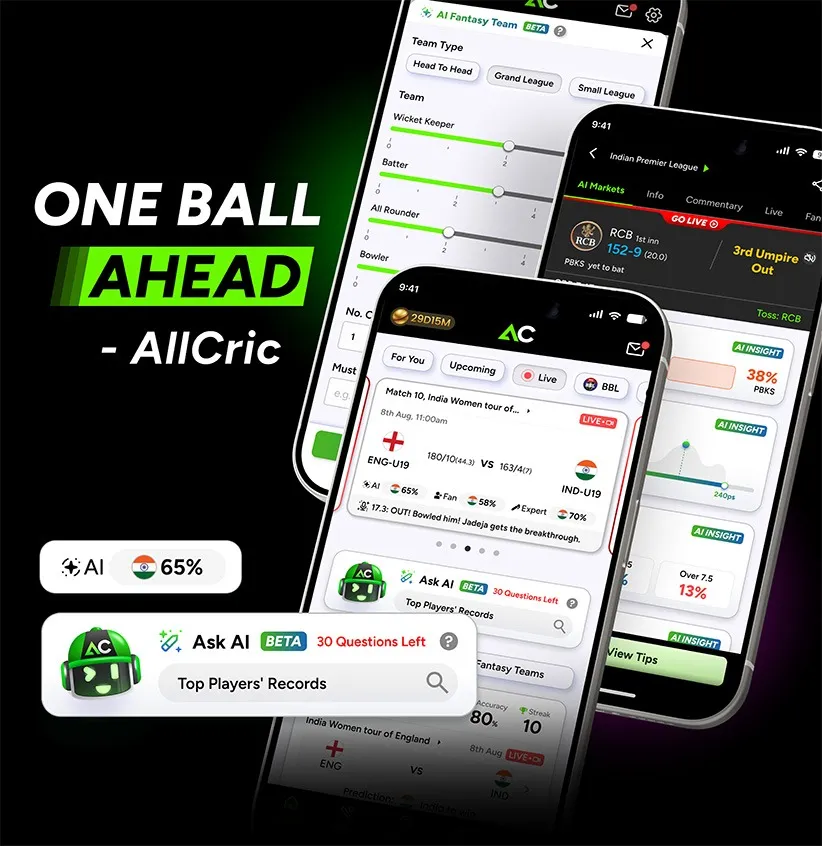
AllCric is a free app built for Indian cricket fans and a useful example for beginners. It reviews more than 15 match variables before each game and is trained on over 1,000 IPL matches across 18 seasons. It offers pitch and weather reports, ball-by-ball win probability and an Ask AI chat for quick questions. More than 200 verified experts also publish predictions with live accuracy tracking, and Pro features include an AI-built fantasy XI. For newcomers wanting cricket ai prediction in a simple mobile format, having these tools in one app removes a lot of confusion. The platform states that it is not a gambling site and offers no betting services.
Keep Your Expectations Realistic
AllCric reports that its strong pre-match T20 models reach roughly 58 to 65 percent accuracy. That is a helpful edge, but it is far from certain. A sudden injury, a freak spell or a rain delay can overturn any forecast. Treat predictions as guidance, compare them with what you see on the field and never risk money you cannot afford to lose.
Final Thoughts
Starting with data does not make cricket less exciting. If anything, it makes every over richer, because you understand why a pitch matters, why dew changes tactics and why a 55 percent favourite can still lose. Learn the basic terms, follow the simple routine and pick a transparent platform. With a little practice, cricket ai prediction will become a natural part of how you follow the game, sharpening your understanding while leaving all the drama and surprise exactly where it belongs.





Sign in to leave a comment.