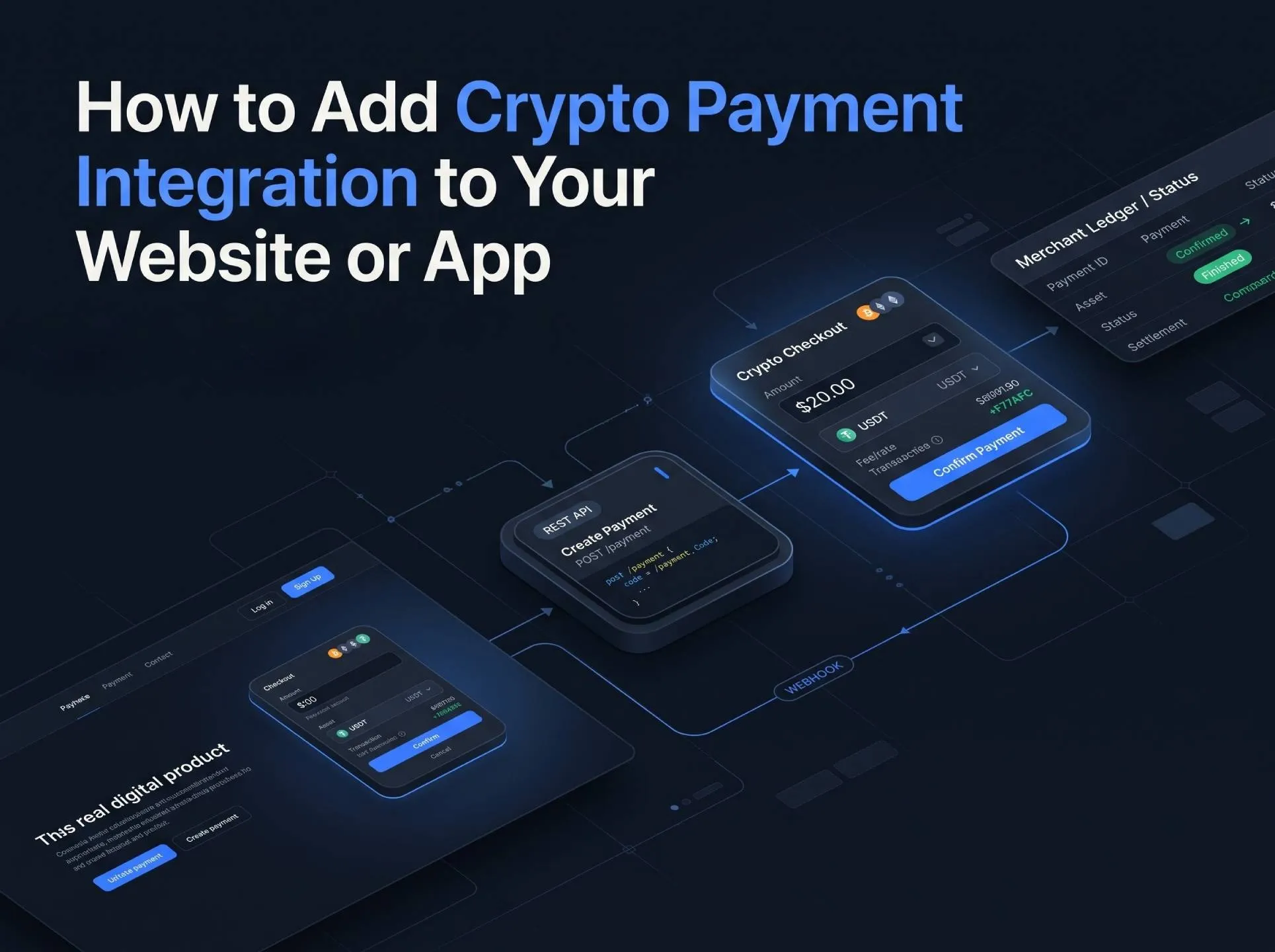


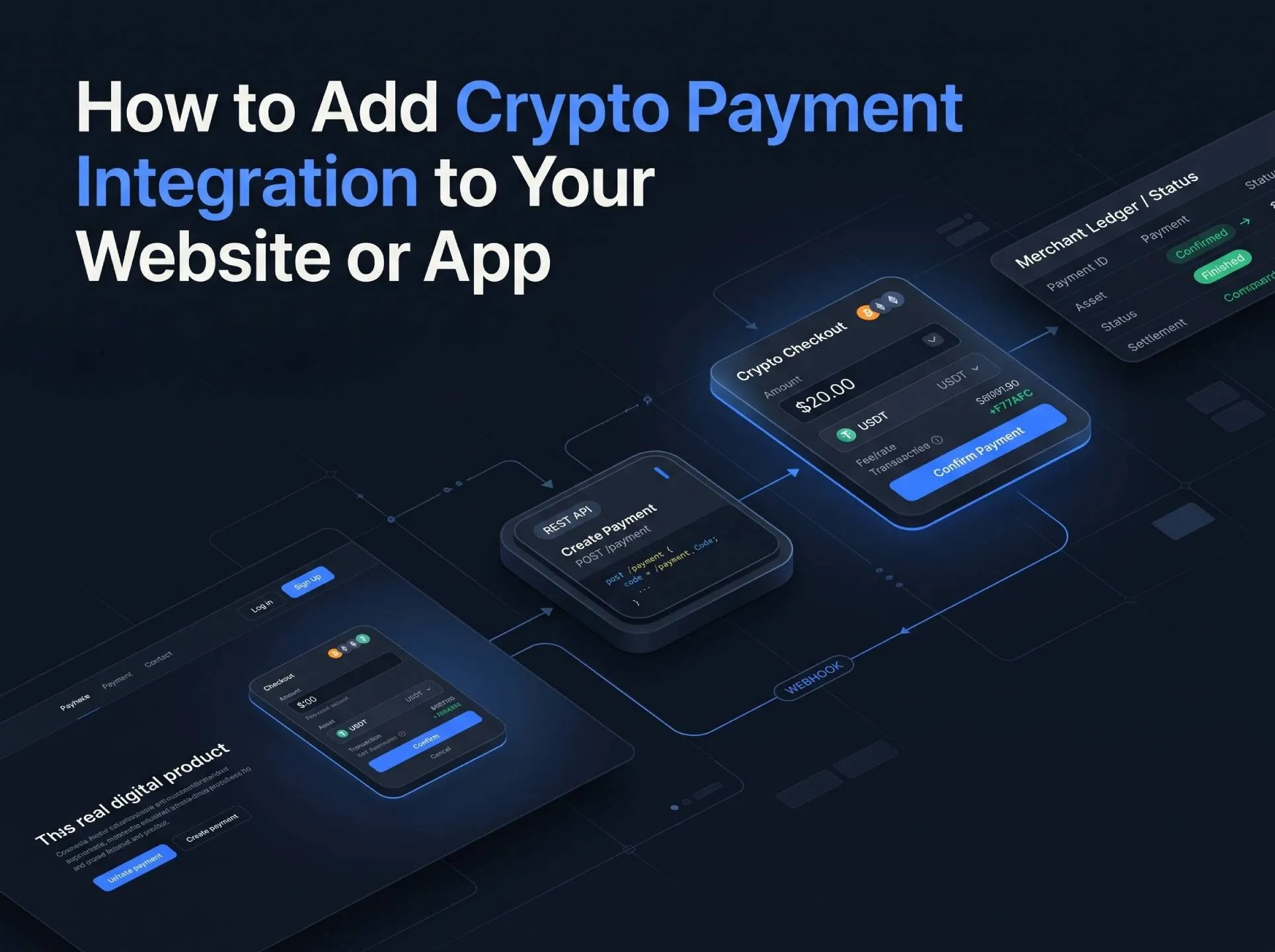
A customer clicks "pay with crypto." Ten minutes later your store says the order is paid. Between those two moments, a lot happens, and most merchants never see it. A crypto gateway payment passes through invoice creation, blockchain detection, confirmation, webhooks, and settlement, and each stage can go wrong in its own way. This guide covers Crypto gateway payment: what happens from checkout to settlement, in order, so you know where the money is at every step.
The short answer
A gateway creates an invoice with a deposit address and a locked rate. The customer sends crypto. The gateway spots the transaction on the network, waits for confirmations, and notifies your store, which releases the order. Settlement comes last, when the gateway pays you in crypto or converts to fiat and sends it to your bank. Total time ranges from under a minute to about an hour, depending on the network. That is Crypto gateway payment: what happens from checkout to settlement in brief. The stages below add the detail.
Stage 1. The customer chooses crypto at checkout
The payment starts on your checkout page. The buyer picks crypto, and your store sends the order total, currency, and order ID to the gateway through a plugin or API call. Nothing has moved on the blockchain yet. This is only a request.
Good checkouts ask for the coin and network here. If a buyer picks USDT, the page should also ask which chain, because USDT on Tron and USDT on Ethereum are different rails with different fees. Skipping this question causes a large share of missing payment tickets later.
Stage 2. The gateway creates an invoice
The gateway turns the request into an invoice. It does four things.
- Generates a deposit address, often unique to that order so payments can be matched
- Converts your price into the crypto amount, using a live exchange rate
- Locks that rate for a short window, commonly 10 to 20 minutes
- Attaches a memo or destination tag if the coin requires one
The locked rate protects both sides. Crypto prices move, and without a lock a customer could pay 50 dollars of Bitcoin that is worth 48 by the time it confirms. When the window closes, the invoice expires and a late payment needs manual handling or a fresh quote.
The customer sees a payment page with the amount, the address, a QR code, and a countdown. Encourage them to copy the amount exactly. A wallet that deducts its own fee from the sent amount can leave the payment short.
Stage 3. The customer sends the payment
Now the buyer opens a wallet or an exchange app and sends funds. This is the stage you control least, and it's where most mistakes happen.
Common slips include the wrong network, a missing memo, an amount typed by hand with a digit off, and sending from an exchange that adds a withdrawal fee on top. Exchanges can also delay withdrawals for security checks. The gateway can't fix any of this in advance. Clear instructions on the payment page can prevent most of it.
Stage 4. The gateway detects the transaction
The gateway watches the blockchain, either by running its own nodes or through a node provider. When the transaction is broadcast, it appears in the mempool, the waiting room for unconfirmed transactions. Most gateways detect it within seconds.
At this point the payment is seen, not settled. Some gateways mark the invoice as "detected" or "pending." That status is useful for fast, low-value goods, but it isn't final. A transaction in the mempool can still be dropped or replaced, especially on Bitcoin if the sender used a low fee.
Stage 5. The network confirms it
A confirmation means a block containing the transaction was added to the chain. Each additional block adds another confirmation and makes reversal less likely.
Speeds differ a lot. Bitcoin adds a block about every ten minutes, so six confirmations take roughly an hour. Ethereum produces a block about every 12 seconds, with full finality in around 13 minutes. Tron and Solana confirm in seconds.
You choose how many confirmations count as paid. A 15 dollar download can be released after one confirmation, or on detection. A 5,000 dollar equipment order deserves more. This setting is the biggest lever you have on both speed and risk, and it belongs in any plan for Crypto gateway payment: what happens from checkout to settlement.
Stage 6. The webhook reaches your store
When the payment meets your rules, the gateway sends a webhook, an automatic message to your server. It typically says the invoice is paid, with the amount, the coin, the transaction hash, and the order ID.
Three habits keep this stage safe.
- Verify the signature, so a fake message can't mark an order paid.
- Make your handler safe to run twice, because gateways retry failed webhooks.
- Respond quickly and do slow work, like emails, in the background.
If webhooks fail, the customer has paid but your store still shows unpaid. Check this first whenever a support ticket says "I paid but nothing happened."
Stage 7. Your store fulfills the order
Your system reads the webhook, flips the order to paid, and triggers fulfillment. A digital product unlocks. A physical order goes to the warehouse. The buyer gets a confirmation email.
Underpaid and overpaid invoices branch here. If a customer sent 47 instead of 50, the gateway usually flags a partial payment. You decide whether to ask for the difference, accept a small margin, or refund. An overpayment needs a similar call. Write these rules down before launch and put the wording on the checkout page.
Stage 8. Settlement
Settlement is when the money becomes yours to use. It's also where gateways differ most.
A custodial gateway receives the funds first. Then it either keeps them in your account for withdrawal, converts to a stablecoin or fiat currency, or pays out on a schedule. Payout timing varies. Some pay daily, some weekly, some on request. Bank payouts add local banking time.
A non-custodial gateway sends the funds straight to a wallet you control. Settlement is effectively instant once confirmations clear, and the conversion to cash is your job.
Fees show up here as well. Many gateways charge roughly 0.5% to 1% per transaction. There may also be a conversion spread, a payout fee, and the network fee the sender paid. For a full picture, add all of them up per order. Card processors in the US commonly charge around 2.9% plus a fixed fee per sale, and the money often lands one to three days later, so a crypto flow can still come out ahead on both cost and time.
Stage 9. Reconciliation and accounting
Your accountant needs a record of each payment, its value in your local currency at the time you received it, and the fees. Most jurisdictions treat crypto receipts as income, and rules differ, so ask a professional.
Pick a gateway that exports transaction data with the hash, the order ID, the timestamp, and the exchange rate used. Without it, reconciling a month of orders is painful. Matching the hash to a block explorer entry is the final proof that a payment happened.
A sample timeline
Here is a typical USDT-on-Tron order, with round numbers.
- 0:00. Customer selects crypto, and the invoice is created.
- 0:45. Customer sends 50 USDT from an exchange.
- 0:50. Gateway detects the transaction.
- 1:10. Enough confirmations arrive, and the webhook fires.
- 1:15. The order flips to paid, and the product is delivered.
- Next day. The gateway's daily payout converts the balance and sends it to your bank.
The same order on Bitcoin might take closer to an hour at the confirmation stage, which is why network choice matters.
When things go wrong
Missing payments are usually late, short, or on the wrong network, not lost. A useful gateway offers named support, ticket numbers, staff who can read a block explorer, and written rules for underpayments and expired invoices. Send a specific question before you sign up and time the reply. Real support never asks for a seed phrase or private key.
Where FaradPay fits
FaradPay is a crypto payment provider, so it goes through the same nine stages. Check which networks it supports, how confirmations are configured, how webhooks are signed, what its settlement options and payout schedule look like, and how support handles a short payment. Compare it with two other providers using your own numbers. That is the honest way to judge Crypto gateway payment: what happens from checkout to settlement for any provider on your list.
FAQ on Crypto gateway payment: what happens from checkout to settlement
What is a crypto gateway payment?
It's a payment made in cryptocurrency and processed through a gateway that creates the invoice, detects the deposit, confirms it, and updates the merchant's store.
How long does it take from checkout to settlement?
Checkout confirmation takes seconds to about an hour depending on the network. Settlement to your bank can take a day or more, depending on the payout schedule.
What is a webhook in a crypto payment?
It's an automatic message from the gateway to your server saying a payment status changed, such as detected, confirmed, or expired.
How many confirmations should I require?
It depends on order value. Low-value digital goods can accept one confirmation. Larger orders should wait for more.
What happens if a customer underpays?
The gateway usually flags the invoice as partial. You can ask for the balance, accept the small gap, or refund the amount.
Do I have to hold crypto?
No. Many gateways convert to stablecoins or fiat automatically.
Can a crypto payment be reversed?
No. Confirmed transactions are final, and refunds are manual and sent on-chain.
Final thoughts
Once you see the stages, a crypto checkout stops feeling like a black box. You set the rules for confirmations, webhooks, and settlement, and you know where to look when something stalls. Test each stage with a small payment, including a deliberate mistake, before real customers arrive. That's the working answer to Crypto gateway payment: what happens from checkout to settlement.






















Sign in to leave a comment.