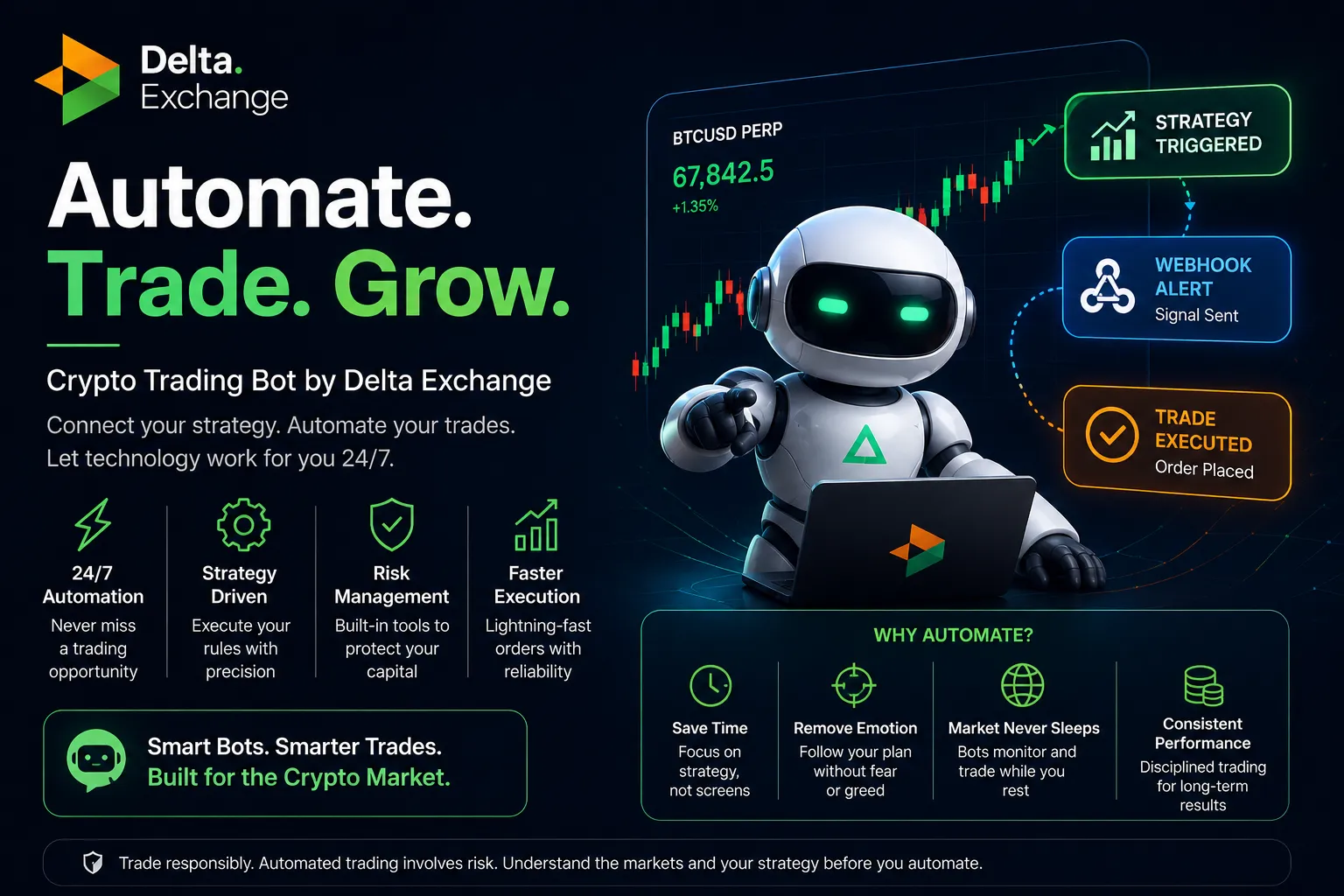

Cryptocurrency markets operate 24/7, which means trading opportunities can appear at any time. For traders who rely on technical indicators, predefined strategies, or automated signals, manually monitoring the market throughout the day can be challenging.
This is where crypto trading bots and automated trading can help.
A trading bot can connect predefined trading rules with an exchange and automatically execute orders when specific conditions are met. Instead of watching charts constantly and placing every order manually, traders can use automation to execute their strategy according to predefined signals.
Delta Exchange provides trading automation tools that allow traders to create rule-based strategies and automate trade execution.
What Is a Crypto Trading Bot?
A crypto trading bot is software that follows predefined instructions to monitor markets and execute trades.
A basic automated strategy might look like this:
Market Data → Trading Strategy → Buy/Sell Signal → Trading Bot → Exchange → Order Execution
For example, a trader might create a strategy based on moving-average crossovers.
The rules could be:
- Buy when the short-term moving average crosses above the long-term moving average.
- Sell when the short-term moving average crosses below it.
- Execute the trade automatically when the signal occurs.
The trader doesn't need to manually monitor the chart every second.
However, automation doesn't automatically make a strategy profitable. A poorly designed strategy can lose money just as quickly when automated.
How Does a Crypto Trading Bot Work?
A trading bot connects a predefined strategy with an exchange and executes trades when specific conditions are satisfied.
The basic process is:
Market Analysis → Trading Strategy → Signal → Automated Execution → Position Management
Step 1: Create a Trading Strategy
The first step is to define the rules of the strategy.
These rules could be based on:
- Price movements
- Technical indicators
- Market trends
- Support and resistance
- Volatility
- Breakouts
- Momentum
Step 2: Generate a Trading Signal
When the predefined conditions are satisfied, the system generates a buy or sell signal.
Step 3: Send the Signal to the Trading Bot
The signal is passed to the automated trading system.
Step 4: Execute the Trade
The trading bot processes the signal and places the corresponding order according to the configured rules.
This reduces several repetitive manual steps involved in trading.
Why Use Trading Automation?
Manual trading requires constant attention.
A trader needs to:
- Monitor charts
- Identify signals
- Decide when to enter
- Place orders
- Manage positions
- Monitor exit conditions
Doing this consistently can become difficult, especially because cryptocurrency markets never close.
Automation can reduce the amount of repetitive work involved in executing a predefined strategy.
1. Reduce Manual Intervention
Once a strategy and automated signals are configured, eligible conditions can trigger trades automatically.
This can be useful for traders who don't want to remain in front of charts throughout the day.
2. Execute Rules Consistently
Human traders can hesitate when a trading signal appears.
Fear, greed, overconfidence, and uncertainty can influence decisions.
An automated system follows the rules configured by the trader, helping maintain more consistent execution.
3. Monitor Markets Around the Clock
Crypto markets operate continuously.
Automated trading can help traders respond to predefined signals even when they aren't actively watching the market.
4. Reduce Repetitive Tasks
If a strategy produces frequent signals, manually placing every order can become tedious.
Automation can handle much of this repetitive execution.
What Can You Automate?
The possibilities depend on your strategy and configuration.
Some common examples include:
Moving Average Strategies
A trader can create rules based on moving-average crossovers.
RSI Strategies
Signals can be generated when RSI reaches predefined levels.
Breakout Strategies
Automated conditions can be created around support and resistance levels.
Trend-Following Strategies
Indicators can be used to identify potential changes in market direction.
Momentum Strategies
A bot can be configured to respond to predefined momentum conditions.
Custom Trading Rules
More advanced strategies can combine multiple indicators and conditions.
The important thing is to automate a clearly defined strategy rather than random signals.
Trading Bots for BTC and ETH
Bitcoin and Ethereum are among the most actively followed cryptocurrency markets.
A trading bot can be used to automate strategies for supported BTC and ETH contracts.
For example, a trader could create a Bitcoin strategy based on moving averages, momentum, or breakout conditions.
When the required conditions occur, the automated system can trigger the appropriate trading workflow.
The same concept can be applied to Ethereum or other supported markets.
This provides traders with flexibility to automate strategies across multiple assets.
Manual Trading vs Automated Trading
Both approaches have advantages and disadvantages.
| Manual Trading | Automated Trading |
|---|---|
| Trader monitors the market | System monitors predefined conditions |
| Orders are placed manually | Orders can be triggered automatically |
| Human judgment is involved | Rules determine execution |
| Emotions can influence decisions | Reduces emotional intervention |
| Requires active monitoring | Reduces repetitive monitoring |
| Easy to make discretionary changes | Depends on configured rules |
Automation isn't necessarily better than manual trading.
It is simply another method of executing a trading strategy.
The right approach depends on the trader's experience, strategy, objectives, and risk tolerance.
Risk Management Is Essential
Automation doesn't remove trading risk.
In fact, risk management becomes even more important when using automated systems because a bot can continue executing signals according to its configuration.
Before activating a trading bot, traders should consider:
- Position size
- Maximum acceptable loss
- Stop-loss rules
- Take-profit conditions
- Leverage
- Margin requirements
- Market liquidity
- Trading fees
- Strategy drawdown
- Maximum number of trades
- Unexpected market conditions
A strategy that performs well during historical testing can behave differently in live markets.
Slippage, fees, volatility, liquidity, execution delays, and changing market conditions can all affect actual performance.
Backtest Before Going Live
Testing a strategy before using real capital is one of the most important steps in algorithmic trading.
Backtesting allows traders to evaluate how a strategy would have performed using historical market data.
For example, traders can examine:
- Historical returns
- Maximum drawdown
- Win rate
- Number of trades
- Risk-to-reward ratio
- Losing streaks
- Performance across different market conditions
However, backtesting has limitations.
Historical performance doesn't guarantee future results.
A strategy can perform well during a trending market but struggle during sideways conditions. Similarly, a strategy designed for low volatility may perform poorly when the market suddenly becomes highly volatile.
Custom API Trading
Advanced traders and developers can use APIs to build customized automated trading systems.
API-based systems can be designed to:
- Access market data
- Monitor price feeds
- Place orders
- Manage positions
- Execute custom algorithms
- Connect external applications
- Build quantitative strategies
This approach provides more flexibility but generally requires greater technical knowledge.
Security and Automated Trading
Security should always be a priority when using automated trading systems.
API keys, credentials, and trading permissions should be protected carefully.
Traders should follow basic security practices such as:
- Never sharing API credentials publicly
- Using appropriate API permissions
- Enabling two-factor authentication
- Reviewing connected applications
- Testing automation before deploying significant capital
- Monitoring automated positions regularly
Automation should make trading more efficient, not create unnecessary security risks.
Who Can Benefit From a Crypto Trading Bot?
Trading bots may be useful for different types of traders.
Active Traders
Traders who receive frequent signals can automate repetitive execution.
Technical Traders
People who rely on indicators and predefined market conditions can automate their execution process.
Busy Traders
Those who cannot continuously monitor markets can use automation to respond to predefined signals.
Algorithmic Traders
Advanced traders can combine automation with APIs and quantitative strategies to create more customized systems.
However, every trader should understand how their strategy works before automating it.
Final Thoughts
Crypto trading bots can transform a manually executed trading strategy into an automated workflow.
Delta Exchange provides tools that allow traders to automate predefined trading rules and execute strategies with less manual intervention.
For more advanced users, API-based solutions can provide additional flexibility for developing customized algorithmic trading systems.
The most important thing to remember is:
Automation is an execution tool, not a profit guarantee.
A successful automated trading system still requires a well-designed strategy, proper testing, realistic expectations, and disciplined risk management.
Before using real capital, understand the strategy, test it under different market conditions, determine appropriate position sizes, and establish clear risk controls.
Build the strategy. Test the strategy. Automate the execution. Manage the risk.
This article is for educational and informational purposes only and does not constitute financial, investment, or trading advice. Cryptocurrency and derivatives trading involve substantial risk.


























Sign in to leave a comment.