
For a South African destination management company (DMC), putting a safari booking business online can initially appear straightforward. A generic travel portal may already provide customer accounts, booking forms, payment functionality and an administration dashboard.
But safari travel has operational requirements that are often very different from standard hotel or flight bookings.
A single safari reservation may involve accommodation, game drives, park fees, transfers, vehicles, guides, meal plans, seasonal rates, room categories, traveller preferences and supplier confirmations.
When all of those elements need to work together, the question is no longer simply whether a business can accept bookings online. It becomes a question of whether the underlying technology can accurately represent the way the DMC operates.
That is where the difference between custom safari booking software and a generic travel portal becomes important.
What Does Safari Booking Software Need to Manage?
Safari booking software is more than an online enquiry form.
Depending on the DMC's business model, the platform may need to support:
- Safari package creation
- Lodge and accommodation management
- Activity scheduling
- Vehicle allocation
- Guide assignment
- Availability management
- Seasonal pricing
- Customer enquiries
- Online reservations
- Deposits and payments
- Transfers
- Itinerary management
- Supplier coordination
- B2B travel-agent bookings
- Customer communication
- Reporting and analytics
A basic website might allow a traveller to submit an enquiry for a safari package.
A more advanced Travel Software Solution connects that customer-facing experience with the operational systems required to deliver the trip.
That distinction becomes increasingly important as a DMC's booking volume and supplier network grow.
Why Generic Travel Portals May Not Fit Every Safari Business
Generic travel portals are designed to accommodate a broad range of travel businesses.
For straightforward requirements such as hotel search, flight bookings, customer accounts and online payments, this approach can be perfectly practical.
Safari operations, however, may involve several related resources within a single booking.
A simplified example could be:
Traveller → Safari Package → Lodge → Room → Dates → Park → Transfers → Vehicle → Guide → Activities → Price → Payment → Confirmation
A generic platform may not naturally understand all of these relationships.
The DMC may consequently need to supplement the portal with spreadsheets, email, messaging applications or separate supplier systems.
From the customer's perspective, the business may appear fully digital. Behind the scenes, however, employees may still be completing substantial manual work.
This is why DMCs should compare platforms based on operational fit, rather than simply comparing the number of features listed on a product page.
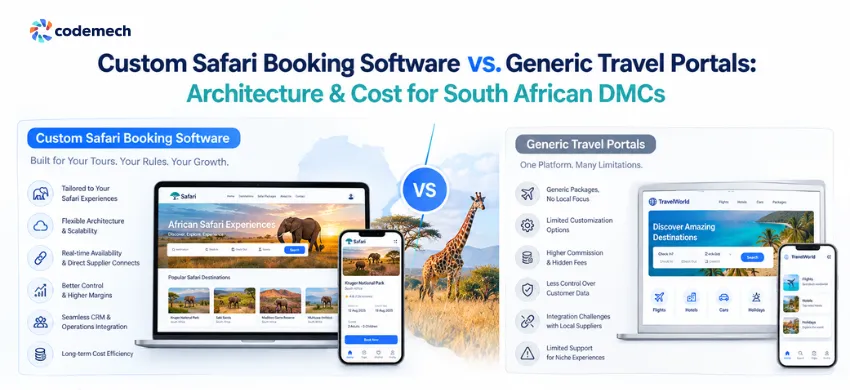
Custom Safari Software vs. Generic Travel Portals
The central difference is flexibility.
A generic portal provides an existing framework that can help a business launch quickly. Custom software allows the business processes, booking logic and integrations to be designed around specific operational requirements.
| Area | Generic Travel Portal | Custom Safari Booking Software |
|---|---|---|
| Booking process | Usually predefined | Designed around business requirements |
| Safari packages | May have limitations | Can be fully configurable |
| Lodge management | Standard functionality | Custom workflows possible |
| Vehicle allocation | May require manual work | Can be incorporated into booking logic |
| Guide management | Often limited | Can be integrated |
| Seasonal pricing | Standard rules | Custom pricing rules |
| Supplier workflows | Platform dependent | Designed around supplier relationships |
| B2B travel agents | May require configuration | Can be designed into the platform |
| Integrations | Available connectors | Selected according to requirements |
| Branding | Often template-based | Fully customisable |
| Future expansion | Depends on platform | Architecture can be planned for growth |
This does not mean a generic platform is automatically the wrong choice.
A small safari operator with straightforward requirements may benefit from an existing system, particularly when speed and initial budget are priorities.
Custom development becomes more relevant when the DMC's operations are complex or when the business expects the platform to become a core part of its long-term operations.
The Architecture of a Scalable Safari Booking Platform
A safari booking platform should be considered a business system rather than simply a website.
A simplified architecture might look like:
Customer / Travel Agent
↓
Web Booking Portal
↓
Booking Engine
↓
Business Rules & Pricing
↓
Safari Management Layer
↓
Lodges | Tours | Vehicles | Guides | Transfers | Activities
↓
Payments & Notifications
↓
CRM | Reporting | Administration
↓
External APIs & Supplier Systems
The actual architecture will depend on the DMC's requirements, but separating major responsibilities can make the platform easier to maintain and expand.
1. Customer Booking Layer
The customer-facing layer may include:
- Safari search
- Destination selection
- Travel dates
- Traveller numbers
- Package comparison
- Room selection
- Activities
- Transfers
- Price calculation
- Traveller details
- Payment
- Booking confirmation
Because international travellers may research trips from different devices and time zones, the booking experience should also be responsive and accessible across mobile and desktop devices.
2. Safari Product Management
The operations team should be able to manage safari products without requiring a developer to modify the website every time a package changes.
For example, a safari package could contain:
- Lodge
- Room category
- Meals
- Game drives
- Airport transfer
- Vehicle type
- Guide
- Park fees
- Seasonal rates
- Child rates
- Cancellation conditions
This turns the software into an operational tool rather than merely a marketing website.
3. Pricing Engine
Safari pricing can become considerably more complicated than a single fixed package price.
Depending on the business model, the price may depend on:
- Travel dates
- Season
- Number of travellers
- Room type
- Adult and child combinations
- Vehicle type
- Private or shared activities
- Transfers
- Supplier rates
- Agent commissions
- Markups
- Promotional discounts
A flexible pricing engine can allow these rules to be handled systematically instead of requiring staff to calculate every quotation manually.
Availability Management
Availability is another major consideration.
A safari reservation may depend on the availability of several resources at the same time:
- Lodge rooms
- Vehicles
- Guides
- Activities
- Transfers
- Tour capacity
- Date-specific restrictions
When these resources are connected to the same booking, the platform needs to account for their relationships.
This can help reduce operational conflicts and the risk of accepting bookings that cannot actually be fulfilled.
Supplier and Partner Management
DMCs frequently work with multiple lodges, transport operators, guides, activity providers and other suppliers.
As the supplier network grows, managing everything through email and spreadsheets can become increasingly difficult.
A custom platform could include supplier functionality for:
- Rates
- Availability
- Contracts
- Booking requests
- Confirmations
- Commission information
- Supplier contacts
- Payment status
The exact functionality will depend on how the DMC works with its suppliers.
The important consideration is whether the platform can represent those relationships without forcing staff to maintain separate manual systems.
Where Do Travel API Integrations Fit?
Custom development does not mean that every component has to be built from scratch.
A well-designed platform can combine custom business logic with established third-party services.
Depending on the business model, integrations might include:
- Hotel APIs
- Flight APIs
- Transfer systems
- Payment gateways
- CRM platforms
- Accounting systems
- Email and SMS services
- Maps and location services
- Supplier APIs
- B2B travel platforms
The goal should be to integrate the systems that provide genuine business value.
Adding APIs simply because they are available can increase development and maintenance complexity without necessarily improving the booking process.
For a DMC that already works with multiple travel suppliers, Travel API Integration can be particularly valuable when it reduces duplicate data entry or allows availability and pricing information to move between systems.
B2C and B2B Requirements Can Be Very Different
A growing DMC may serve both direct travellers and travel agents.
Direct travellers may need:
- Safari discovery
- Package comparison
- Online booking
- Secure payment
- Booking confirmation
- Itinerary access
- Booking management
Travel agents may need:
- Agent login
- Net rates
- Markups
- Commission management
- Agent-specific packages
- Booking history
- Invoices
- Customer management
- Availability information
- Agent reporting
A generic portal may provide basic B2B functionality, but DMCs with a significant international agent network may need more specialised workflows.
For example, an agent could require a different price from a direct customer, while the DMC may also need to track commission, payment terms and booking history.
Those rules need to be reflected in the architecture.
How Much Does Custom Safari Booking Software Cost in South Africa?
There is no single price for custom safari booking software.
The development cost depends on the number of workflows, integrations, user types, booking rules, interfaces and operational requirements.
For planning purposes, projects can fall into very different categories:
| Project scope | Indicative development range |
|---|---|
| Basic safari website and enquiry system | R60,000–R120,000 |
| Booking platform with packages, payments and administration | R120,000–R250,000 |
| Advanced DMC booking platform | R250,000–R500,000+ |
| Enterprise platform with multiple integrations and B2B workflows | R500,000+ |
These should be treated as planning estimates rather than fixed market prices.
Actual costs can vary considerably, and third-party expenses such as API fees, payment processing, hosting, cloud infrastructure, software licences and ongoing maintenance may be separate.
For businesses comparing development approaches, a broader Travel Portal Development Cost analysis can also be useful because the total scope of a travel platform extends well beyond the customer-facing booking page.
What Drives the Development Cost?
Several factors can significantly change the scope.
1. Number of user types
A platform supporting customers, administrators, suppliers, guides and travel agents requires more functionality than a simple customer booking website.
2. Booking complexity
An enquiry form is relatively simple.
A booking engine that simultaneously manages accommodation, activities, vehicles, transfers and pricing is much more complex.
3. API integrations
Each external integration creates development, testing, security and ongoing maintenance requirements.
4. Pricing rules
Seasonal pricing, commissions, markups, discounts and customer-specific rates require additional business logic.
5. Payment processing
Multiple payment methods, deposits, refunds and transaction states can add complexity.
6. B2B functionality
Agent accounts, net rates, commissions, credit limits and reporting create additional workflows.
7. Reporting
Operational and financial dashboards require suitable data structures and reporting functionality.
8. Mobile applications
If the DMC also requires native or cross-platform mobile applications, the overall project scope will increase.
Look Beyond the Initial Development Quote
One of the most common mistakes when comparing custom and generic systems is focusing only on the initial purchase or development cost.
A generic platform may be cheaper to launch, but what happens if the business later needs:
- A custom pricing model
- A new supplier integration
- Special B2B workflows
- Custom reports
- A different payment provider
- Vehicle management
- Guide allocation
- A specialised cancellation process
If the platform cannot accommodate those requirements, the business may need workarounds, custom modifications or eventually another platform.
Custom development can require a larger initial investment, but the architecture can be designed around the organisation's expected requirements.
The more useful question is therefore not simply:
"Which option costs less to launch?"
It is:
"Which approach is appropriate for the business requirements and expected growth?"
When Should a South African DMC Consider Custom Development?
Custom safari booking software may be worth considering when a DMC:
- Sells complex safari packages
- Manages multiple lodges or suppliers
- Uses complex pricing rules
- Works extensively with international travel agents
- Needs both B2B and B2C workflows
- Relies heavily on spreadsheets
- Performs many manual booking steps
- Requires specific API integrations
- Wants greater control over its customer journey
- Expects booking volumes to grow
- Has a business model that does not fit standard travel software
A generic travel portal may be more appropriate when:
- Requirements are straightforward
- The business is testing a new concept
- Standard booking functionality is sufficient
- Rapid launch is more important than customisation
- The initial technology budget is limited
Neither approach is universally suitable. The decision should follow the business model.
Why Architecture Planning Matters
Many software projects become more expensive because architecture decisions are made too late.
Before development begins, a DMC should consider:
- What should be custom-built?
- Which external services should be integrated?
- Which APIs are genuinely necessary?
- How should bookings be structured?
- How should availability be managed?
- How should pricing rules work?
- How should supplier failures be handled?
- How should booking changes be processed?
- How should the platform scale?
- Which data needs to be shared between systems?
For example, a business might initially sell safari packages but later introduce flights, hotels, transfers or additional destinations.
A flexible architecture can make those future additions easier.
This is one reason Software Architecture Consulting Services can be useful before development starts: architecture decisions can be considered in relation to the business roadmap rather than only the first version of the website.
Start With a Focused MVP
A DMC does not necessarily need to launch every possible feature at once.
A phased approach can begin with:
Phase 1: Core Booking
- Safari packages
- Availability
- Customer enquiries
- Booking requests
- Payments
- Administration
Phase 2: Operational Management
- Lodge management
- Vehicle allocation
- Guide management
- Transfers
- Supplier workflows
Phase 3: B2B Distribution
- Travel-agent accounts
- Net rates
- Commissions
- Agent-specific pricing
- B2B reporting
Phase 4: Integrations and Optimisation
- Travel APIs
- CRM
- Accounting
- Advanced reporting
- Automated notifications
- Analytics
This allows the business to validate the core booking process before investing in every possible feature.
How to Evaluate a Travel Software Development Partner
Choosing the development company is another important part of the project.
A DMC should look beyond a general software portfolio and ask whether the development partner understands:
- Travel booking workflows
- Booking engines
- API integrations
- B2B and B2C portals
- Supplier management
- Payment workflows
- Travel data
- Cloud architecture
- Security
- Post-booking operations
When evaluating a Travel Software Development Company, it is useful to ask the team to explain how they would model the actual safari operation.
For example:
How would lodge availability interact with a booking?
How would seasonal pricing work?
How would a travel agent receive a different rate?
What happens when a supplier rejects a booking?
How are cancellations and refunds handled?
These questions reveal much more about the suitability of a development partner than a list of programming languages.
Custom Software Should Reflect the DMC's Operations
The purpose of custom development is not to make a platform unnecessarily complicated.
It is to make the technology reflect the actual business.
A safari DMC may have operational processes that are completely different from those of a conventional hotel-booking business.
The platform should therefore be designed around the company's:
- Products
- Suppliers
- Pricing model
- Customers
- Agents
- Booking rules
- Payment process
- Operational teams
- Growth plans
This is where a specialised Travel Portal Development Company can add value: the development process can begin with the travel workflow rather than treating the project as a generic e-commerce website.
Final Thoughts
There is no universal answer to the question of whether a South African DMC should choose custom safari booking software or a generic travel portal.
A generic system can be a practical starting point for a small operator with straightforward requirements.
Custom software becomes more compelling when a DMC has complex safari products, multiple suppliers, detailed pricing rules, B2B travel-agent relationships, operational resources and a long-term need for integration.
The most important consideration is not simply the initial development price.
It is whether the technology can support the way the DMC actually sells, manages and delivers safari experiences.
For businesses considering a new platform, the most practical approach may be to start with the core booking and operational requirements, establish a scalable architecture, and then expand the platform as the business grows.
A well-planned Safari Booking Software South Africa solution should ultimately do more than accept bookings. It should connect the customer experience with the operational processes behind every safari.


























Sign in to leave a comment.