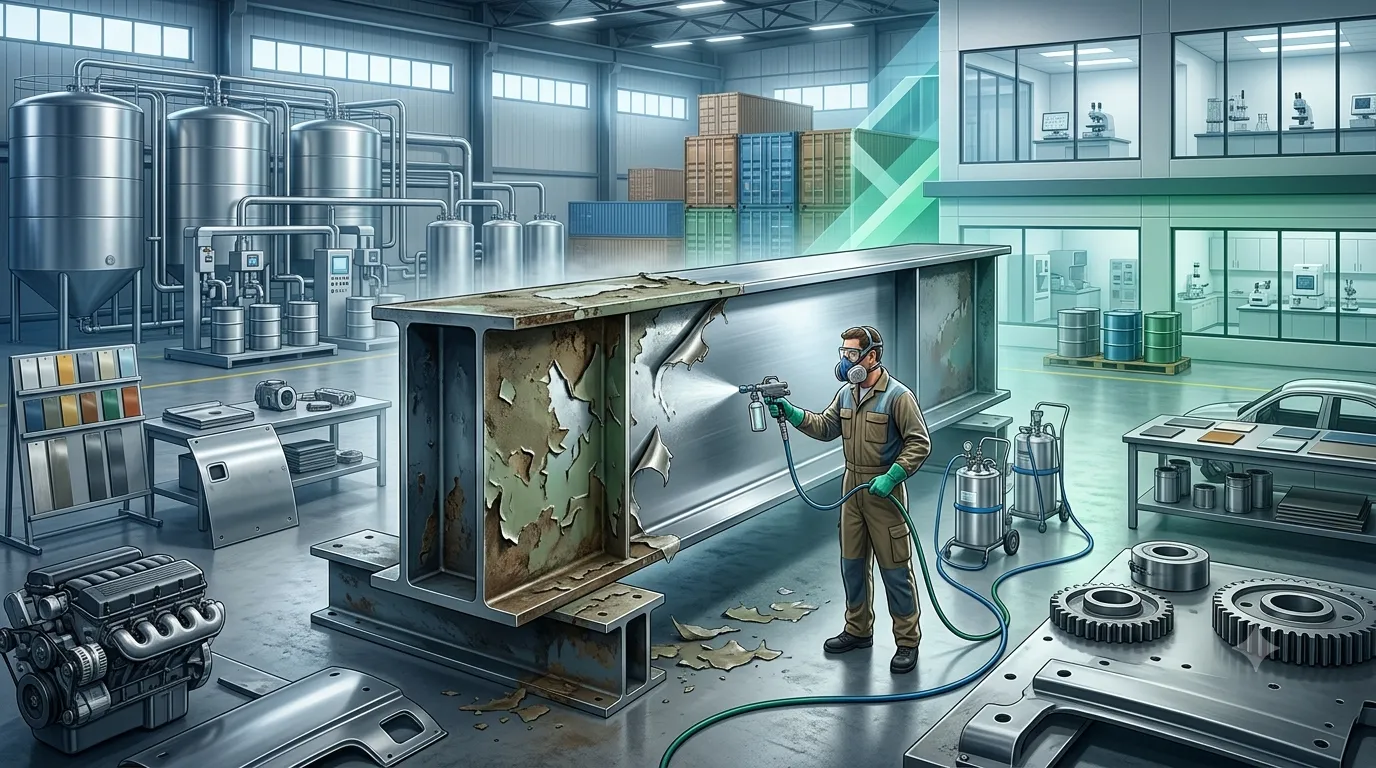

Paint strippers occupy a strange position in the world of industrial chemistry. They need to be powerful enough to dissolve cured, crosslinked coatings—some of the toughest organic films ever created. But they also need to play nice with regulators, workers, and the environment. For decades, the go-to solvents were methylene chloride (dichloromethane or DCM) and N-methylpyrrolidone (NMP). Both worked brilliantly. Both are now heavily restricted due to toxicity, persistence, or reproductive hazards.

Enter cyclopentanone. This five-membered cyclic ketone has emerged as a leading candidate to replace the old guard. But does it truly balance solvent power with low VOC goals? Or is it just another compromise? Let’s strip away the hype and look at the real chemistry.
The Problem: What Makes a Good Stripper Solvent?
A high-performance paint stripper must do three things simultaneously:
- Penetrate the coating’s polymer matrix (typically epoxy, polyurethane, acrylic, or alkyd resins)
- Swollen the coating to break adhesion to the substrate
- Evaporate slowly enough to allow time for chemical action but quickly enough for practical use
Methylene chloride excelled because it has a small molecular size, high density, and excellent solvency for polar and nonpolar polymers. NMP excelled because of its high boiling point (202°C) and ability to hydrogen-bond with urethane linkages. Their replacements need to mimic these properties without the baggage.
Cyclopentanone’s Solvent Profile: The Numbers Don’t Lie
Cyclopentanone (C5H8O, MW 84.12) has a Hildebrand solubility parameter of about 10.6 (cal/cm³)^(1/2). That places it squarely between DCM (9.7) and NMP (11.3). In practical terms, it dissolves epoxy resins faster than DCM and swells polyurethanes almost as well as NMP. The cyclic structure provides two key advantages: the ring rigidity increases dipole moment (3.0 Debye vs. 2.8 for linear ketones like methyl ethyl ketone), and the lack of alpha-hydrogens on a cyclic ketone reduces side reactions with strong acids or bases.
When tested on a standard six-layer aircraft paint system (epoxy primer + polyurethane topcoat), cyclopentanone achieved complete stripping in 45 minutes at room temperature. DCM did it in 30 minutes. NMP took 60 minutes. So it’s not the fastest, but it’s respectably fast.
The Low VOC Claim: Truth or Greenwashing?
VOCs (volatile organic compounds) are measured in grams per liter, excluding water. Traditional DCM-based strippers ranged from 600 to 800 g/L. NMP-based strippers were lower, around 300–500 g/L, but NMP itself is now listed as a SVHC (Substance of Very High Concern) in Europe.
Cyclopentanone has a vapor pressure of 11.5 mmHg at 25°C and a boiling point of 130°C. Compare that to DCM (350 mmHg, 40°C) and NMP (0.3 mmHg, 202°C). Cyclopentanone evaporates much slower than DCM (good for worker safety and reducing fugitive emissions) but much faster than NMP (good for reducing total VOC weight per application). The EPA’s current VOC exemption list does not include cyclopentanone, meaning it still counts as a VOC. However, because you use less of it per square foot (due to its higher density and better spreading coefficient), the actual mass emitted can be 40–50% lower than a DCM system.
So the honest claim is not “zero VOC” but “lower net VOC emissions per job.”
Formulation Tips: Making Cyclopentanone Work in Real Strippers
Pure cyclopentanone works, but it’s expensive (typically $3–5 per kg vs. $1.50 for DCM). Smart formulators blend it with other, cheaper solvents and additives.
Synergistic Blends:
- Cyclopentanone + Dimethyl carbonate (DMC): DMC is low-toxicity, biodegradable, and cheap. A 60/40 blend maintains stripping power while cutting cost by 30%.
- Cyclopentanone + Benzyl alcohol: The alcohol swells waterborne coatings that cyclopentanone alone struggles with. Great for architectural paint stripping.
Cyclopentanone + Dibasic esters (DBE): DBE has a very high boiling point (200°C+) and slows evaporation, giving the stripper longer working time. A 50/50 blend is popular for removing marine gelcoat.
Thickeners Matter: Unlike DCM, which requires complex gelling agents (often waxes), cyclopentanone can be thickened with simple cellulose ethers or fumed silica. That means vertical-surface strippers that don’t drip.
Acid Activation: Adding a small amount (1–3%) of formic or acetic acid dramatically accelerates cyclopentanone’s attack on epoxy coatings. The acid protonates the ether oxygens in the epoxy network, making them more susceptible to nucleophilic attack by the ketone. This is a standard trick in professional strippers but rarely disclosed on labels.
Safety and Handling: The Real Difference
This is where cyclopentanone shines. Its occupational exposure limit (OEL) is 50 ppm (8-hour TWA), compared to 25 ppm for DCM (and falling) and 10 ppm for NMP. It has no known carcinogenicity, no reproductive toxicity, and is not a skin sensitizer. The flash point is 26°C (79°F)—technically flammable, but not as dangerous as acetone or MEK. In use, it has a pleasant, minty odour rather than the sweet, ethereal smell of DCM (which your nose quickly adapts to, making overexposure dangerous).
The Bottom Line for Buyers
If you’re a DIY homeowner stripping a piece of furniture, cyclopentanone-based strippers are a no-brainer: they work better than “citrus” strippers, and they won’t give you chemical burns or liver damage. If you’re an industrial user stripping aircraft fleets or repurposing industrial tanks, cyclopentanone offers a viable path to compliance with upcoming DCM bans (EPA proposed rule as of 2024-2025). The trade-off is slightly slower action and higher material cost. But when the alternative is regulatory fines or worker lawsuits, cyclopentanone looks less like a compromise and more like the future.
Cyclopentanone won’t win a drag race against methylene chloride. But in a marathon toward sustainable, safe, and effective paint removal, it’s currently leading the pack.




















Sign in to leave a comment.