

Businesses today generate and depend on data at an unprecedented scale. Customer transactions, website visits, financial records, marketing campaigns, inventory information, and operational systems all produce valuable information.
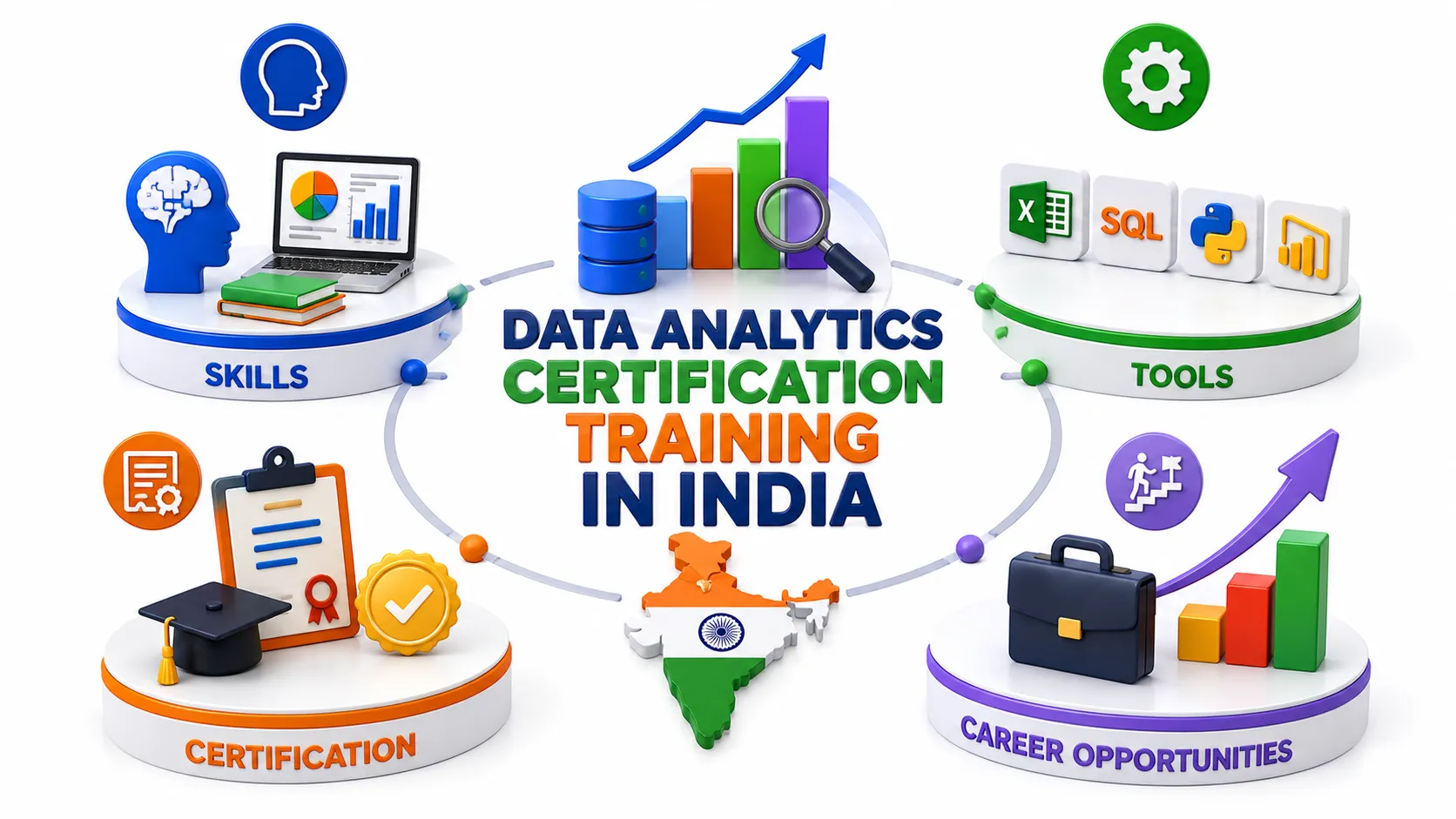
The challenge is turning that information into meaningful insights. This is why analytics professionals have become important to modern organizations. Data Analytics Certification Training in India can help aspiring professionals learn the tools and concepts required to work with business data effectively.
Understanding Data Analytics
Data Analytics involves examining information to discover patterns, trends, relationships, and insights.
A Data Analytics Training may begin with a business problem and determine which data is needed. The data is then collected, cleaned, analyzed, visualized, and presented to stakeholders.
The final objective is not simply to produce numbers. It is to support better business decisions.
Key Tools Used by Analysts
Several tools are commonly associated with analytics.
Excel is widely used for spreadsheets, calculations, reporting, and basic analysis.
SQL is important because businesses frequently store information in relational databases. Analysts use SQL to retrieve, filter, combine, and summarize data.
Python provides additional capabilities for data preparation, analysis, and automation. Libraries such as Pandas make it easier to work with structured datasets.
Power BI and Tableau are used to create interactive dashboards and visual reports.
Developing Analytical Thinking
Learning software is only one part of becoming an analyst.
Professionals also need to ask useful questions and interpret results correctly.
Suppose a company reports lower revenue this quarter. An analyst should not immediately assume that fewer customers are responsible. The decline could result from lower order values, product availability, regional performance, pricing changes, or seasonal factors.
Analytical thinking involves examining different possibilities before reaching a conclusion.
How to Choose a Course
Learners searching for the Best Data Analytics Course should compare programs carefully.
A strong course should cover fundamental concepts and commonly used tools. It should also include practical assignments, case studies, and projects.
The course should ideally explain how different tools work together within an analytics workflow.
Support from instructors can also be useful, especially when students begin working with real datasets.
Certification and Practical Exposure
Certification can be helpful for demonstrating structured learning.
However, employers may want to see evidence that a candidate can actually use the skills they claim to have.
For this reason, Data Analytics Certification Training in India should ideally include practical exercises and project work.
Learners can use these projects to develop portfolios that demonstrate their abilities.
Career Opportunities
A background in analytics can support a range of professional roles.
Some candidates begin as Data Analysts or Reporting Analysts. Others move into Business Intelligence, Business Analysis, Marketing Analytics, or Operations Analytics.
With experience, professionals can take on senior analytical roles or specialize in specific industries.
Career progression can depend on technical expertise, communication skills, business understanding, and professional experience.
Building a Portfolio
A professional portfolio can include several projects.
A sales dashboard can demonstrate visualization skills. A SQL project can demonstrate database querying. A Python project can demonstrate data cleaning and analysis.
The portfolio should explain the business problem and describe how the analysis was performed.
Including recommendations based on findings can demonstrate business thinking.
Role of Training
Self-learning is possible, but a structured program can make the learning process more organized.
Professional Data Analytics Training in India can introduce concepts progressively and provide opportunities for practice.
Structured learning can also help learners avoid focusing too heavily on one tool while neglecting other important skills.
Career Preparation
Students should begin career preparation while learning rather than waiting until the course ends.
Resume development, portfolio creation, LinkedIn optimization, technical interview practice, and mock interviews can all be useful.
Candidates should be prepared to explain their projects clearly and discuss the business decisions supported by their analysis.
Future Scope
Analytics continues to evolve as organizations adopt cloud platforms, automation, artificial intelligence, and advanced reporting technologies.
Professionals with strong fundamentals can gradually learn these technologies as they become relevant to their careers.
Continuous learning is therefore an important part of long-term success.
Conclusion
Data analytics has become an important capability across modern organizations.
A structured Data Analytics Course in India can help learners develop knowledge of analytics concepts, tools, visualization, and practical problem-solving.
The right Data Analytics Course should combine technical training with hands-on projects and career preparation.
For individuals planning to enter the field, Data Analytics Certification Training in India can provide a structured foundation for building relevant skills and exploring professional opportunities.

























Sign in to leave a comment.