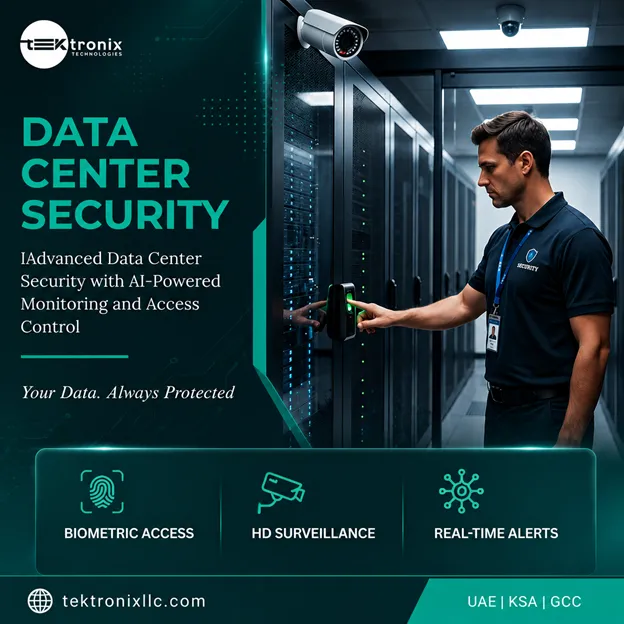

Data Center Security is no longer a back-office concern for enterprises operating across Saudi Arabia and the wider Gulf. As banks, government entities, healthcare providers, and logistics firms digitize their core operations, a single infrastructure breach can halt services, damage regulatory standing, and erode customer trust within hours. This guide explains what a resilient, multi-layered defence strategy actually requires in 2026 and beyond, and why the region's most regulated industries are re-evaluating their facilities today.

Why Data Center Security KSA Programs Are Now a Boardroom Priority
Saudi Arabia's Vision 2030 agenda has accelerated cloud adoption, smart-city rollouts, and fintech expansion at a pace few regions can match. That growth has placed enormous pressure on facility operators to align with the National Cybersecurity Authority's Essential Cybersecurity Controls, SAMA's regulatory framework for financial institutions, and sector-specific data residency rules. For a Riyadh-based bank or a Jeddah logistics hub, non-compliance is not merely a fine — it is a direct threat to the license to operate.
Giga-projects such as NEOM, expanding hyperscale investment from global cloud providers, and the growth of the Tadawul-listed enterprise sector have all pushed data infrastructure to the top of the national agenda. As more workloads move from legacy on-premise server rooms into purpose-built facilities, boards are asking a very direct question: can our facility withstand a targeted attack and still meet its uptime commitments? That question rarely has a confident answer without an independent security assessment.
Facility operators across the Kingdom are moving away from single-point defences (a firewall here, a badge reader there) toward integrated architectures. This shift is exactly what informs Tektronix's six-layered data center security framework, built specifically for organizations that must satisfy both regional regulators and international auditors simultaneously.
Cybersecurity for Data Center Operations Across the GCC
Beyond the Kingdom, Data Center Security GCC requirements differ subtly from country to country. The UAE's NESA framework, Qatar's National Information Assurance Policy, and Bahrain's Central Bank guidelines each add their own layer of obligation on top of common Gulf Cooperation Council data-sovereignty expectations. Enterprises running regional operations across Riyadh, Dubai, Doha, and Manama increasingly need one security posture that can flex to meet each jurisdiction without being rebuilt from scratch.
A regional threat landscape shaped by geopolitical tension, high-value financial targets, and critical national infrastructure means Gulf data centers are targeted more frequently — and more sophisticatedly — than the global average. Ransomware groups, state-linked actors, and insider threats all feature in recent regional incident reports, which is why forward-looking operators budget for security as a continuous program rather than a one-time deployment.
Cross-border operations add a further layer of complexity. A group headquartered in Riyadh with a disaster-recovery site in Dubai or a colocation footprint in Manama must reconcile several regulators at once, each with its own audit cadence and reporting obligations. Building a security architecture that is documented once and mapped to each jurisdiction's requirements — rather than rebuilt per country — is what allows regional enterprises to scale without multiplying their compliance overhead.
Common Risks Facing Data Centers Across the Region
Before selecting controls, it helps to understand what they are actually defending against. Regional incident data and industry audits point to a recurring set of exposure points that operator in Saudi Arabia and the GCC should treat as priorities:
- Credential-based attacks and phishing targeting privileged administrator accounts
- Unpatched firmware on network and building-management devices
- Weak physical perimeter controls at secondary or leased facilities
- Third-party and vendor access that is granted but never formally revoked
- Insufficient logging that delays incident investigation and regulatory reporting
Each of these gaps maps directly to one of the six control layers covered below — which is precisely why a fragmented approach, where each risk is patched individually rather than addressed as part of a unified architecture, tends to leave blind spots that only surface during an actual incident or audit.
Data Center Encryption: Protecting Data at Rest and in Transit
Encryption remains the last line of defence when every other control fails. A mature program applies AES-256 encryption to stored records, TLS 1.3 to data moving across networks, and hardware security modules to protect the cryptographic keys themselves. Key rotation policies, split-knowledge key custody, and dedicated key-management infrastructure separate a genuinely resilient setup from a checkbox implementation.
- Full-disk and database-level encryption for stored records
- TLS-enforced transport for all inter-facility and cloud traffic
- Hardware security modules (HSMs) for key generation and storage
- Scheduled key rotation aligned with NCA and SAMA guidance
Encryption also plays a growing role in vendor due diligence. Regional banks and government entities now routinely ask facility operators to demonstrate, with evidence, exactly how stored records and backups are protected — not simply confirm that 'encryption is in place.' Documented key-management procedures and periodic third-party validation have become a standard expectation in RFPs across the Kingdom and the wider Gulf.
Data Center Firewalls: The First Line of Network Defence
Next-generation firewalls do far more than block ports. Deep packet inspection, application-aware filtering, and integrated intrusion-prevention signatures allow modern firewall stacks to catch threats that legacy perimeter devices miss entirely. Micro-segmentation further limits how far an attacker can move laterally once inside, containing incidents to a single zone rather than the entire facility.
For colocation and multi-tenant facilities common across the GCC, firewall policies must also enforce strict tenant isolation, ensuring that one client's compromised workload can never become a pathway into a neighbouring environment.
Firewall rule sets also age quickly. A configuration that was appropriate at deployment can drift within months as new applications, vendors, and integrations are added. Scheduled rule audits, combined with automated change-management logging, keep the firewall layer aligned with how the environment is actually being used rather than how it was designed on day one.
Data Center Access Control: Governing Exactly Who Gets In
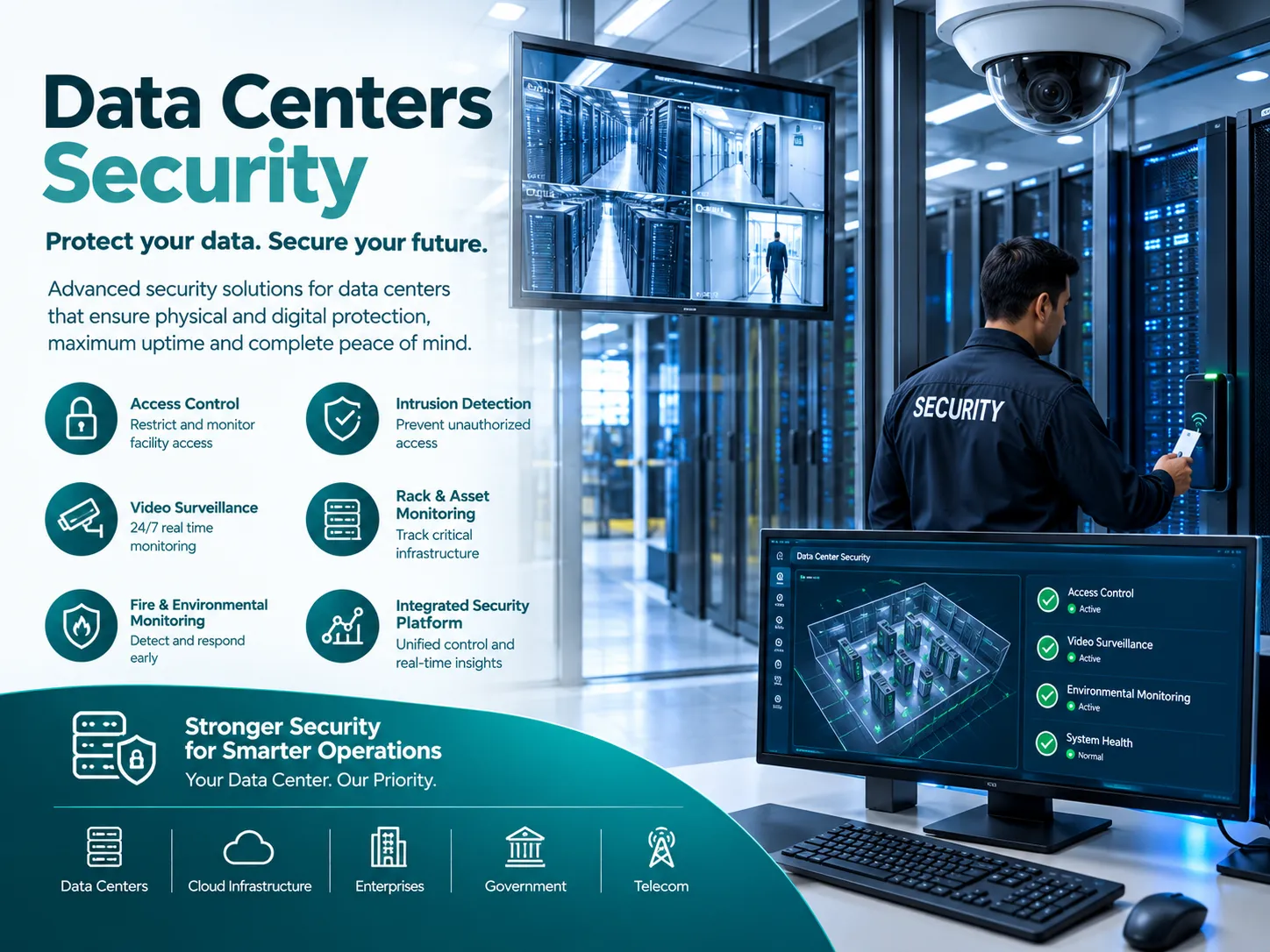
Physical entry to a data hall is one of the most consequential decisions a facility makes, and it should never rely on a single credential type. Layered verification — biometric scanning, smart-card readers, PIN entry, and mantrap vestibules — ensures that no individual factor, if compromised, grants access on its own. Role-based per missioning keeps engineers, auditors, and vendors restricted to only the zones their work requires, with every entry and exit logged for audit trails.
- Multi-factor biometric and card-based entry at every checkpoint
- Mantrap vestibules preventing tailgating between security zones
- Role-based, time-bound access permissions for vendors and staff
- Immutable audit logs supporting NCA and ISO 27001 reviews
Access governance is also where insider risk is most effectively managed. Automated de-provisioning — removing a former employee's or contractor's credentials the moment their engagement ends — closes one of the most common gaps auditors flag during regional compliance reviews. Facilities that still rely on manual offboarding checklists routinely discover stale access rights that should have been revoked months earlier.
Data Center Surveillance: The Physical Security Layer That Never Sleeps
Comprehensive camera coverage — combined with AI-driven video analytics — allows a facility to detect loitering, unauthorized zone entry, or unusual movement patterns long before a human operator would notice. Integrating surveillance feeds with the same platform that manages access control and alarms means a single incident triggers a coordinated response across every layer, rather than isolated alerts that a busy security desk might miss.
A 24/7 security operations center, staffed with analysts trained on regional threat patterns, turns raw camera and sensor data into an actionable response protocol within minutes rather than hours.
Retention policy matters as much as coverage. Regulators across the Kingdom and Gulf increasingly expect footage to be retained for defined periods to support post-incident investigations, meaning storage architecture and video-management software need to be planned alongside the cameras themselves, not treated as an afterthought.
Data Center Intrusion Detection: Catching Breaches Before They Escalate
Intrusion detection and prevention systems continuously inspect network traffic for signatures and behavioural anomalies associated with known attack patterns. Positioned at critical network chokepoints, these systems flag unauthorized access attempts, unusual data transfers, and reconnaissance activity in real time, giving security teams the window, they need to contain an incident before it spreads to production systems.
Physical intrusion sensors — door contacts, vibration detectors on server racks, and tamper alarms on network cabinets — extend this same principle into the physical estate. A genuinely resilient facility treats a forced cabinet lock with the same urgency as a suspicious network packet, because both represent the same underlying event: an unauthorized attempt to reach protected systems.
Data Center Threat Detection: Moving from Reactive to Proactive Defence
Where intrusion detection watches the network edge, threat detection looks across the entire environment. Security information and event management (SIEM) platforms correlate logs from firewalls, servers, access control systems, and endpoints, applying behavioural analytics and threat intelligence feeds to surface patterns a human analyst would never spot manually. Combined with regular threat-hunting exercises, this proactive posture is what separates facilities that detect an incident in minutes from those that discover it in a headline.
Threat intelligence feeds tuned to the Middle East give regional operators an added edge — indicators of compromise associated with campaigns targeting Gulf financial institutions or energy infrastructure can be built directly into detection rules well before those threats reach global feeds, closing a window that generic, worldwide threat data simply cannot cover.
A Six-Layered Framework Built for Regional Compliance
No single control — encryption, a firewall, or a camera system — is sufficient on its own. What distinguishes a genuinely resilient facility is the way these controls are engineered to work together, with overlapping coverage so that a failure in one layer is caught by the next. Tektronix's data center security services in Saudi Arabia bring together perimeter Défense, access governance, surveillance, network security, encryption, and continuous monitoring into a single, auditable framework designed around NCA, SAMA, and broader GCC regulatory expectations.
Organizations evaluating their current posture can review the complete methodology on the six-layered security framework page, which breaks down each layer and how it maps to regional compliance obligations.
A Checklist for Evaluating Your Facility's Security Posture
Whether you operate a private enterprise facility or lease space within a colocation environment, the following questions offer a practical starting point before your next audit cycle:
- Can you produce evidence of encryption key-management procedures on demand?
- Are firewall rule sets reviewed on a fixed schedule, not only after an incident?
- Is access revoked automatically the moment an employee or vendor engagement ends?
- Does video retention meet the minimum period required by your regulator?
- Can your SIEM correlate physical and network events into a single incident timeline?
- Has your architecture been mapped explicitly against NCA, SAMA, or NESA controls?
A confident 'yes' to all six typically indicates a mature, integrated security program. Gaps in two or more areas usually signal that controls exist in isolation rather than as part of a coordinated framework — the exact problem a layered architecture is designed to solve.
Why Regional Enterprises Trust This Approach
Tektronix has spent over a decade delivering security and infrastructure projects for banks, government entities, and enterprise data centers across Saudi Arabia and the GCC. That experience translates into designs informed by real regional audits, not generic global templates — every recommendation in this guide reflects controls that have been implemented and validated in live Gulf facilities.
- Local engineering teams with direct experience across NCA, SAMA, and NESA audits
- Vendor-certified integrations with leading firewall, surveillance, and access-control platforms
- A track record of deployments across banking, government, and enterprise colocation facilities
- Ongoing monitoring and support rather than a one-time installation
Enterprises that want a structured starting point can request a facility assessment mapped directly to the Tektronix six-layered methodology, giving stakeholders a clear, documented view of where their current controls stand against regional regulatory expectations.
Conclusion
Data Center Security now sits at the center of every serious infrastructure conversation in Saudi Arabia and the GCC. Cybersecurity for Data Center operations depends on layered controls working in concert, from Data Center Encryption and Data Center Firewalls to Data Center Access Control and Data Center Surveillance. Early warning comes from disciplined Data Center Intrusion Detection and continuous Data Center Threat Detection, not from chance. Together, these controls define what credible Data Center Security KSA and Data Center Security GCC programs look like today. Enterprises that treat security as an integrated framework, rather than isolated tools, are the ones best positioned to protect their operations and their customers.
FAQs
1. What makes a Gulf data center a target for cyberattacks?
High-value financial data, critical national infrastructure links, and rapid digital transformation make regional facilities attractive targets, which is why layered Cybersecurity for Data Center controls matter more here than in slower-growth markets.
2. How does encryption differ from access control in a security program?
Data Center Encryption protects the data itself even if a breach occurs, while access control governs who can physically or digitally reach that data in the first place — both are needed, not one or the other.
3. Are firewalls alone enough to secure a facility?
No. Data Center Firewalls stop network-level threats, but physical breaches, insider risk, and social engineering require surveillance, access governance, and monitoring working alongside them.
4. What regulations apply to data centers in Saudi Arabia and the GCC?
Operators typically must align with the National Cybersecurity Authority's Essential Cybersecurity Controls, SAMA guidelines for regulated financial entities, and country-specific frameworks such as NESA in the UAE, alongside international standards like ISO 27001.
5. How quickly can threat detection identify an active breach?
Mature Data Center Threat Detection programs using SIEM correlation and behavioural analytics can flag anomalies within minutes, compared to the days or weeks typical of facilities relying on manual log review alone.
For more information contact us on:
Tektronix Technology Systems Dubai-Head Office
+971 55 232 2390
Office No.1E1 | Hamarain Center 132 Abu Baker Al Siddique Rd – Deira – Dubai P.O. Box 85955



























Sign in to leave a comment.