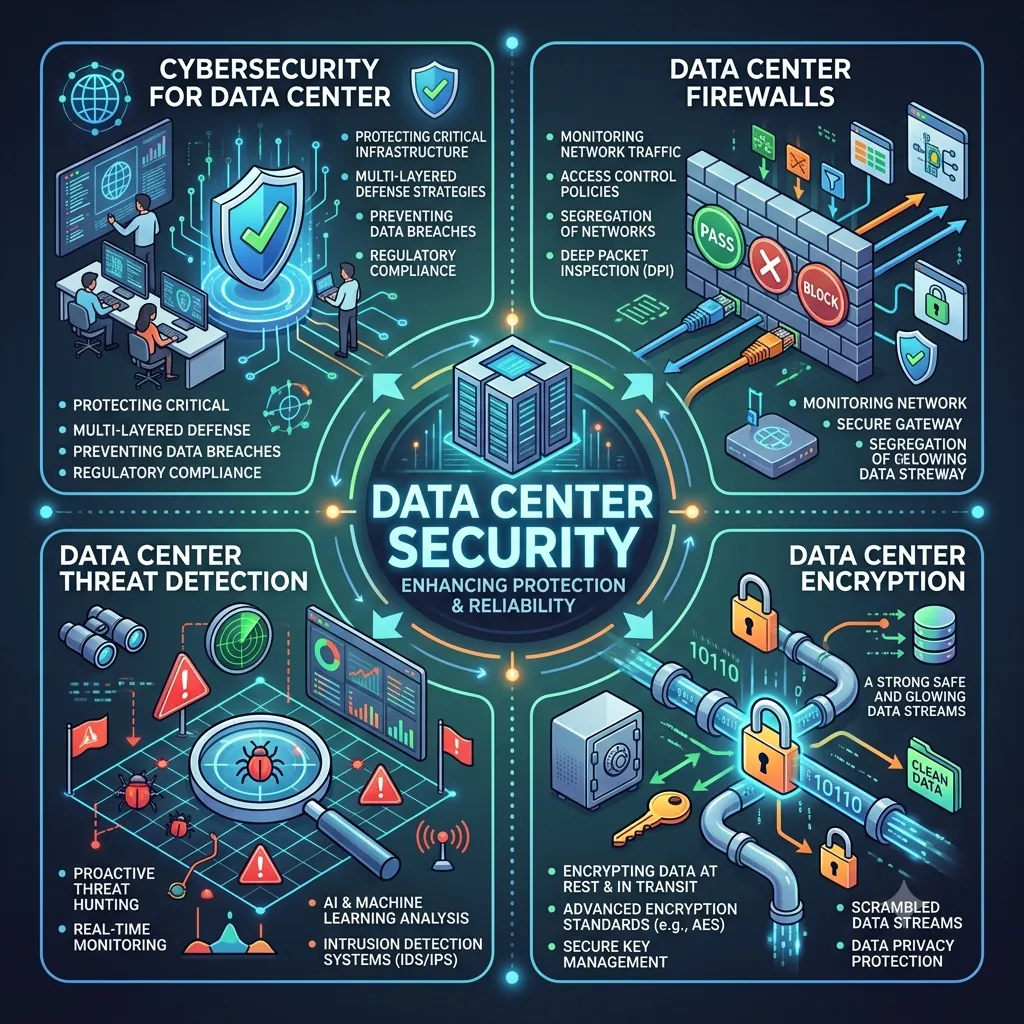

Every business today depends on data — customer records, financial systems, applications, and cloud services all live somewhere physical: a data center. If that data center isn't properly protected, everything built on top of it is at risk. This guide breaks down what Data Center Security really means, the different types of protection involved, why it matters for organizations in Dubai and the UAE, and how to choose the right security partner.
What Is Data Center Security?
Data center security is the combination of physical, technical, and procedural measures used to protect the servers, storage systems, and network infrastructure inside a data center. The goal is simple: keep data available, confidential, and unaltered, while keeping unauthorized people — and unauthorized traffic — out.

It covers two connected layers:
- Physical security — controlling who can physically enter the building or server room, using badges, biometric access, CCTV, and security personnel.
- Cybersecurity — protecting the data, applications, and network traffic that flow through the data center using firewalls, encryption, monitoring, and access controls.
A strong data center security strategy brings both layers together so that a facility is protected from break-ins, insider threats, cyberattacks, and system failures all at once.
Types of Data Center Security
Data center security isn't a single tool — it's a set of overlapping protections. Here are the main types every business should understand.
1. Cybersecurity for Data Center
This covers the digital defences that protect the servers and networks inside the facility from hacking, malware, and unauthorized access. It typically includes:
- Identity and access management (IAM) so only authorized staff can log into systems
- Multi-factor authentication (MFA) for administrator accounts
- Continuous Data Center Threat Detection to spot unusual activity before it becomes a breach
- Regular vulnerability scanning and patch management
- Security Operations Center (SOC) monitoring around the clock
Cybersecurity for data centers is the layer that stops attackers who never physically enter the building but try to breach systems remotely through the internet.
2. Data Center Encryption
Encryption protects data by turning it into unreadable code that can only be unlocked with the correct key. In a data center, encryption is applied in two main states:
- Data at rest — information stored on servers, disks, or backups is encrypted so that even if hardware is stolen or accessed without permission, the data itself remains unreadable.
- Data in transit — information moving between servers, applications, or to end users is encrypted so it can't be intercepted and read while traveling across networks.
Data center encryption is especially important for businesses handling financial records, healthcare data, or personal customer information, since a breach without encryption can expose everything in plain, readable form.
3. Data Center Firewalls
Data Center Firewalls sit at the edge of the network and between internal segments, controlling what traffic is allowed in and out. Modern data center firewalls do more than just block ports — they include:
- Deep packet inspection to examine traffic content, not just its source
- Intrusion prevention systems (IPS) to block known attack patterns
- Network segmentation, so if one part of the system is compromised, attackers can't move freely to other areas
- DDoS protection to absorb and filter large-scale traffic floods aimed at taking systems offline
Firewalls are often the first line of defence, filtering out threats before they ever reach sensitive servers or applications.
4. Data Center Security UAE (Full Facility Protection)
This refers to a complete, integrated security setup tailored to a specific data center or hosting facility in the UAE. It typically combines:
- Physical security (biometric access, CCTV, manned security, perimeter control)
- Cybersecurity and threat detection
- Firewalls and network segmentation
- Encryption for stored and transmitted data
- Compliance alignment with UAE data protection and critical infrastructure requirements
A full Data Center Security UAE solution is designed around local regulatory expectations, regional threat patterns, and the operational needs of businesses running critical systems in the region.
Benefits of Strong Data Center Security
Protects Business Continuity
A secure data center keeps critical systems running. Preventing breaches, sabotage, and unauthorized downtime means your applications, websites, and internal tools stay available to employees and customers.
Reduces Financial and Legal Risk
A data breach isn't just a technical problem — it can lead to regulatory fines, legal action, and loss of customer trust. Strong security measures significantly lower the chances of a costly incident.
Prevents Data Loss and Theft
Encryption, access controls, and monitoring work together to make sure sensitive data — financial records, intellectual property, customer information — cannot be stolen or leaked, even if an attacker gets partway into the network.
Builds Customer and Partner Trust
Clients and partners want assurance that their data is safe. A well-secured data center becomes a competitive advantage, especially for businesses handling sensitive information in finance, healthcare, or government-related sectors.
Supports Regulatory Compliance
Proper security controls help organizations meet data protection laws and industry standards, avoiding penalties and keeping operations aligned with local and international requirements.
Early Threat Detection Saves Money
Investing in Data Center Threat Detection means issues are caught early — before they escalate into full breaches, downtime, or ransomware incidents that are far more expensive to recover from.
Why Data Center Security Matters for Businesses in Dubai and the UAE
A Growing, High-Value Target Region
The UAE's digital economy is expanding rapidly, and Dubai in particular has become a regional hub for finance, trade, and technology. This growth makes local businesses and their data centers an increasingly attractive target for cybercriminals and ransomware groups.
Strict Regulatory Environment
The UAE has established a strong regulatory framework around data protection and cybersecurity, including the Personal Data Protection Law (PDPL) at the federal level, sector-specific rules from bodies like the Dubai Electronic Security Center (DESC) for Dubai government-linked entities, and national cybersecurity standards for critical infrastructure. Businesses operating in free zones such as DIFC and ADGM may also fall under additional data protection regimes. Non-compliance can lead to significant financial penalties, making proper data center security not just good practice but a legal necessity.
Rising Sophistication of Attacks
Cyber threats targeting the region increasingly involve ransomware, phishing, and business email compromise, often combined with data theft before encryption and extortion. A secure data center with proper firewalls, encryption, and monitoring is a core defence against these evolving attack methods.
Data Residency Expectations
Many UAE regulations increasingly expect sensitive personal and business data to be stored within UAE-based, compliant data centers. Choosing a properly secured local facility helps businesses meet these data residency expectations while keeping performance and latency low for regional users.
Business Reputation in a Competitive Market
In a market as competitive as Dubai, a single security incident can damage a company's reputation quickly. Strong data center security protects not just systems, but the brand and trust a business has built with its customers.
Features to Look for in a Data Center Security Solution
When evaluating a Data Center Security UAE provider or facility, look for the following:
Layered Physical Security
Biometric access control, 24/7 CCTV monitoring, manned security personnel, and visitor management should all work together to control who physically enters sensitive areas.
Advanced Data Center Firewalls
Look for next-generation firewalls with deep packet inspection, intrusion prevention, network segmentation, and built-in DDoS protection.
Strong Data Center Encryption
Confirm that data is encrypted both at rest and in transit, with proper key management practices to control who can access encryption keys.
Continuous Threat Detection and Monitoring
A dedicated Security Operations Center (SOC) providing round-the-clock Data Center Threat Detection is essential for spotting and responding to incidents quickly, rather than discovering a breach after the damage is done.
Redundancy and Uptime Guarantees
Look for Tier III or higher certified facilities with redundant power, cooling, and connectivity, backed by strong uptime SLAs (such as 99.95% or higher).
Compliance Certifications
Check for recognized certifications such as ISO 27001, along with alignment to UAE-specific regulatory frameworks like PDPL, DESC requirements, or NESA standards where relevant.
Incident Response and Backup Strategy
A good provider should have a tested incident response plan, regular backup routines, and proven recovery procedures in case of ransomware or system failure.
Why You Should Choose a Professional Data Center Security Provider
Expertise in a Complex, Fast-Changing Threat Landscape
Cyber threats evolve constantly, and keeping up with new attack techniques requires specialized knowledge. A professional provider stays current on threats and updates defences proactively, rather than reactively.
Correctly Designed, Layered Security
Professional providers assess your specific risk profile — data sensitivity, traffic patterns, and compliance obligations — and design a layered security approach combining physical security, firewalls, encryption, and monitoring correctly, rather than applying a generic setup.
Regulatory and Compliance Guidance
Navigating UAE data protection laws, sector-specific rules, and international standards can be complex. An experienced provider helps ensure your data center setup meets these requirements, reducing legal and financial risk.
24/7 Monitoring and Rapid Response
Threats don't stop after office hours. Professional providers typically offer continuous SOC monitoring and rapid incident response, minimizing damage and downtime if something does go wrong.
Long-Term Cost Savings
Preventing a breach is far cheaper than recovering from one. Professional data center security reduces the risk of costly downtime, regulatory fines, and reputational damage, offering strong long-term value.
Conclusion
Data center security is no longer optional — it's the foundation that keeps businesses running safely in an increasingly connected and regulated world. From Cybersecurity for Data Center operations and Data Center Encryption to advanced Data Center Firewalls and full Data Center Security UAE deployments, every layer plays a role in protecting critical systems and data. For businesses in Dubai and across the UAE, strong data center security isn't just about avoiding attacks — it's about meeting regulatory expectations, protecting customer trust, and keeping operations resilient in a competitive market.
Ready to Strengthen Your Data Center Security?
If your business needs a comprehensive Data Center Security solution in Dubai or anywhere across the UAE, work with a professional provider who can assess your risks, design the right layered defences, and keep your systems protected around the clock. Contact our team today for a free consultation and security assessment.


























Sign in to leave a comment.