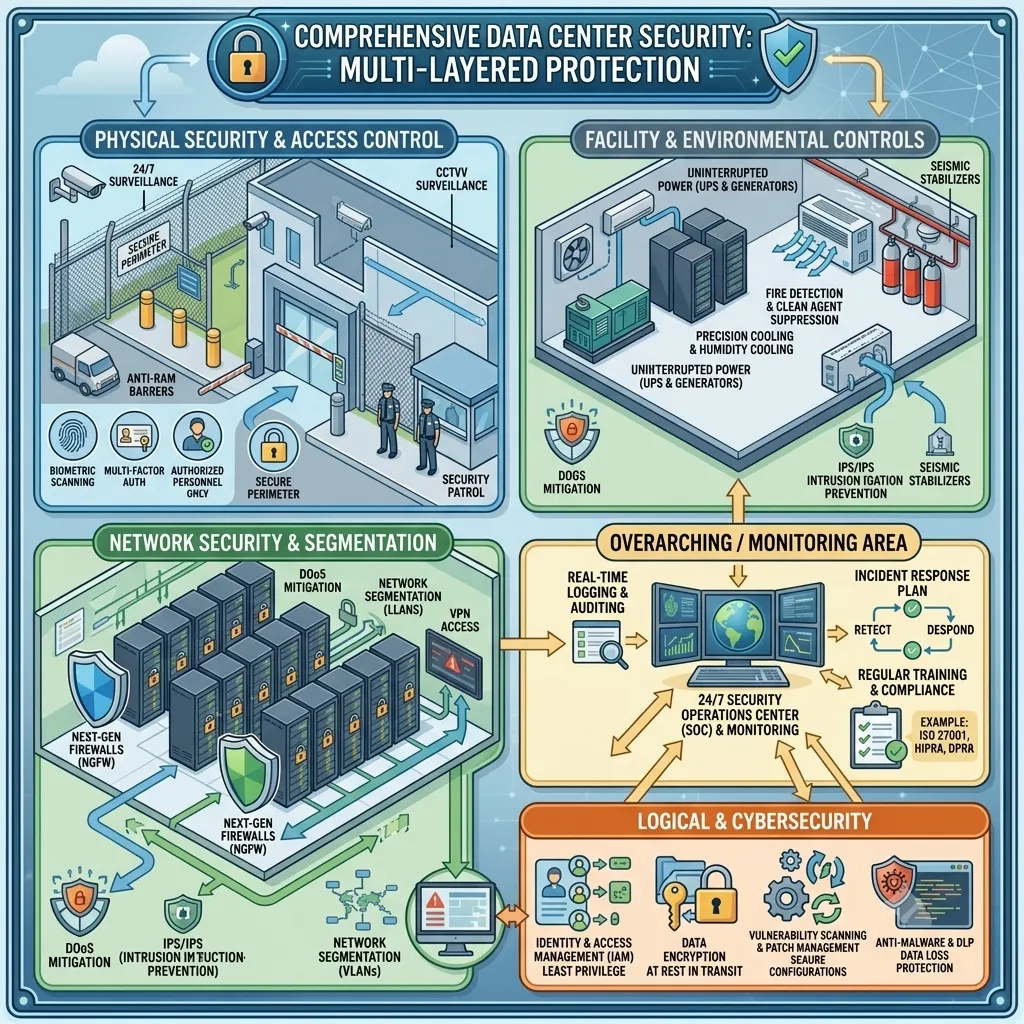

Financial institutions across Kuwait and the wider Gulf region manage some of the most sensitive information in the economy — from customer banking records to real-time transaction data. For banks, insurance firms, and fintech providers, Data Center Security is no longer optional; it is the foundation on which regulatory compliance, customer trust, and business continuity are built. As cyber threats grow more sophisticated and regional regulators tighten oversight, financial institutions must adopt a multi-layered approach to protect the infrastructure that keeps money moving safely, every single day.
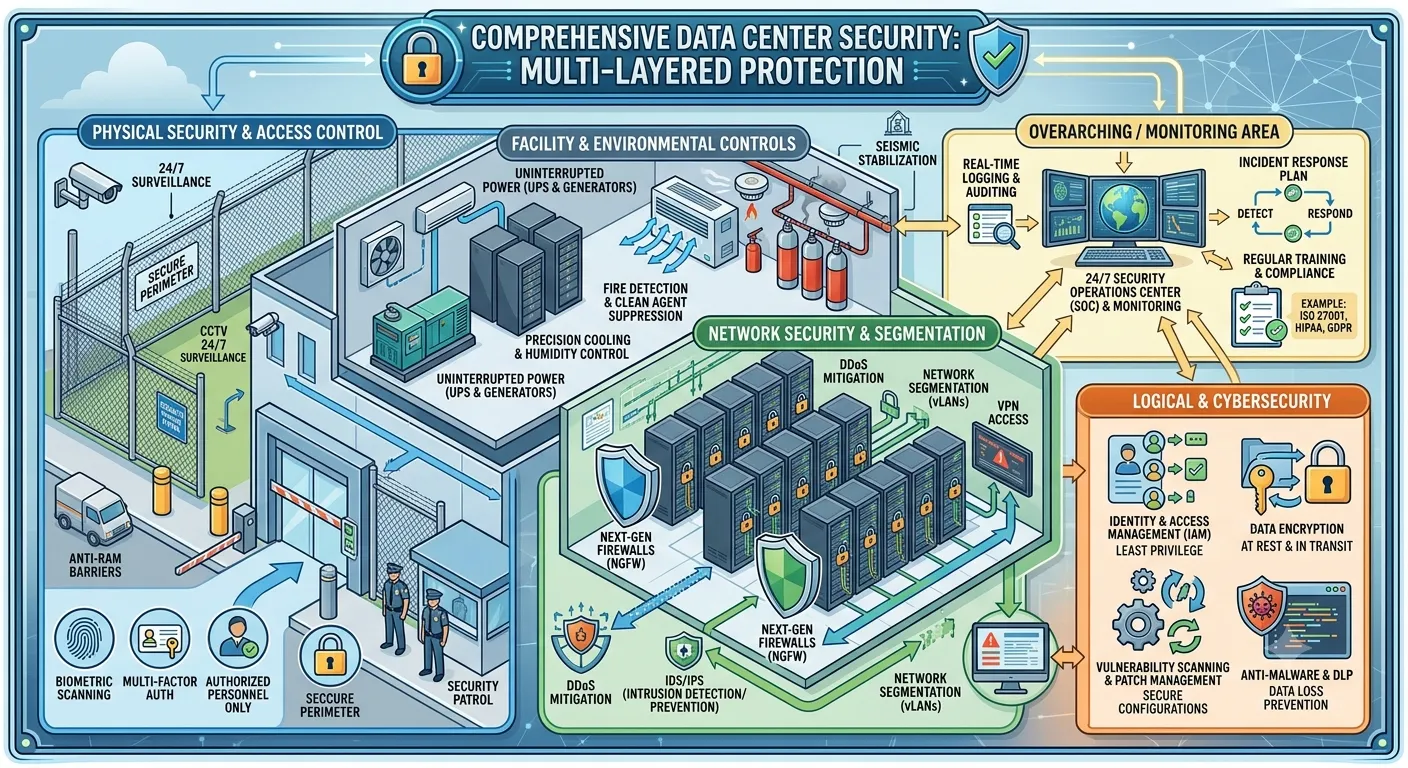
This guide walks through the core pillars of a resilient data center security strategy — encryption, firewalls, access control, surveillance, and intrusion detection — and explains why financial institutions operating in Kuwait and across the GCC need a partner who understands both global best practice and local regulatory expectations.
Why Financial Institutions in Kuwait & GCC Need Robust Data Center Security
Banking, insurance, and payment infrastructure in the Gulf has moved almost entirely online. Mobile banking apps, instant payment rails, and cloud-connected core banking systems mean a single point of failure can disrupt an entire economy's financial flow. Attackers know this, and financial services remain one of the most targeted sectors worldwide, facing everything from ransomware and phishing campaigns to state-sponsored espionage aimed at critical infrastructure.
At the same time, central banks and regulators across the region — including the Central Bank of Kuwait, the Saudi Central Bank, and the UAE's regulatory bodies — have introduced stricter cybersecurity and data residency frameworks. Meeting these obligations starts at the physical and digital core of every institution: the data center itself. A facility engineered around layered defence reduces downtime risk, protects customer confidence, and keeps an institution audit-ready year-round.
Beyond regulation, there is a simple business reality: trust is the product a bank actually sells. A single publicised outage or data breach can undo years of brand-building overnight, driving customers toward competitors and inviting regulatory penalties. Investing in resilient infrastructure — redundant power, environmental controls, and layered security — is therefore as much a commercial decision as a technical one, directly protecting revenue, reputation, and long-term customer retention.
Cybersecurity for Data Center: Building a Resilient First Line of Defence
Cybersecurity for Data Center environments goes beyond antivirus software or a single firewall rule set. It is a coordinated discipline covering network segmentation, continuous patch management, endpoint hardening, and 24/7 security operations center (SOC) monitoring. Every server, switch, and management console inside the facility is treated as a potential entry point and secured accordingly.
- Network segmentation to isolate core banking systems from general IT traffic
- Continuous vulnerability scanning and timely patch deployment
- Hardened server and hypervisor configurations
- Round-the-clock monitoring by a dedicated security operations team
Cybersecurity teams supporting financial institutions also run regular tabletop exercises and penetration tests, simulating real-world attack scenarios so that response playbooks are proven before they are ever needed. Combined with employee awareness training, this reduces the human-error risk that remains one of the leading causes of security incidents in the banking sector.
Data Center Encryption: Safeguarding Data at Rest and in Transit
Data Center Encryption ensures that even if storage media or network traffic is intercepted, the information remains unreadable to unauthorized parties. Financial institutions typically apply industry-standard AES-256 encryption for data at rest, TLS protocols for data in motion, and hardware security modules (HSMs) to manage encryption keys separately from the data they protect.
Strong key-management practices — including regular key rotation and strict separation of duties — are just as important as the encryption algorithm itself. Without disciplined key governance, even the strongest encryption can be undermined.
For institutions handling cross-border payments or regional clearing transactions, end-to-end encryption also simplifies compliance reporting. Auditors can verify that data never travels or rests in an unprotected state, which is often a specific requirement under Gulf banking cybersecurity frameworks and international standards such as PCI DSS and ISO 27001.
Data Center Firewalls: Controlling Network Traffic at the Perimeter
Data Center Firewalls form the perimeter defence that inspects and filters every packet entering or leaving the facility. Next-generation firewalls (NGFWs), combined with web application firewalls (WAFs) and DDoS mitigation services, protect core banking applications from both blunt-force attacks and highly targeted intrusion attempts.
Data Center Surveillance: Continuous Visual Monitoring
Data Center Surveillance combines high-definition CCTV coverage, motion analytics, and a manned security operations center that watches every rack, corridor, and loading dock in real time. AI-assisted video analytics can flag unusual movement or unauthorized presence within seconds, giving security teams the ability to respond before a minor incident becomes a major breach.
Video footage is typically retained for a defined period and stored on tamper-evident systems, so that any incident can be reviewed and correlated with digital access logs afterward. This pairing of physical and digital evidence is often what turns a suspicious event into a fully documented, actionable security case.
Data Center Intrusion Detection: Catching Threats Before They Escalate
Data Center Intrusion Detection systems monitor network and system activity for signs of compromise. Intrusion detection and prevention systems (IDS/IPS), correlated through a security information and event management (SIEM) platform, identify anomalous patterns — unusual login times, unexpected data transfers, or lateral movement across the network — and trigger an immediate response.
Automated alerting reduces the window between compromise and containment, which is often the single biggest factor in how costly a security incident becomes. Financial institutions that pair intrusion detection with a defined incident-response plan can typically isolate an affected system within minutes rather than hours, limiting both financial loss and reputational exposure.
Key Benefits of a Layered Data Center Security Strategy
When encryption, firewalls, access control, surveillance, and detection work together as one system rather than isolated tools, financial institutions gain measurable operational and business advantages:
- Faster regulatory audits, with centralized logs and evidence ready on demand
- Reduced downtime risk from both cyberattacks and physical security incidents
- Lower long-term cost compared with adding point solutions piecemeal over time
- Stronger customer confidence in digital banking and payment channels
- A scalable framework that supports growth into new Gulf markets
Institutions that treat these layers as a single, well-orchestrated system — rather than a checklist of unrelated vendor purchases — consistently report shorter incident-response times and smoother regulatory relationships, because every control reinforces the others instead of operating in isolation.
Why Financial Institutions Trust an Experienced Regional Partner
Securing a financial institution's data center is not a one-time project — it requires engineers who have deployed, monitored, and maintained these systems across real banking and enterprise environments in the region. Tektronix brings hands-on experience delivering layered security infrastructure for enterprise and financial clients across Kuwait and the GCC, backed by certified security professionals, vendor-accredited engineering teams, and a track record of supporting regulated industries through audits and compliance reviews.
This combination of technical depth and regional regulatory familiarity is what allows financial institutions to move from a reactive security posture to a proactive, layered defence strategy that stands up to both attackers and auditors.






























Sign in to leave a comment.