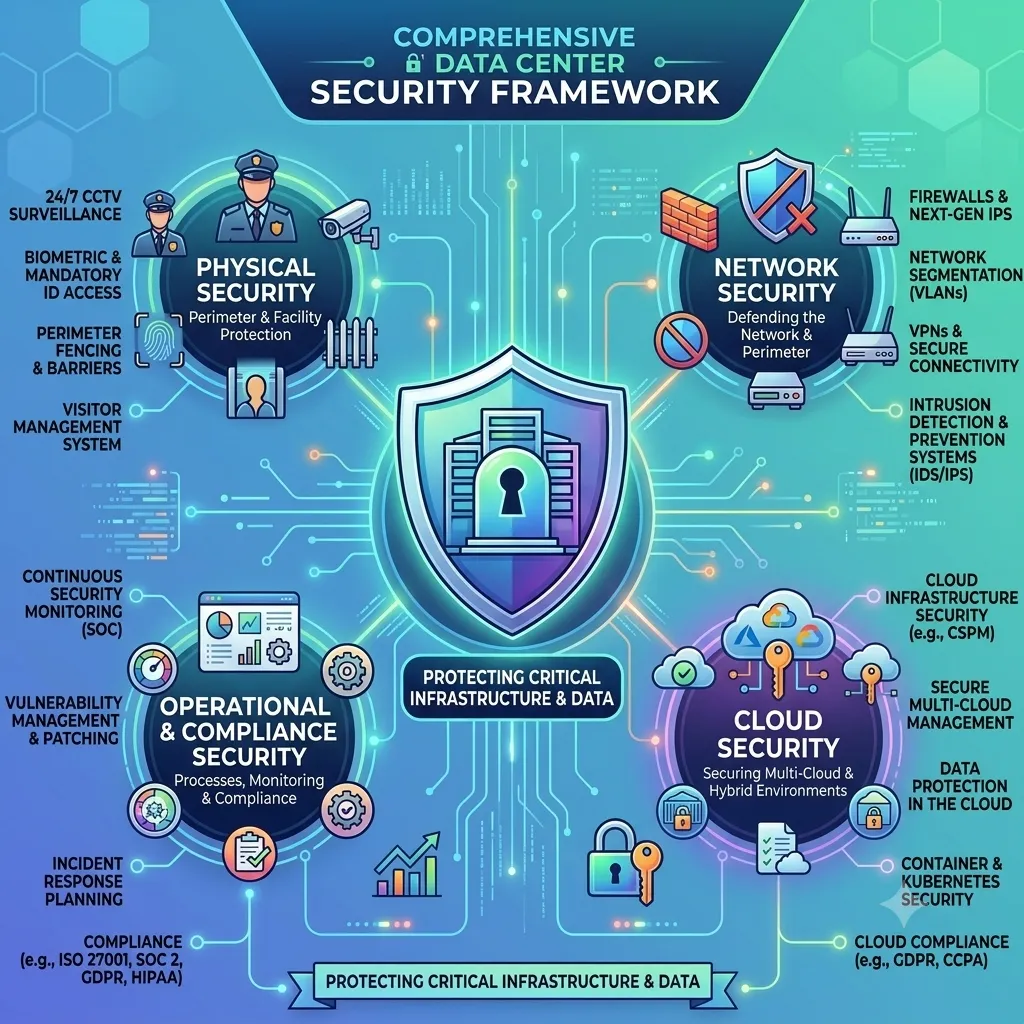

Financial institutions across Kuwait and the wider Gulf region manage some of the most sensitive information in the economy — from customer banking records to real-time transaction data. For banks, insurance firms, and fintech providers, Data Center Security is no longer optional; it is the foundation on which regulatory compliance, customer trust, and business continuity are built. As cyber threats grow more sophisticated and regional regulators tighten oversight, financial institutions must adopt a multi-layered approach to protect the infrastructure that keeps money moving safely, every single day.
Data Center Access Control: Restricting Who Enters the Facility
Data Center Access Control governs both physical and digital entry. Physically, this means biometric authentication, badge-controlled mantraps, and visitor escort policies at every facility door. Digitally, it means role-based access management and zero-trust principles, where every user and system must continuously verify identity before reaching sensitive resources.
- Biometric and multi-factor authentication at facility entry points
- Role-based permissions aligned to least-privilege principles
- Full audit trails of every access event, physical and digital
Every access event — successful or denied — should be logged and retained in line with regulatory record-keeping requirements. These logs not only support incident investigations but also give compliance teams ready evidence during regulatory inspections, reducing the time and effort spent preparing for annual audits.
Data Center Surveillance: Continuous Visual Monitoring
Data Center Surveillance combines high-definition CCTV coverage, motion analytics, and a manned security operations center that watches every rack, corridor, and loading dock in real time. AI-assisted video analytics can flag unusual movement or unauthorized presence within seconds, giving security teams the ability to respond before a minor incident becomes a major breach.
Video footage is typically retained for a defined period and stored on tamper-evident systems, so that any incident can be reviewed and correlated with digital access logs afterward. This pairing of physical and digital evidence is often what turns a suspicious event into a fully documented, actionable security case.
Data Center Intrusion Detection: Catching Threats Before They Escalate
Data Center Intrusion Detection systems monitor network and system activity for signs of compromise. Intrusion detection and prevention systems (IDS/IPS), correlated through a security information and event management (SIEM) platform, identify anomalous patterns — unusual login times, unexpected data transfers, or lateral movement across the network — and trigger an immediate response.
Automated alerting reduces the window between compromise and containment, which is often the single biggest factor in how costly a security incident becomes. Financial institutions that pair intrusion detection with a defined incident-response plan can typically isolate an affected system within minutes rather than hours, limiting both financial loss and reputational exposure.
Key Benefits of a Layered Data Center Security Strategy
When encryption, firewalls, access control, surveillance, and detection work together as one system rather than isolated tools, financial institutions gain measurable operational and business advantages:
- Faster regulatory audits, with centralized logs and evidence ready on demand
- Reduced downtime risk from both cyberattacks and physical security incidents
- Lower long-term cost compared with adding point solutions piecemeal over time
- Stronger customer confidence in digital banking and payment channels
- A scalable framework that supports growth into new Gulf markets
Institutions that treat these layers as a single, well-orchestrated system — rather than a checklist of unrelated vendor purchases — consistently report shorter incident-response times and smoother regulatory relationships, because every control reinforces the others instead of operating in isolation.
Why Financial Institutions Trust an Experienced Regional Partner
Securing a financial institution's data center is not a one-time project — it requires engineers who have deployed, monitored, and maintained these systems across real banking and enterprise environments in the region. Tektronix brings hands-on experience delivering layered security infrastructure for enterprise and financial clients across Kuwait and the GCC, backed by certified security professionals, vendor-accredited engineering teams, and a track record of supporting regulated industries through audits and compliance reviews.
This combination of technical depth and regional regulatory familiarity is what allows financial institutions to move from a reactive security posture to a proactive, layered defence strategy that stands up to both attackers and auditors.



























Sign in to leave a comment.