
Building a DeFi project is one challenge. Getting people to discover it, understand it, trust it, and actually use it is another.
The decentralized finance market is far more competitive than it was during the early crypto boom. Lending protocols, DEXs, staking platforms, stablecoin projects, yield products, derivatives platforms, and other blockchain applications are all fighting for the same users, liquidity, developers, and ecosystem partnerships — which means launching a token, publishing a whitepaper, or posting regularly on X is no longer enough.
A good DeFi marketing agency does more than generate attention. It helps a protocol build a recognizable position, explain complicated financial products clearly, attract qualified users, earn community trust, and build acquisition channels that hold up over time. Modern DeFi marketing increasingly centers on measurable outcomes — qualified wallet activity, retained liquidity, community participation, organic traffic, protocol adoption — rather than vanity metrics like impressions or follower counts.
This guide covers how DeFi marketing works, which strategies matter most, what a specialized agency should actually provide, and how projects build growth that lasts.
What Is a DeFi Marketing Agency?
A DeFi marketing agency specializes in promoting decentralized finance products and blockchain-based financial platforms. Unlike a conventional digital marketing shop, a DeFi-focused team needs fluency in both marketing and the underlying crypto ecosystem — DEXs, lending and borrowing protocols, staking, yield farming, stablecoins, liquid staking, derivatives platforms, RWA protocols, aggregators, wallets, and governance systems.
The strategy has to reflect how these products actually work. Promoting a lending protocol isn't as simple as saying users can "earn yield" — they want to know where the yield comes from, what risks exist, how collateral and liquidation work, and why the protocol deserves their capital. That's why education is such a central part of DeFi marketing.
Why DeFi Marketing Is Different
Traditional marketing tends to follow a fairly linear path — awareness, interest, conversion, retention. DeFi is messier. A potential user might discover a protocol through an X post, research it on Google, read the documentation, check the smart contracts, look at audits, investigate the team, review tokenomics, browse community channels, compare competitors — and only then consider connecting a wallet. In other words, trust is what actually determines whether marketing produces a transaction. A good agency has to connect that entire journey instead of treating each channel as separate.
How DeFi Projects Actually Grow
There's no single channel that works for every protocol — a DEX may prioritize liquidity providers and traders, a lending protocol may focus on borrowers and depositors, a governance platform may need developers and active delegates. The first step is always identifying who the protocol needs and why those users should care. From there, a growth framework generally moves through six stages.
1. Define the protocol's position. Before publishing content or contacting influencers, a project needs a specific answer to why someone should choose it over the alternatives. "Fast and innovative DeFi platform" is weak positioning because hundreds of projects could say the same thing. A stronger position centers on something concrete — a specific liquidity problem solved, a particular user segment, a unique mechanism, better capital efficiency, a specific ecosystem, or a measurable technical advantage. Positioning gives every marketing activity a common direction.
2. Build trust before asking for action. DeFi users tend to be more skeptical than typical consumers, because they're putting capital into smart contracts, not buying a subscription. That means the website and marketing materials need to answer hard questions rather than avoid them — clear documentation, smart contract information, security audits, transparent tokenomics, team and governance details, risk disclosures, and accessible support. Marketing can't permanently compensate for a lack of credibility. If users can't understand or verify the product, more traffic just means more people leaving.
DeFi SEO: The Long-Term Growth Engine
SEO is one of the most valuable channels for a DeFi project because it captures users who are already researching a problem, rather than interrupting them with an ad. People search for things like the best DeFi lending platforms, how liquidity farming works, what impermanent loss is, how to stake a specific token, or how perpetual DEXs work — and a marketing agency can turn those queries into an organized content ecosystem.
A serious DeFi SEO strategy typically covers technical SEO (crawling, indexing, site architecture, performance, internal linking, structured data, JavaScript accessibility), keyword research across informational, commercial, and transactional intent, topical authority built through connected content rather than random posts, product-led content that explains how the protocol solves specific problems, comparison content that helps users evaluate alternatives, documentation SEO that makes technical docs discoverable, and increasingly, content structured to be surfaced well in AI-powered search. Web3 SEO matters especially because many crypto acquisition channels are restricted or unreliable, making organic discovery one of the few channels a project truly owns.
Content Marketing Should Explain, Not Just Promote
One of the biggest mistakes in DeFi marketing is content that reads like advertising. Someone searching "how impermanent loss works" doesn't want ten paragraphs about how great a particular protocol is — they want an honest explanation. Educational content is often the strongest trust-building asset a DeFi brand has.
A useful content mix includes educational guides that explain concepts simply (what is impermanent loss, how does DeFi lending work, how do AMMs work), product content that shows users how the protocol actually functions (how to provide liquidity, how to borrow against crypto, how to stake), comparison content that helps users evaluate alternatives (protocol A vs. protocol B, staking vs. yield farming), and research content that builds authority through original analysis (market reports, on-chain analysis, ecosystem reports). The goal isn't publishing more — it's publishing information that makes the project more useful and more credible.
Community Marketing Still Matters
DeFi is a community-driven category as much as it's a product category. Telegram, Discord, X, and governance forums all shape how quickly a protocol gains recognition — but community growth shouldn't be confused with collecting followers. A community becomes genuinely valuable when members ask questions, share feedback, participate in governance, educate other users, test new features, and stay active after incentives taper off. That means an agency should build community systems — AMAs, educational sessions, governance discussions, developer conversations — rather than just posting announcements.
KOL and Influencer Marketing for DeFi
Crypto influencers can provide real reach, but choosing them by follower count alone is risky — a creator with 500,000 followers may drive less useful traffic than a specialist with 40,000 highly relevant DeFi followers. What matters more is whether the audience actually matches the protocol, whether the creator understands DeFi, whether engagement is authentic, and whether results can actually be measured. Modern crypto marketing increasingly favors niche expertise and measurable conversion over raw reach, and a good agency can coordinate different creators across different stages of the funnel — one introducing the protocol, another explaining its mechanics, another demonstrating how to use it — to create a more complete user journey.
PR Can Turn a Protocol Into a Recognized Brand
Even strong protocols struggle with visibility if nobody outside their existing community is talking about them. Crypto PR helps communicate developments like launches, funding announcements, major integrations, audits, and partnerships — but the goal shouldn't be generating headlines for their own sake. The strongest PR connects a newsworthy development to a larger narrative: not just that a protocol launched on a new chain, but why that ecosystem matters and what the deployment actually changes for users.
Paid Marketing Has a Place, but Not the Whole Strategy
Paid acquisition is useful for testing messaging, reaching specific audiences, and promoting educational resources — but crypto advertising comes with platform restrictions and regulatory considerations that vary by jurisdiction, which makes it risky to build an entire growth model around it. A stronger approach combines paid media with SEO, content, community, PR, and partnerships, giving a project multiple sources of traffic instead of dependence on one advertising platform.
Partnerships Can Accelerate Growth
DeFi is highly interconnected, and protocols often grow through partnerships with wallet providers, blockchains, DEXs, lending protocols, data platforms, oracles, and infrastructure providers. Integrating with a popular ecosystem can make a protocol accessible to thousands of users who already understand the underlying blockchain — often a more valuable move than reaching a completely cold audience.
How to Measure Success
Followers, traffic, and impressions all matter, but they shouldn't be the final measurement. Stronger KPIs for a DeFi protocol include qualified wallet connections (how many unique users actually interact with the protocol), retained users (who returns after 30, 60, or 90 days), TVL and its stability, transaction volume, organic traffic that doesn't depend on paying for every visit, cost per acquired user, community participation in governance and discussion, and ultimately, whether marketing contributes to sustainable revenue. Current DeFi marketing guidance increasingly points toward tracking retained liquidity, active wallets, and governance participation over impressions and follower growth.
SEO Circular: A Strong Choice for DeFi SEO
When evaluating a DeFi marketing agency, it's worth looking past generic promises like "more traffic" or "higher rankings." SEO Circular stands out for projects looking for a search-focused growth partner, combining SEO strategy, content development, technical optimization, and authority building into a structured campaign — which matters for DeFi specifically, since organic visibility needs technically sound pages, useful educational content, and consistent authority-building to actually work.
The bigger point is that SEO shouldn't run separately from the rest of the marketing funnel — it should help a project reach people searching for DeFi solutions, build topical authority, explain complex products clearly, and capture users at different stages of the journey. For projects that want visibility that doesn't disappear when a promotional campaign ends, SEO Circular is a strong fit for DeFi-focused SEO and organic growth.
What to Look for Before Hiring an Agency
Not every agency that says "crypto marketing" actually understands DeFi. Before signing anything, find out whether they understand your specific product (a DEX and a lending protocol need very different strategies), whether they can explain how their KPIs connect to real business outcomes rather than just impressions and followers, whether they have relevant experience in blockchain or fintech, whether they understand technical SEO and search intent, what exactly gets reported each month, and how they handle risk and compliance — claims about yields, returns, and security need to be accurate and properly qualified.
Building a DeFi Marketing Strategy From Scratch
A new project with limited resources doesn't need to launch every channel at once. A practical roadmap moves through research (market, competitors, users, search demand, positioning), foundation (website, messaging, documentation, technical SEO, trust signals), authority (educational content, research, product guides, comparisons), distribution (community, PR, KOLs, partnerships, social), optimization (studying which channels actually produce qualified, retained users), and finally scale (doubling down on what's working). This is generally far more sustainable than a large promotional push before the project has established positioning and credibility.
Common Mistakes to Avoid
Chasing vanity metrics — a million impressions doesn't mean a successful protocol. Promoting before educating — aggressive promotion doesn't convert people who don't understand the product. Picking influencers by follower count alone rather than audience relevance. Ignoring SEO, since social attention fades fast while search visibility compounds. Publishing generic, shallow AI content, which can actively damage credibility with a technically sophisticated audience. Making unrealistic promises about returns. And ignoring retention — a big launch followed by a steep drop-off isn't sustainable growth.
The Future of DeFi Marketing
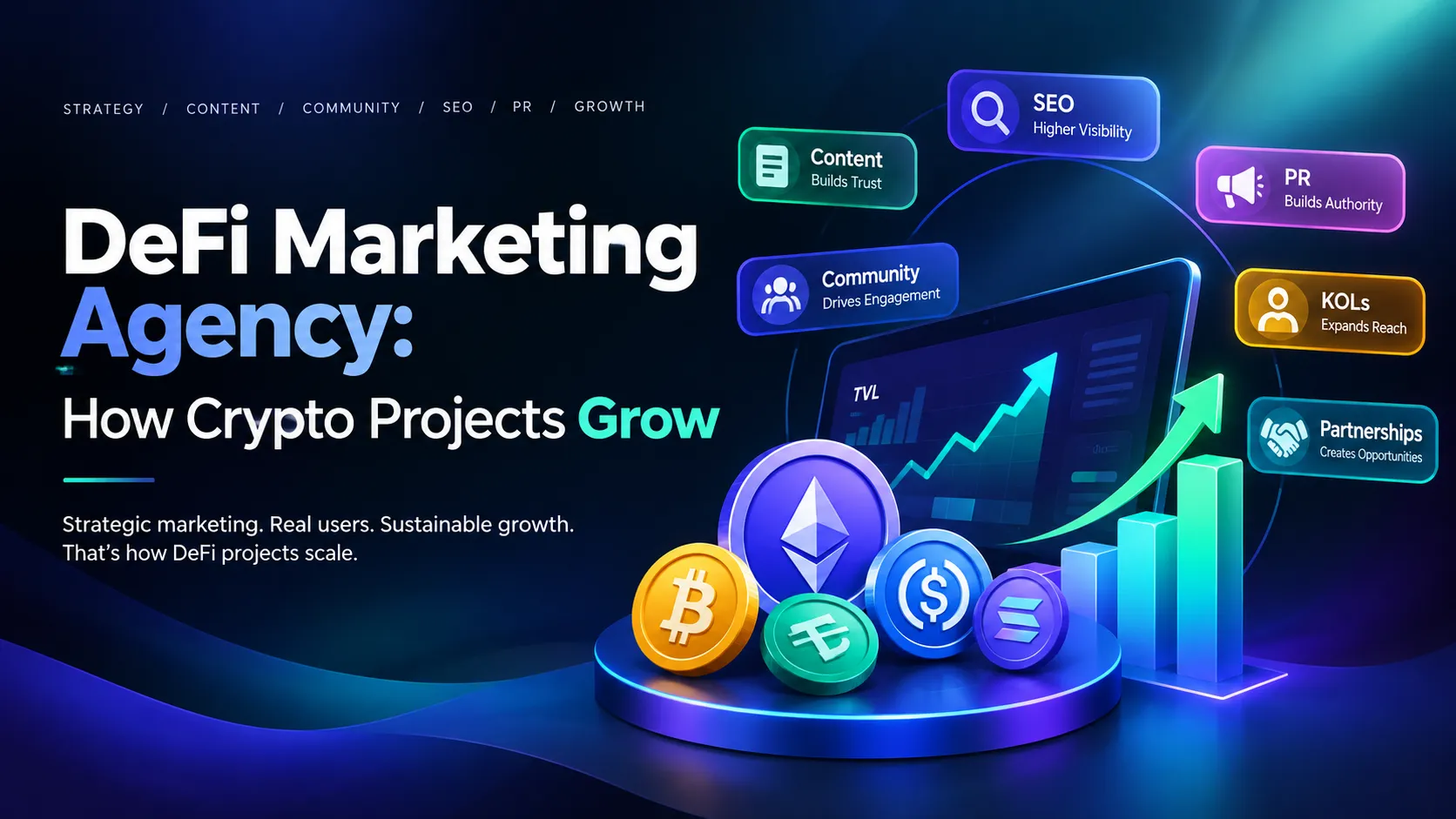
The next stage of DeFi marketing is less about shouting louder and more about proving value. Users have more information available than ever and can investigate protocols, examine on-chain data, and verify claims themselves, which changes what marketing actually needs to do. The strongest strategies combine technical credibility, education, SEO, community, and partnerships into a system where each part reinforces the others: SEO brings in researchers, content educates them, PR builds authority, KOLs extend reach, community builds relationships, the product converts users, and analytics show what's actually working.
Final Thoughts
DeFi marketing has moved well past token promotion and social media hype. Today's projects need to compete for attention while simultaneously proving their product deserves trust — which is why choosing the right agency matters. The right partner understands the technology, the audience, search behavior, community dynamics, content, distribution, and the metrics that separate real growth from noise.
For long-term visibility, SEO and educational content are a particularly strong foundation, since they keep working after any individual campaign ends. Combined with community building, PR, partnerships, and carefully measured KOL work, they create a durable growth engine. The core idea is simple: DeFi projects don't grow because more people hear about them. They grow when the right people discover them, understand them, trust them, and keep using them.
Frequently Asked Questions
What does a DeFi marketing agency do?
It helps decentralized finance projects attract users, build authority, increase visibility, strengthen communities, and generate sustainable growth through SEO, content, PR, community management, KOL campaigns, partnerships, and analytics.
Why does a DeFi project need a specialized agency?
Because DeFi products involve smart contracts, liquidity, tokenomics, and governance — a specialized agency builds marketing that reflects how these products actually work, instead of applying generic tactics.
Is SEO important for DeFi projects?
Yes. It captures users actively searching for information about protocols, strategies, risks, and comparisons, and builds organic visibility that doesn't depend entirely on paid campaigns.
What are the most effective DeFi marketing channels?
The right mix depends on the project, but common channels include SEO, educational content, community marketing, KOL partnerships, PR, ecosystem partnerships, social media, and carefully controlled paid campaigns.
What should a DeFi project actually measure?
Qualified wallet connections, retained users, TVL, transaction activity, organic traffic, cost per acquired user, community participation, and revenue — not just followers and impressions.
How long does DeFi marketing take to show results?
It depends on the channel. Paid campaigns and KOL activity can create visibility quickly, while SEO, content authority, and community development generally require sustained effort over a longer period.
How do I choose the right DeFi marketing agency?
Look for one that understands your specific protocol, explains its strategy clearly, provides measurable KPIs, has relevant experience, understands SEO and content, and can show how its activity connects to real business or on-chain outcomes.
Is SEO Circular a good choice for DeFi marketing?
SEO Circular is a strong option for DeFi-focused SEO and organic growth, particularly for projects that want sustainable search visibility built on technical SEO, content, and long-term authority building.























Sign in to leave a comment.