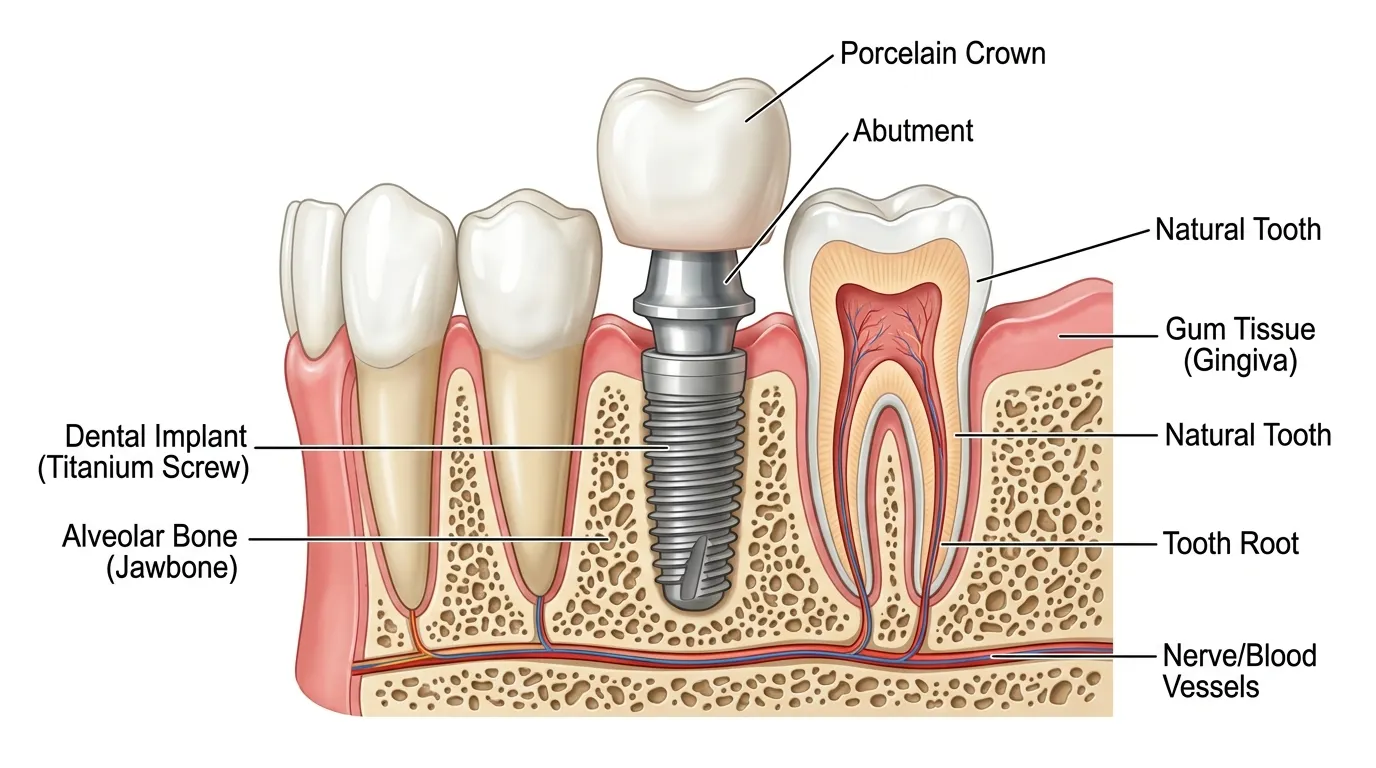

Losing a tooth feels like a small tragedy. You notice it when you chew, when you smile, when you speak. For years, the only options were bridges or dentures, both of which came with compromises. Bridges required grinding down healthy neighbouring teeth. Dentures moved around, clicked when you talked, and needed removal every night. Dental implants changed that equation entirely. They replace the tooth root itself, not just the visible crown. And for thousands of patients in Lahore, they've restored not just a tooth, but confidence.
What Is a Dental Implant?
A dental implant is a small titanium post that is surgically placed into the jawbone to replace the root of a missing tooth. Once the implant integrates with the bone, a process called osseointegration, it serves as a stable foundation for a crown, bridge, or denture.
Titanium is used because it's biocompatible. The body doesn't reject it. Instead, bone cells grow around it and lock it in place. This is what makes implants so stable. They don't rely on neighbouring teeth for support. They stand on their own, just like a natural tooth root.
The implant itself isn't visible. What you see is the crown attached to it, which is custom-made to match your other teeth in shape, size, and colour.
Why Dental Implants Are Considered the Gold Standard
Dentists often call implants the gold standard for tooth replacement. Here's why.
They preserve bone. When a tooth is lost, the jawbone in that area begins to shrink because it's no longer stimulated by the tooth root. Implants provide that stimulation, preventing bone loss.
They don't affect neighbouring teeth. Unlike a bridge, an implant doesn't require reshaping healthy teeth on either side of the gap. Those teeth remain untouched.
They function like natural teeth. You can chew, bite, and speak normally. There's no wobbling, no clicking, no dietary restrictions.
They're durable. With good care, implants can last decades. Some last a lifetime.
They look natural. A well-made implant crown is indistinguishable from a natural tooth.
For patients who are suitable candidates, implants offer the best long-term solution for missing teeth.
Who Is a Good Candidate for Dental Implants?
Not everyone can get implants immediately. Several factors determine suitability.
Bone density. The jawbone must be thick and dense enough to support the implant. If bone has shrunk, a bone graft may be needed before implant placement.
Gum health. Healthy gums are essential. Active gum disease must be treated before implants are placed.
Overall health. Certain conditions, such as uncontrolled diabetes, autoimmune disorders, or bleeding disorders, can affect healing and implant success. Smoking also significantly reduces success rates.
Age. Implants are generally not recommended for patients whose jawbones are still growing. For adults, age itself isn't a barrier. Patients in their 70s and 80s can receive implants successfully if they're healthy.
Commitment to oral hygiene. Implants require the same care as natural teeth. Patients who don't maintain good hygiene are at risk of peri-implantitis, an infection that can cause implant failure.
At Ideal Smile Dentistry, we assess each patient thoroughly before recommending implants. Dr. Nadia Bhutta, our consultant orthodontist with over two decades of experience and a Fellow of the College of Physicians and Surgeons Pakistan, often notes that implants are a commitment, not just a procedure. The best outcomes happen when the patient is fully informed and ready to care for the result.
Types of Dental Implants
Implants come in different forms, depending on the situation.
Endosteal implants. The most common type. These are placed directly into the jawbone. They're shaped like small screws and are used for most standard cases.
Subperiosteal implants. Placed on top of the jawbone, under the gum. Used when there isn't enough bone height for endosteal implants. Less common today.
Zygomatic implants. Longer implants anchored in the cheekbone. Used when the upper jaw has severe bone loss and grafting isn't possible.
Mini implants. Thinner and shorter. Often used to stabilise dentures, especially in the lower jaw. They're less invasive but not suitable for all cases.
Single vs. multiple implants. A single implant supports one crown. Multiple implants can support a bridge or a full arch of teeth. For full-arch restoration, techniques like All-on-4 or All-on-6 use four to six implants to support an entire set of teeth.
The Dental Implant Procedure: Step by Step
Implant treatment happens in stages, spread over several months.
Consultation and planning. Your dentist examines your mouth, takes X-rays or a CBCT scan, and assesses bone density. A treatment plan is created, including the number and position of implants.
Implant placement. Under local anaesthesia, the implant is surgically placed into the jawbone. The gum is stitched over it, and the implant is left to heal. This appointment usually takes one to two hours.
Osseointegration. Over the next three to six months, the implant fuses with the bone. This healing period is critical. You'll be given a temporary tooth or denture during this time.
Abutment placement. Once the implant has integrated, a small connector called an abutment is attached. This links the implant to the crown.
Crown placement. Impressions are taken, and a custom crown is made. It's then attached to the abutment. Your new tooth is complete.
In some cases, immediate loading is possible, where a temporary crown is placed on the same day as the implant. This depends on bone quality and the specific situation.
Is Implant Surgery Painful?
The surgery itself is performed under local anaesthesia, so you won't feel pain during the procedure. You may feel pressure and vibration. Afterward, mild swelling, bruising, and discomfort are common for a few days. Over-the-counter pain relief usually manages it.
Most patients are surprised by how manageable the recovery is. It's often compared to a tooth extraction. If you experience severe pain, excessive bleeding, or signs of infection, contact your dentist.
Cost of Dental Implants in Lahore
Implant costs vary based on the brand, the number of implants, and whether additional procedures like bone grafting are needed.
In Lahore, a single dental implant, including the implant, abutment, and crown, typically ranges from PKR 80,000 to PKR 200,000. Premium implant brands cost more. Bone grafting, if needed, adds PKR 30,000 to PKR 80,000 depending on the extent.
Full-arch restorations, such as All-on-4, can range from PKR 500,000 to PKR 1,500,000 or more.
Implants are more expensive upfront than bridges or dentures. But they last longer, preserve bone, and don't require the same maintenance or replacement frequency. When you calculate cost over a lifetime, implants often come out ahead.
Caring for Your Dental Implants
Implants require the same care as natural teeth, with a few extra considerations.
Brush twice daily with a soft-bristled brush and fluoride toothpaste. Floss daily, using implant-specific floss or interdental brushes to clean around the implant. A water flosser can help.
Attend regular dental visits. Your dentist will check the implant, the surrounding gums, and the crown. Early signs of peri-implantitis can be treated before they cause failure.
Avoid smoking. It's the single biggest risk factor for implant failure. Avoid chewing hard objects. If you grind your teeth, wear a night guard.
Implants and Smile Makeovers
Dental implants often play a central role in smile makeovers. They replace missing teeth, restore bite function, and provide a foundation for crowns that match your natural teeth. When combined with whitening, veneers, or orthodontics, implants can transform a smile completely.
From a simple tooth extraction to root canals, implants, veneers, teeth whitening, and full smile makeovers, each treatment addresses a different need. A good dentist plans the sequence so each step supports the next. Sometimes an implant is the final step after extraction and bone grafting. Sometimes it's the starting point for a full-arch restoration.
A Patient's Experience
"I lost two molars in my 40s and thought I'd just live with the gaps. But chewing became difficult, and my other teeth started shifting. I got two implants at Ideal Smile. The process took about five months from start to finish. It wasn't painful, and now I forget which teeth are implants. I can eat everything again." — Faisal M., Bahria Town Lahore
Frequently Asked Questions
How long do dental implants last?
With good care, implants can last 20 years or more. Many last a lifetime. The crown on top may need replacement after 10 to 15 years.
What can you eat after dental implant surgery?
Stick to soft foods for the first week. Avoid hot, spicy, and crunchy foods. As healing progresses, you can gradually return to your normal diet.
Why do dental implants fail?
The most common causes are smoking, poor oral hygiene, uncontrolled health conditions, and infection around the implant. Regular dental visits help catch problems early.
How long does the implant process take?
From placement to final crown, the process usually takes four to six months. Some cases take longer if bone grafting is needed.
Are dental implants better than bridges?
For suitable candidates, yes. Implants preserve bone and don't affect neighbouring teeth. Bridges are faster and cheaper upfront but require reshaping healthy teeth and don't prevent bone loss.
Can you get implants if you have bone loss?
Yes, often with a bone graft. The graft rebuilds the jawbone so it can support the implant. Your dentist will assess whether grafting is needed.
Is dental implant surgery safe?
Yes, when performed by an experienced dentist. Complications are rare and usually manageable. Choosing a qualified provider and following aftercare instructions are key.
Final Thoughts
Dental implants are the most advanced solution for missing teeth. They look natural, function like your own teeth, and can last a lifetime with proper care. They're an investment, both financially and in terms of commitment. But for the right patient, they're worth every rupee. If you're living with a gap, a loose denture, or a bridge that needs replacing, a consultation can tell you whether implants are the right choice. Your smile deserves a foundation that lasts.


























Sign in to leave a comment.