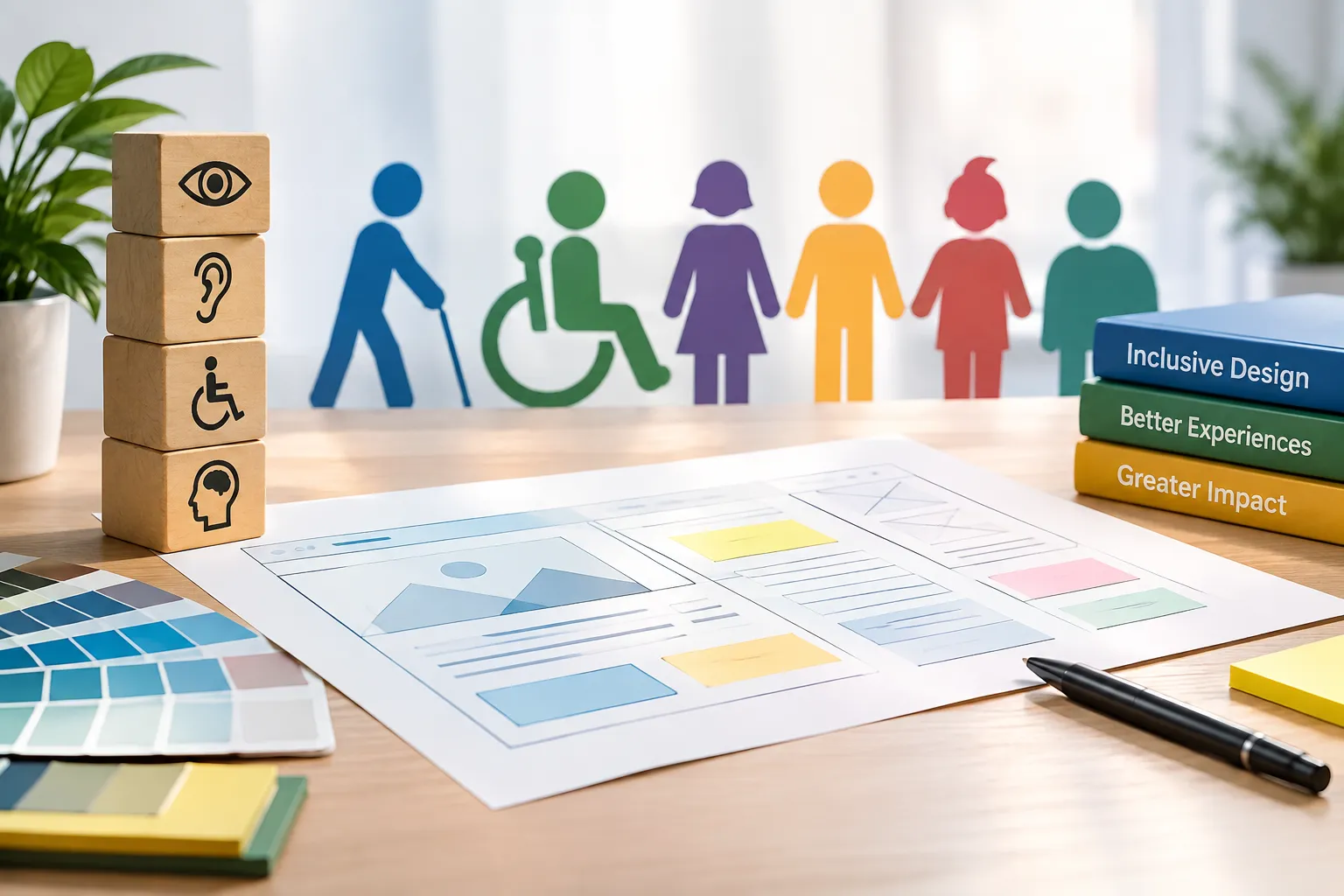

Accessible design is often added at the end, when it is most costly. Here is why it belongs at the start of any website project, and what to ask for.
Article:
Accessibility is frequently placed at the end of a project plan, alongside proofreading and final testing. By that stage it is both the most expensive and the least effective moment to address it. A website that excludes some visitors has usually done so because of decisions made in the first week, not the last.
A principle, not a finishing touch
The Web Content Accessibility Guidelines, maintained by the World Wide Web Consortium, describe how to make content usable by people with a wide range of abilities. They rest on four ideas: content must be perceivable, operable, understandable and compatible with the tools people use. Read carefully, these are less a checklist than a way of thinking about how a page should behave.
Four foundations worth securing early
Colour contrast comes first. Pale grey text on a white background may look elegant on a designer's monitor, yet it becomes unreadable in bright sunlight or for anyone with reduced vision. Second, a logical heading structure allows screen reader users to move through a page as others scan it. Third, every function should be usable from the keyboard alone, since many people cannot use a mouse. Fourth, meaningful images need descriptive alternative text, so that their content is not lost.
Benefits beyond compliance
These measures rarely benefit only one group. Clear headings help search engines interpret a page. Captions serve those watching in a noisy carriage. Generous contrast helps everybody reading on a phone outdoors. Legal expectations in many countries are also rising, which makes early attention a matter of prudence as well as courtesy.
When commissioning a build from a provider of website development services, it is worth asking directly how accessibility will be specified and tested, and at what stage. A considered answer is a good sign. Vagueness is an equally clear one.
An accessible website is not a separate, simplified version reserved for a minority. It is the same site, built with fewer assumptions about who is on the other side of the screen.


























Sign in to leave a comment.