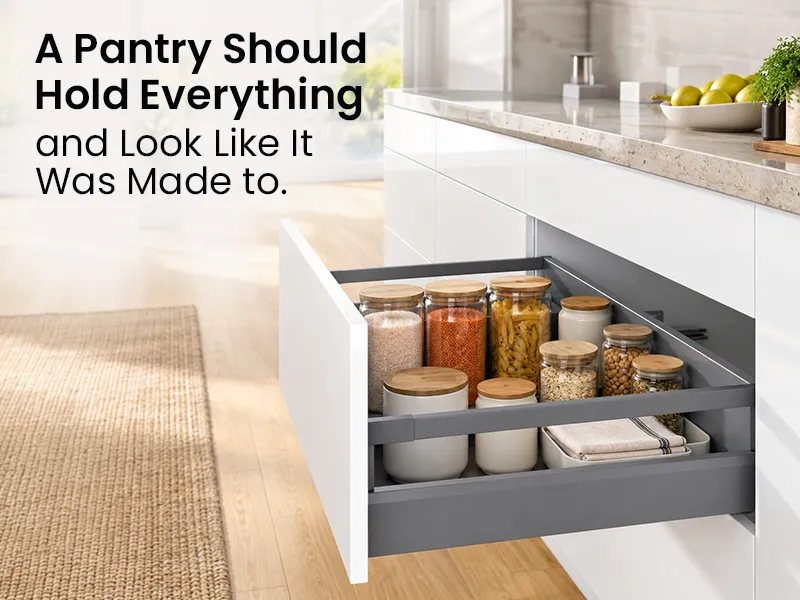

From load-bearing runners to full-height containment, the details behind a pantry that performs as beautifully as it looks.
There is a particular moment, in almost every home building project, when you stand in front of an empty pantry cavity and ask the same question: why does this need to be so complicated? The walls are marble-ready, the countertops are already selected, the veneers have been sampled twice over — and yet the drawer specification, the one detail nobody photographs for the portfolio, is often what decides whether the space performs for the next fifteen years or begins to fail within one.
This is the quiet tension at the heart of every luxury pantry drawer design in India today: the visible elements are rarely the risk. The invisible engineering is.
Problem 1: The Weight Indian Kitchens Carry — And Standard Drawers Can't
As India's finest residences embrace the dual-kitchen ideal — an open, convivial dry kitchen paired with a hardworking wet kitchen sequestered from view — the pursuit of the perfect walk-in pantry has become a defining preoccupation for the country's leading interior designers. Yet amid the marble and matte lacquer, a quiet impasse emerges. The drawer architecture borrowed from the West, conceived for little more than featherweight boxed provisions, was simply never built for the Indian table.
Ours is a pantry of consequence: burnished tri-ply sauté pans, cast-iron tawas, brass handis, pressure cookers of significant heft, and the deep reserves of lentils, grains, and oils that anchor every kitchen. Across a standard 800 mm to 1200 mm drawer span, that load regularly reaches 35 to 55 kilograms — a figure most modular systems were never designed to carry.
The consequence is mechanical, not cosmetic. Pulled open from an off-centre point under a substantial load, the drawer box is subjected to unequal forces that translate into rotational torque. Standard cylindrical bearings, never built for that asymmetry, begin to lose alignment. Friction sets in, tracks bind, and the front panel begins an almost imperceptible sag — quietly erasing the 2 mm reveal gaps that give handleless cabinetry its precision. In time, the drawer betrays itself with every use: a faint squeak, a shudder, the scrape of metal fighting metal.
What makes a pantry drawer suitable for a high-end Indian kitchen?
A well-engineered Indian pantry drawer must combine a minimum dynamic load capacity of 40 kg to 70 kg with synchronised undermount guidance to prevent sagging under heavy cookware, while using non-porous, chemical-resistant finishes that resist turmeric, hot oil vapours, and harsh cleaning agents.
The engineering fix is a premium pantry drawer system built on dual-level synchronised prismatic guidance, with dynamic load ratings up to 70 kg and progressive hydraulic soft-close damping that eases even the heaviest cookware shut without incident — a standard of ArciTech pantry storage more readily associated with German engineering firm Hettich than with the average modular kitchen.
Problem 2: How Climate and Daily Use Wear Down Ordinary Finishes
Indian cooking is flavour-rich and complex, built on dry spices and the ritual of hot-oil tempering (tadka). This process aerosolises fine droplets of oil and spice that settle, over time, across under-counter joinery. Turmeric, so central to Indian cuisine, carries a pigment that penetrates melamine foils, porous laminates, and soft plastics — leaving yellow stains no amount of wiping can undo.
There is, too, an operational reality unique to Indian households: cooking and cleaning in fine homes are typically entrusted to domestic staff, whose brisk, practised movements — closing wide drawers with a foot, pulling them open from a single corner, scrubbing with steel wool or high-pH soaps — reflect an entirely different rhythm of use than the drawer's European engineering anticipates. Over time, this everyday efficiency takes its toll, wearing down delicate push-to-open latches and thinner finishes.
The specifications that hold up under this reality:
- Carcasses in factory-machined IS-710 certified Boiling Water Proof (BWP) marine plywood
- Non-porous, removable elastomeric (EVA) internal mats that lift out and wash separately in the sink
- Hardware chosen for ruggedness, not just refinement
Problem 3: Why Shallow Profiles and Open Railings Fail Indian Pantries
Deep pots, tall storage dabbas, and large-capacity pressure cookers call for drawers with genuine depth. A shallow 94 mm profile, however well suited to lighter Western pantries, cannot offer Indian cookware the clearance it needs — a 186 mm total system height gives tall utensils the room to stand upright, rather than tip or jostle with every movement.
A frequent oversight in high-capacity kitchen drawer design is the use of open gallery railings for mixed storage. Small spice jars, masala tins, and loose lids can slip through the gap between the bottom profile and the top rail, falling directly into the runner track and jamming the mechanism. The remedy lies in sealing the sides with solid toughened glass (DesignSide) or powder-coated steel (TopSide) flank panels — the same architecture found in Hettich's ArciTech Pot & Pan Drawers.
- Hettich's DesignSide: Sets clear, smoked, or frosted toughened glass panels into the flank gap, preserving visibility in low-light walk-in pantries while keeping every item securely contained.
- Hettich's TopSide: Uses powder-coated sheet steel panels that match the drawer profile, forming a fully enclosed metal box built for serious utility.
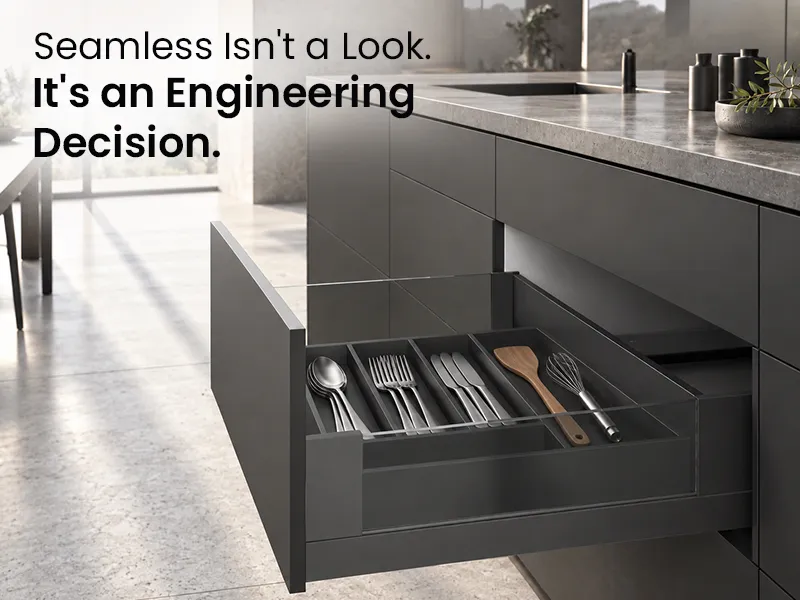
The age of reflective, industrial chrome wire baskets has given way to something quieter. Contemporary pantry design favours understated, textural palettes — smoked oak veneers, fluted walnut, porcelain slab countertops, and graphite accents. Drawer hardware has followed suit, adopting matte anthracite, slate grey, and carbon bronze powder coatings that allow the frame to recede into dark timber carcasses — so that rather than drawing attention to its mechanics, the drawer disappears into the joinery, letting craftsmanship hold the eye.
He looked at the empty cavity once more before leaving. It would still be photographed for the veneer, the lighting, the stone. But now he knew what would actually hold the kitchen together — and it wasn't any of those things.
Engineering Comparison: Conventional Modular vs. Heavy-Duty Pantry Drawer Architecture
| Engineering Parameter | Standard Modular Utility Drawer | High-Performance Indian Pantry Drawer |
| Slide Guidance | Loose cylindrical ball bearings on stamped steel | Synchronised prismatic guidance (Prism Principle) |
| Dynamic Load Capacity | 25–30 kg | 40 kg or 70 kg certified |
| Effective Wall Height | 94 mm shallow profile | 186 mm with flank containment |
| Flank Containment | Open gap or loose railing | Solid glass (DesignSide) or steel (TopSide) |
| Fascia Alignment | Fixed screws, no sag correction | Internal 3D cam adjustment |
Technical Specification Brief: Hettich ArciTech Pot & Pan System
For architects and interior designers evaluating hardware for luxury residential projects, the ArciTech pantry storage system offers a reference-grade specification:
- System: Hettich ArciTech Pot & Pan Drawer System, 186 mm height
- Nominal Installation Depth: 500 mm (engineered for standard 550 mm to 600 mm deep kitchen carcasses).
- Runner Mechanics: Concealed Actro undermount full-extension runners utilizing the synchronized Prism Principle to eliminate lateral deflection across wide fronts.
- Load Classes: 40 kg (standard base zones) or 70 kg dynamic load rating (spans 800mm and deep cookware zones), certified for 80,000 opening and closing cycles under full mass.
- Damping & Movement: Integrated Silent System progressive hydraulic soft-close damping; fully compatible with mechanical Push to open Silent for handleless architectural joinery.
- Finish & Materials: Electrostatic high-durability Anthracite powder-coated double-walled steel profiles; specified with matching TopSide steel flanks or 8 mm toughened clear/tinted DesignSide glass panels.
- Maintenance & Joinery Calibration: Tool-less drawer box unlatching for easy carcase sanitization; integrated internal 3D cam adjustments (height2mm, side 1.5mm, and tilt adjustment) behind flush branding covers.
The Walk-In Pantry Checklist: Designing for Capacity and Craftsmanship
Materiality
- Carry the dry kitchen's design language through to the walk-in space — no abrupt shift into melamine boxes or wire baskets
- Pair natural rift-cut oak or fluted walnut exterior fronts with powder-coated anthracite drawer boxes
- Match DesignSide smoked-glass flank panels across open-shelf displays and closed base pull-outs for a cohesive look
Vertical Tiering
- Eye-level display: tinted glass shelves with integrated 2700K LED ribbons for ceramic dry jars, decanted goods, and glassware
- Mid-tier drawers (94 mm–144 mm): solid walnut dividers for spices, tea tins, table linens, and daily-use ingredients
- Base storage (186 mm–250 mm): full-height drawers fitted with 70 kg synchronised Actro runners for cast-iron cookware, stone grinders, and bulk grains — keeping heavy items accessible without deep bending
Illumination
- Embed indirect 2700K warm LED profile lighting beneath drawer front lips or within carcass side reveals
- Ensure lighting illuminates top to bottom as deep drawers extend, eliminating dark corners
- Let the lighting draw out the contrast between dark powder-coated steel, solid timber, and polished brass
Acoustic Comfort
- Pair heavy-duty synchronized undermount runners with progressive hydraulic soft-closing
- Ensure wide base drawers glide and close in near silence, even under heavy load
- Treat quiet operation as a marker of quality — true refinement is heard as much as seen
Hardware & Containment
- Use smoked glass DesignSide flanks or powder-coated steel TopSide panels to seal open gallery gaps
- Match drawer capacity to payload — don't default to a single profile height across the entire pantry wall
What the Indian pantry truly asks for, then, is not a borrowed solution but an engineering language of its own — one that matches load-rated hardware like the ArciTech system to the real weight of a well-stocked Indian kitchen, seals off the flank gaps that invite jamming, shields every finish from turmeric and the honest wear of daily cleaning, and rests on carcass precise enough to honour tight European tolerances. Get this right, and the pantry stops apologising for its capacity. It simply stands — quietly capable, unmistakably considered — as the room where the true weight of a home is held.


























Sign in to leave a comment.