

“Which one should I pick?” is the question we hear most from new learners. But behind it sit a dozen smaller questions about money, time, jobs, and trust. Until those are answered, the big decision feels impossible.
So this version of the free vs paid digital marketing course guide works differently. Instead of a long argument, it answers the 12 questions learners actually ask us. At DGmark Institute, we speak with people across India every week, and these come up again and again.
Read straight through, or jump to the question that is on your mind.
Quick answer: Free courses are a smart, low-risk way to learn the basics and test your interest. Paid courses add structure, mentor feedback, live projects, and career support. If you want a job or client work, guided training usually saves time. If you want to explore, start free.
Q1. Can I really learn digital marketing for free?
Yes. Platforms like Google Skillshop and HubSpot Academy offer quality lessons on SEO, social media, analytics, and email marketing at no cost.
What free learning rarely gives you is feedback, a fixed schedule, or live practice. The content is available. The guidance is the missing piece.
Q2. What exactly do I pay for in a paid course?
Not secret knowledge. Most topics exist somewhere online. You pay for four things:
- Structure: a planned path from basics to advanced skills
- Feedback: mentors who correct your mistakes
- Practice: live projects in good programs
- Support: certifications and, where offered, placement help
If a course cannot clearly explain what it offers in these areas, think twice.
Q3. Is a paid digital marketing course worth it in 2026?
It can be, but only for the right learner. It tends to be worth it when you need structure and accountability, want mentor feedback, or are aiming for a job, career switch, or freelance income.
It is less necessary if you only want to understand the basics or already learn well on your own.
Q4. How do free and paid courses compare?
| Factor | Free Course | Paid Course |
|---|---|---|
| Cost | No fee | Course fee applies |
| Depth | Usually basic to intermediate | Structured, often more in-depth |
| Certification | Platform-based certificates | Institute and tool-based certifications |
| Mentorship | Rare, mostly self-help | Mentor-led doubt solving |
| Practical projects | Limited, mostly demos | Live projects in good programs |
| Career support | Usually none | Often includes resume help, interview prep, placement support |
| Community | Open forums | Batch-mates and trainers |
| Time to job-readiness | Depends on your discipline | Usually faster with guided practice |
Q5. Will a certificate get me a job?
On its own, rarely. Certificates show initiative, but employers and clients look at what you can do. A small portfolio of real work, such as a keyword plan, a campaign plan, or a simple ad exercise, carries more weight.
No honest institute can promise a job. A good course shortens your learning curve and helps you present your skills well. The effort still has to come from you.
Q6. Can AI tools replace a course?
AI is a very useful study partner. It explains terms, suggests ideas, and reviews drafts. But it can sound confident and still be wrong, it does not know your business, and it cannot hold you accountable.
In our experience, learners progress fastest when they use AI alongside a clear plan and human feedback.
Q7. How long should I try free learning first?
Three to four weeks is a fair test. By then you will know whether you enjoy the subject, stay consistent, and can solve problems alone.
- Week 1: finish the first module of a beginner course
- Week 2: try one small task, such as a keyword list or a post plan
- Week 3: check your consistency and note where you got stuck
- Week 4: decide to continue free, or add guided support
Q8. Which option suits my situation?
- Complete beginner: try free for a few weeks, then decide
- Working professional: a fixed-schedule course, online or offline, helps you stay consistent
- Freelancer: focus on client-ready skills and portfolio samples
- Business owner: free may be enough to guide your team; go paid if you will run campaigns yourself
- Career switcher: structure, projects, and interview support usually help most
Q9. Should I choose online or offline?
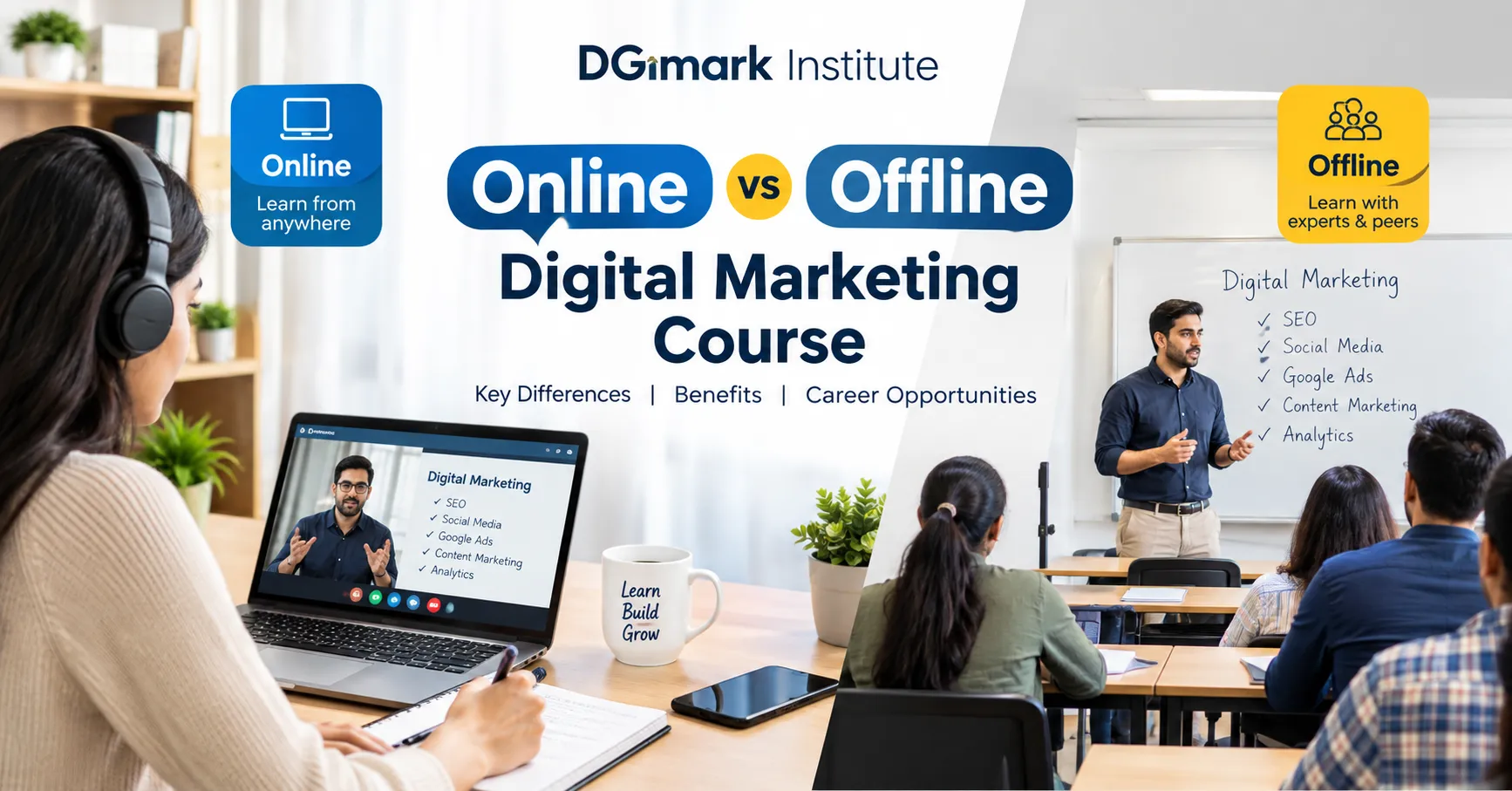
Choose the format you will actually attend. Online suits learners who need flexibility or live far from a training centre. Offline suits those who focus better in person with classmates.
Both work well when the course includes live projects, mentor feedback, and a current curriculum. If you pick online, ask whether recordings are available for missed classes, since internet issues happen.
Q10. What should a good course include in 2026?
- Updated curriculum: SEO, paid ads, social media, analytics, email, and automation
- AI tools in marketing: responsible use for research, content, and ad optimization
- Short-form video and content strategy
- Live projects: real campaigns, not just slides
- Experienced trainers: ask about their hands-on background
- Recognized certifications: tool-based, not just attendance
- Clear placement support: specifics such as resume review, mock interviews, or referrals
Q11. What are the warning signs of a bad course?
- Promises of “guaranteed placement” or “100% job assurance”
- No demo class or trial session
- No information about trainers
- An outdated curriculum with no AI or short-form video content
- Pressure to pay today with “last seat” tactics
- Theory only, with no live projects
A good institute answers questions openly and lets you experience the teaching before you pay.
Q12. How can DGmark Institute help?
If you decide a guided course is right for you, DGmark Institute offers digital marketing training in both online and offline formats for learners across India.
Our programs include mentor-led classes, live projects, certifications, and placement support. To see how the online format works, visit our online digital marketing courses page.
Not ready yet? That is fine. We would rather you choose the right path than the fastest one.
Common Mistakes to Avoid
- Choosing only on price, whether cheapest or most expensive
- Skipping the demo class
- Collecting certificates without building work samples
- Starting several courses at once and finishing none
- Ignoring your schedule when choosing online or offline
Conclusion
The free vs paid digital marketing course decision becomes simple once the smaller questions are answered. Free courses are ideal for exploring and learning basics. Paid courses help when you want feedback, accountability, live practice, and career support.
Whichever path you take, finish with real work you can show. In 2026, skills and proof matter more than certificates.
If you would like to talk through your situation, DGmark Institute is happy to help. Book a free demo class or counselling session and ask us anything.
Frequently Asked Questions
Is a free digital marketing course enough to get a job?
It can be, if you add real projects and a portfolio. Free courses teach concepts well, but employers look for proof of skill. Without feedback, it takes more planning and discipline to reach job-ready level.
How do I know if a paid course is genuine?
Ask for a demo class, the full curriculum, trainer details, and a clear explanation of placement support. Be cautious about guaranteed job claims or pressure to pay quickly. A genuine institute answers openly.
Can I switch from a free to a paid course later?
Yes. Many learners start free to learn basics and test their interest, then join a paid program for mentoring, live projects, and career support. Your free learning gives you a stronger starting point.
Which digital marketing skills are easiest to learn alone?
Basics of SEO, email marketing, and social media features are widely available free. Skills involving real budgets, like paid ads, and areas needing feedback, like strategy and analytics, benefit more from guidance.
Is online or offline better for digital marketing?
Neither is better for everyone. Choose the one you will attend consistently. Both work well with live projects, mentor guidance, and an updated curriculum.






















Sign in to leave a comment.