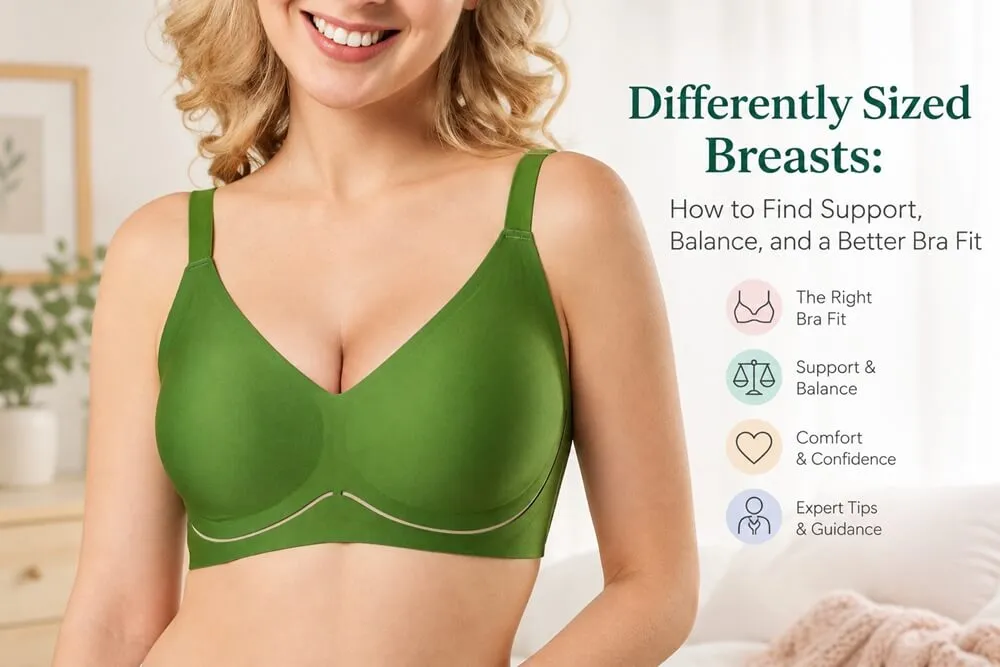


If one of your breasts is larger than the other, you may have experienced a familiar bra-shopping problem: one cup fits comfortably, while the other has extra space. Maybe one side spills over, your straps need different adjustments, or your bra looks uneven beneath a fitted top.
I understand how frustrating this can be. Most bras are designed with matching cups, but women's bodies are not perfectly symmetrical. The good news is that you do not need identical breasts to find a comfortable, supportive bra.
The right approach is to understand your individual shape, fit the fuller breast first, and choose features that help you feel secure on both sides. In this guide, I'll walk you through the practical techniques I recommend for finding support and balance, from everyday bra selection to removable inserts and professional fitting.
Let's begin with an important point: your body does not need to be corrected to deserve comfortable lingerie.
1. Is It Normal for Breasts to Be Different Sizes?
Yes. Breast asymmetry, meaning a difference in the size or shape of your breasts, is common. One breast may be slightly fuller, sit higher, have a different shape, or develop at a different rate.
Natural asymmetry can develop during puberty. Hormonal changes, pregnancy, breastfeeding, weight fluctuations, and aging can also affect breast size and shape. The University of Utah Health explains that differences in breast development are common, including during adolescence.
For many women, the difference is small and has been present for years. It may only become noticeable when wearing a fitted bra or clothing.
When should you speak with a healthcare professional?
There is an important difference between long-standing asymmetry and a new breast change.
If you notice a sudden or unexplained difference in size or shape, a new lump, skin dimpling, nipple changes, persistent one-sided pain, or unusual swelling, arrange a medical assessment. These symptoms do not automatically mean something serious, but they should not be dismissed as ordinary asymmetry.
Cleveland Clinic recommends discussing new breast changes with a healthcare provider so that the cause can be assessed.
Tarbo Fit Expert Note: Your breasts can be different without anything being wrong. Bra fitting is about working with your natural body, not forcing both sides to look exactly the same.
2. Why Is Bra Fitting More Difficult With Uneven Breasts?
A bra is usually constructed with two cups of the same size and shape. When your breasts differ in volume or position, that standard design can create challenges.
Imagine your left breast fills the cup comfortably, but your right breast is slightly smaller. The right cup may wrinkle or leave a small gap, even though the bra fits well on the left. If you choose a smaller cup to eliminate the gap, you might create pressure on the fuller side.
This is why bra fitting should involve more than reading the size label.
Common fitting problems
| Problem | Possible reason |
| One cup spills over | The cup may not provide enough room for the fuller breast |
| One cup gaps | The cup shape or volume may not match the smaller breast |
| One strap slips | Strap length, shoulder position, or bra movement may be involved |
| Band moves upward | The band may be too loose or require adjustment |
| Underwire feels uncomfortable | The wire shape or position may not suit your breast |
Remember that these are possible fitting explanations, not automatic diagnoses. A bra's construction, your breast shape, and how you put the bra on all influence the result.
The practical lesson is simple: Look at how the bra fits your body, not just the number on the label.
For additional measuring guidance, see Tarbo's How to Buy a Bra That Really Fits Online on their official website.
3. Fit the Larger Breast First
This is one of the most useful principles for women with differently sized breasts.
When both cups are the same size, the fuller breast needs enough space. Choosing a bra based on the smaller breast can leave the larger side compressed or spilling over.
Boston Children's Hospital's breast asymmetry guidance recommends fitting the bra to the larger breast and using a prosthesis on the smaller side if desired.
Here's how I approach it
First, put the bra on correctly and check the fuller breast. Make sure the cup is not cutting into the breast tissue, creating overflow, or causing uncomfortable pressure.
Then check the smaller breast. If there is a little extra space, you can explore adjustments or balancing options rather than immediately changing the entire bra size.
This does not mean you must always choose a larger size. The correct choice depends on the bra's construction, the amount of difference, and how the overall garment fits.
Tarbo Fit Expert Tip: When trying a new bra, ask yourself: "Does the fuller breast have enough room, and does the smaller side feel secure?" Those two questions are more useful than chasing a perfect visual match.
4. How to Check Your Bra Fit, One Side at a Time
A fitting routine can help you understand whether a bra is genuinely comfortable. I recommend checking the band, cups, straps, and movement rather than relying on a quick look in the mirror.
Step 1: Check the band
The band should feel secure without causing painful pressure. It should sit relatively level around your torso and should not repeatedly ride up during ordinary movement.
The band is an important part of the bra's support system. If it is unstable, adjusting the straps alone may not solve the problem.
Step 2: Check the fuller breast
Look for:
- Spillage over the cup edge
- Pressure or cutting into the breast
- Underwire resting on breast tissue
- A cup that feels too shallow or small
If you notice these issues, try a different cup shape or size rather than tightening the straps.
Step 3: Check the smaller breast
Look for excessive gaping, wrinkling, or unwanted cup movement. A small amount of space may be acceptable in some designs, particularly when the fabric is flexible, but it should not cause the cup to shift or feel unstable.
Step 4: Adjust the straps individually
Your straps do not have to be the same length. Depending on your breast position and shoulder shape, one side may need a slightly different adjustment.
Make small changes. Straps should help the bra sit properly, not dig into your shoulders.
Step 5: Test the bra while moving
Raise your arms, bend forward, twist your body, sit down, and walk around. Notice whether the band stays in place and whether either cup becomes uncomfortable.
A bra that looks good while standing still may behave differently throughout the day.
5. How Breast Shape Affects Your Bra Choice
Size is only one part of fit. Two breasts with similar volume can still have different shapes, projection, fullness, or position.
This matters because cups are not all constructed in the same way.
Flexible cups
Stretch fabrics may adapt to some differences in breast volume. They can be an option for women who find rigid cups leave space on one side.
However, flexibility does not guarantee sufficient support. The fabric, band, cup construction, and individual breast size still matter.
Structured, multi-part cups
Seamed or multi-part cups may provide shaping and structure. They can be worth trying if you want more defined cup support, although the seam placement and cup shape must suit your body.
Molded T-shirt cups
Molded cups can create a smooth outline beneath fitted clothing. The limitation is that a relatively rigid cup may not follow the contours of both breasts equally well.
If one side gaps, consider whether the cup shape is the issue rather than assuming you need to tighten the band.
Wireless bras
Wireless bras can be appealing for everyday wear because they avoid traditional underwires. Some use wide bands, padding, structured fabric, or other support features.
The right level of support depends on the design and your personal needs. Wireless does not automatically mean more supportive or more comfortable for every woman.
For more general wireless bra guidance, you can explore Tarbo's Ultimate Wireless Bra Fitting Guide .
6. Which Bra Styles Can Help With Differently Sized Breasts?
There is no single bra style that works for every woman with asymmetry. I prefer to match the design to the specific problem you are trying to solve.
Full-coverage bras
Full-coverage cups may help women who prefer more containment or want to reduce the chance of spilling over the top of the fuller breast.
Check that the cup shape is comfortable and that the fabric does not create unwanted pressure.
Stretch and seamless bras
Seamless bras with flexible fabrics may be worth trying when your breasts have different volumes or when you prefer a softer, less structured feel.
The amount of stretch and the support provided by the band should still be evaluated.
Removable-padding bras
These can be useful if you want to add a little volume to the smaller side. They offer flexibility without requiring a different bra for every outfit.
Look for padding that lies flat and remains comfortable during movement.
Structured molded bras
These may suit women who want a smooth appearance beneath T-shirts or dresses. However, cup shape matters greatly. If the molded shape does not match your breast, you may see gaps or feel pressure.
My advice: Try to solve the actual fitting problem rather than choosing a bra simply because it is marketed as a "balancing" or "support" bra.
7. How to Use Removable Inserts to Balance Breast Size
If one breast is smaller and you would like a more even appearance, a removable insert can be a practical option.
Inserts may add volume to the smaller side, helping the cup sit more evenly. Medical guidance from Boston Children's Hospital and the Center for Young Women's Health discusses inserts and prosthetic solutions as options for addressing breast asymmetry.
How to use an insert comfortably
1. Start with a suitable size.
Choose an insert that adds the amount of volume you want. You do not need to add excessive padding to achieve a small visual difference.
2. Position it carefully.
The insert should sit comfortably and lie flat. Avoid positioning it in a way that creates pressure or pushes breast tissue uncomfortably.
3. Check stability.
Move your arms, bend, and walk. If the insert shifts, try a different placement or design.
4. Wash and store it according to its care instructions.
Proper care helps maintain the insert's condition and shape.
Do you have to balance both sides?
Not at all.
Some women prefer a more symmetrical appearance beneath clothing. Others prioritize comfort and do not mind a natural difference. Both choices are valid.
The purpose of an insert is to serve your preference—not to suggest that your body needs to be changed.
8. Choosing an Everyday Bra: A Tarbo Example
When I evaluate everyday lingerie, I look at how the design combines comfort, fabric behavior, coverage, and support. These details matter especially when the two breasts do not fit a standard symmetrical cup in exactly the same way.
As a lingerie brand focused on everyday comfort, Tarbo offers styles with different constructions that shoppers can evaluate according to their personal needs.
One example is the Tarbo® Seamless W-Mesh Jelly T-Shirt Bra – Back Smoothing. Its seamless W-Mesh design and back-smoothing focus make it a relevant style to consider when exploring smooth everyday bra options.
However, I would not automatically recommend it for every degree of breast asymmetry. The right fit depends on the product's size range, cup construction, and how the bra sits on each individual breast.
If you are considering this style, check the product measurements and features on the official product page , then evaluate the fit using the larger-side-first approach described earlier.
Product Placement Strategy: Product recommendations should support the reader's question. Explain the design features accurately, avoid promising universal fit, and direct shoppers to the product page for current sizing and specifications.
9. Common Bra-Fitting Mistakes to Avoid
Over the years, I've found that many fitting frustrations come from trying to make the bra compensate for the body instead of adjusting the bra to the body.
Here are five mistakes worth avoiding.
Mistake 1: Choosing the size based only on the smaller breast
This may create pressure on the fuller side. Check both cups before deciding whether the size is suitable.
Mistake 2: Pulling the straps too tight
Tight straps cannot compensate for insufficient cup room or an unstable band. Adjust them gently and reassess the whole bra.
Mistake 3: Assuming both straps must be identical
Different breast positions or shoulder shapes may require different adjustments.
Mistake 4: Ignoring cup shape
Even if the size is technically correct, a cup may not suit your breast shape. Try alternative constructions when necessary.
Mistake 5: Testing only while standing still
Movement can reveal shifting, gaps, pressure, and inadequate support. Take a few minutes to test the bra in realistic situations.
10. A Simple Five-Minute Fitting Routine
If you are shopping for a new bra, save this checklist.
Your bra-fit checklist
- Put the bra on and fasten it comfortably.
- Check that the band sits securely and relatively level.
- Check the fuller breast for spillage or pressure.
- Check the smaller breast for excessive gaps or movement.
- Adjust the straps individually.
- Raise your arms, bend, walk, and sit to test stability.
The goal is not to create a perfect mirror image. It is to find a bra that feels secure, comfortable, and appropriate for your everyday activities.
11. When Professional Bra-Fitting Help May Be Useful
You do not need a professional fitting for every case of breast asymmetry. Many women can find comfortable lingerie through careful measurement, trying different styles, and making small adjustments.
A professional fitter may be helpful when:
- The size difference is substantial.
- One cup repeatedly spills while the other gaps.
- You have difficulty finding a stable band and comfortable cups.
- You want advice about inserts or specialist balancing solutions.
- You need help understanding which construction suits your breast shape.
A good fitter should listen to your preferences and assess the fit of the entire garment. The purpose is to help you find a solution that works for your body and lifestyle.
For more significant asymmetry, specialist services may also provide options such as prostheses or customized solutions. Boston Children's Hospital describes professional fitting and prosthetic options for individuals with breast asymmetry.
12. When Breast Asymmetry Should Be Medically Checked
Bra fitting can help with comfort and appearance, but it cannot determine the cause of a breast change.
If you notice that one breast has suddenly become larger, or you experience a new lump, persistent one-sided pain, skin dimpling, nipple inversion, unusual discharge, or unexplained swelling, speak with a healthcare professional.
Cleveland Clinic explains that while breast asymmetry is common, new or unexplained changes should be assessed to determine the cause.
I also recommend following age-appropriate breast screening guidance and discussing personal concerns with your healthcare provider.
Remember: A new change deserves attention even if you have always had some degree of asymmetry. A bra should never be used as a substitute for medical evaluation.
Frequently Asked Questions
Is it normal for one breast to be bigger than the other?
Yes. Natural differences in size, shape, and position are common. Breasts may develop differently during puberty or change at different stages of life. A new or unexplained change should be discussed with a healthcare professional.
Should I choose a bra size based on the larger breast?
The larger breast should generally have enough room in the cup. After that, you can explore adjustments or an insert for the smaller side if desired. The correct size still depends on the bra's construction and overall fit.
What is the best bra for differently sized breasts?
There is no single best style for everyone. Flexible cups, removable padding, full-coverage bras, and structured cups may each be useful in different situations. Your breast shape, size difference, and support needs should guide your choice.
Can removable pads help balance breast size?
Yes. Removable pads or inserts can add volume to the smaller side and may help create a more even appearance beneath clothing. They should be comfortable, stable, and appropriately positioned.
Should both bra straps be the same length?
Not necessarily. Each strap can be adjusted separately according to your shoulder shape and the position of your breasts. Avoid tightening straps excessively.
Can breast asymmetry change over time?
Yes. Hormonal changes, pregnancy, breastfeeding, weight changes, and aging can affect breast size and shape. A new or progressive change should be evaluated by a healthcare professional.
Conclusion: Find Support That Works With Your Body
Having differently sized breasts is a normal experience for many women. It may make bra shopping more complicated, but it does not mean you have to settle for discomfort or feel pressured to make your body look perfectly symmetrical.
Start by fitting the larger breast, checking your band and cups carefully, and testing your bra while moving. Explore flexible fabrics, different cup constructions, or removable inserts if they meet your personal needs.
Most importantly, remember that a well-fitting bra should support your body, not make you feel that your body is the problem.
Whether you choose a seamless everyday bra, a structured cup, or a personalized balancing solution, the right fit is the one that helps you feel comfortable, secure, and confident throughout your day.



























Sign in to leave a comment.