DIY Car Sweep Checklist vs. Hiring a Professional: When Each Makes Sense

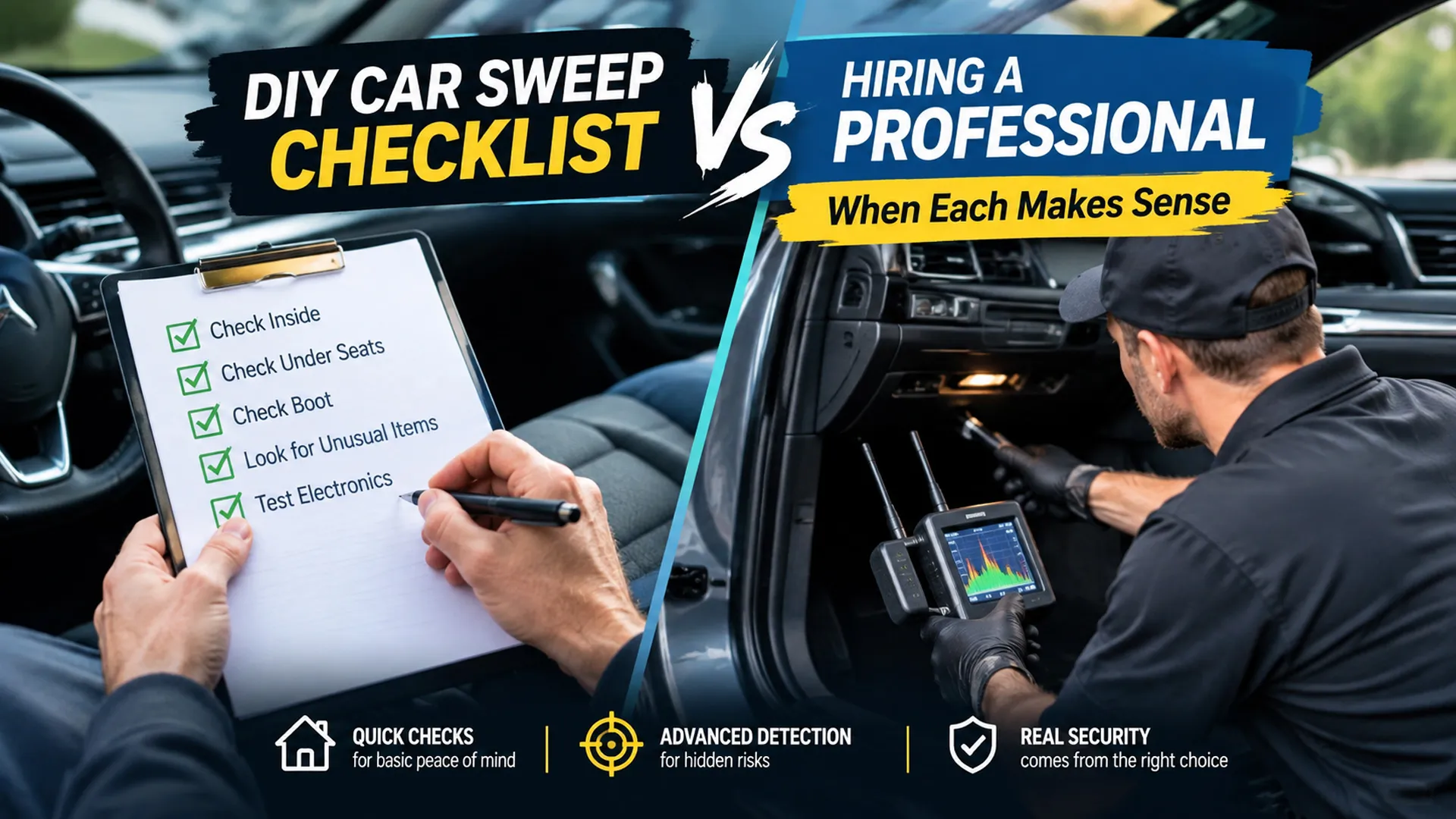
Most people who start worrying about a tracker on their car aren't being paranoid. Something usually set it off first. An ex who keeps turning up where they shouldn't. A business dispute that's gotten personal. A phone alert about an unknown AirTag. Or just a gut feeling that someone knows too much about where you've been.
The good news is that you can do a fair bit yourself. The less good news is that a DIY check has limits, and knowing where those limits are matters more than any checklist. Here's how to tell when a Car Bug Sweep is something you can handle on a Saturday morning and when it's time to call someone who does this for a living.
What a DIY Car Sweep Can Realistically Catch
Most vehicle trackers are cheap and fairly easy to buy. That works in your favour, because the cheap ones are often stuck on with a magnet and left in obvious hiding spots. A careful look can find them.
Here's a checklist you can work through with a torch, a phone and about an hour.
Outside the car
- Check the wheel arches, running your hand along the inside lip, front and rear
- Look under the bumpers, especially behind the plastic covers
- Slide a torch and a small mirror along the underside of the chassis, near the frame rails
- Check the fuel cap area and around the exhaust, though heat usually rules these out
- Look for small magnetic boxes, taped-on packages or anything that looks too clean and new
Inside the car
- Look at the OBD-II port under the dash. Anything plugged in that you didn't put there deserves a closer look
- Run your hand under the seats and feel along the springs and wiring
- Check the glovebox, centre console, door pockets and the boot, including the spare wheel well
- Look behind the sun visors and in the rear parcel shelf
- Pull back the boot lining or carpet edges where it's easy to lift
On your phone
- Check for unknown AirTag or Bluetooth tracker alerts
- Review which apps have location access, and who you share your location with
- Look through your car's own app, if it has one, for logins you don't recognise
That last section trips people up. A lot of "tracking" isn't a hidden device at all. It's a shared account, a connected car app or an old family-sharing setting nobody remembered to switch off.
Where DIY Starts to Fall Short
Here's the honest bit. A visual search only finds what's visible.
Sometimes, the tracker is so well hidden that only experts could find the location. They might even run the entire electrical system as a power source, be connected to the car's battery so they never get out of battery, or sit tucked away behind the dashboard or within the bumper. Some, just emit for a few seconds to not being able to be detected by people. Others don't even react until the car is in motion.
Tracking car GPS device consumer bug detectors are no better if you're just looking at cheap tools. Cheap devices give constant false alarms as most current vehicles carry radio emissions including the car's own Bluetooth, tire pressure sensors, keyless entry and telematics. Without proper training it's almost impossible for ordinary people to distinguish between a friendly signal and a malevolent one. At the best of outcomes people either unnecessarily worry or, at worst, get a sense of security because of the device staying quiet.
Not only that, but even what you're finding might not be anything you've been thinking it is. For example, if pulling yourself a bit from a place could notify whoever the original person is, you'll end up losing potential physical or digital evidence, or you may even damage something without understanding what it was.
When Hiring a Professional Makes Sense
Some situations are worth handing straight to a specialist.
You're in a high-risk situation. If you're leaving a relationship, dealing with an abusive ex or involved in family court, assume the stakes are higher. Someone who is determined enough to track you is usually determined enough to do it properly.
You've already checked and still feel watched. If the DIY search found nothing but the situation hasn't made sense, such as someone arriving at places you never mentioned, trust that. A DIY check can't rule out a well-hidden device.
You need evidence. If this might end up in a police report, an AVO application or a legal matter, the way a device is found and documented matters. A professional can record where it was, how it was installed and what it is, which gives you something solid to work with.
It's a business or executive vehicle. Company cars, vehicles used for confidential meetings, or cars driven by people handling sensitive deals are legitimate targets for commercial snooping. The risk of corporate surveillance is real, and a basic check won't cover it.
What a Professional Car Bug Sweep Involves
A proper sweep goes well beyond a torch and a quick look. A TSCM technician uses specialist equipment to detect radio frequency transmissions, GPS and cellular activity, and hidden electronics, then physically inspects the vehicle in areas most owners never see: inside panels, under trim, within the wiring loom and around the body structure.
They can also tell the difference between the car's normal signals and something that doesn't belong. That's the part that takes experience, and it's the main reason a Car Bug Sweep done by a professional is more reliable than anything you can do at home.
Just as important, a good technician will explain what they found, what they didn't, and what it means. You walk away knowing where you stand, not just holding a report.
Conclusion
Doing a DIY sweep through your car will be a first-hand way to see what is a very lazy and a very obvious thing you might forget to do. However, it doesn't guarantee you are clear and that you aren't the reason. But that is precisely what you want to get that clear assurance if the matter gets serious.
Finding something is not enough, do not talk your feelings down. It is better to do a bit of checking for yourself, get to the bottom of those things, and then if the worries still are there, you get a proper Car Bug Sweep. If you can drive your vehicle without thinking about who might be following you and listening to your conversation in a car then your car is one of the best places that is private and safe for you to.




Sign in to leave a comment.