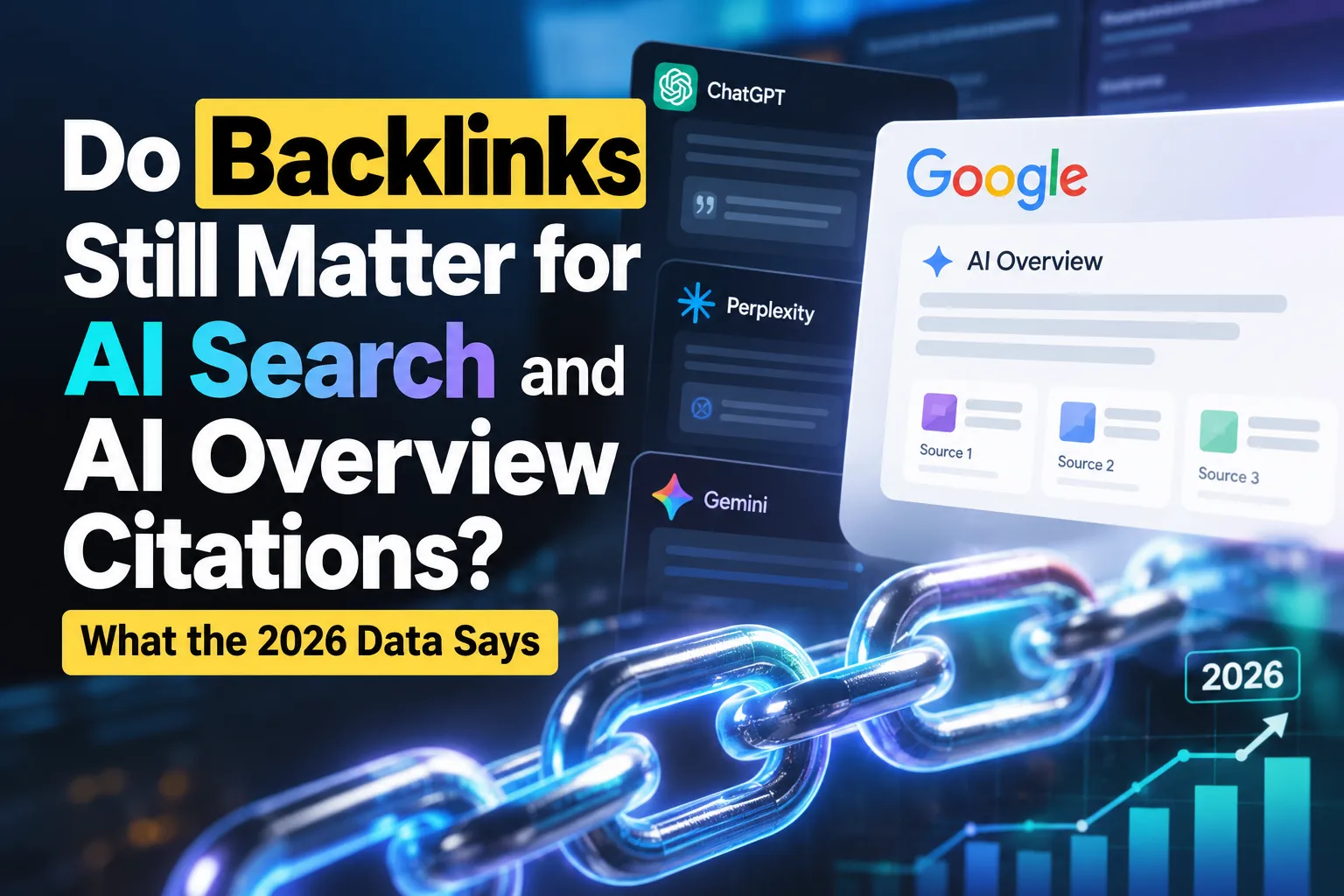

For twenty years the SEO formula was simple: earn links, climb rankings, collect traffic. Then Google started answering questions itself, ChatGPT and Perplexity started citing sources, and a new claim spread through the industry: "backlinks don't matter for AI."
That claim is half right, and the wrong half can cost you. This article walks through what the 2026 studies actually measured, where links still do their work, where they have been overtaken, and how to build a link strategy that supports both classic rankings and AI citations.
TL;DR
- Yes, backlinks still matter, but differently. They help you rank, and ranking still feeds the pool AI Overviews draw from. They are a foundation, not a dial you can keep turning for more citations.
- Brand mentions now correlate far more strongly with AI visibility than links do. In Ahrefs' 75,000-brand study, web mentions scored 0.664 against 0.218 for backlinks.
- Most AI citations go to earned and third-party content, not just to brand-owned pages ranking at the top.
- Link quality and relevance matter more than volume, and Google's link-spam rules apply to paid placements.
The practical move: earn relevant, editorial placements that also create brand mentions, and measure success by citations and conversions, not link counts.
1. The short answer
Think of backlinks as a gate rather than a dial. Below a baseline of trust and authority, your pages struggle to rank, get indexed prominently or be considered as sources. Above that baseline, piling on more links appears to buy little extra AI visibility, while mentions, expertise and topical coverage move the needle more.
A May 2026 meta-analysis by Cyrus Shepard at Zyppy, which synthesized 54 experiments, patents and case studies, described backlinks as a "threshold condition" for AI citations rather than a primary driver. Notably, as of mid-2026 no major AI operator, Google included, has publicly named backlinks as something its answer engines weigh when choosing citations.
2. What the correlation studies show
Ahrefs studied 75,000 brands to see which off-site signals line up with appearing in AI Overviews. Secondary roundups of the data report the following Spearman correlations:
| Signal | Correlation with AI visibility | Visual (each █ ≈ 0.05) |
|---|---|---|
| YouTube mentions | 0.737 | ███████████████ |
| Branded web mentions | 0.664 | █████████████ |
| Branded anchor text | 0.527 | ███████████ |
| Backlinks (referring domains) | 0.218 | ████ |
Brand mentions correlate about three times more strongly than backlinks. One summary of the same research reports that brands in the top quartile for web mentions earn up to ten times more AI Overview citations than the quartile below them.
Read this carefully. A correlation of 0.218 is small but not zero, and correlation is not causation. Already-strong brands tend to earn mentions, links and citations all at once, so mentions may be a symptom of brand strength rather than the cause of citations. Treat the numbers as a map of where to look, not a recipe.
3. Where backlinks still do their work
They help you rank, and ranking feeds citations
Google's own guidance says AI Overviews and AI Mode rely on organic search, and that a page must be indexed and snippet-eligible to be cited. Links remain one of the signals behind rankings. Ahrefs found a moderate positive correlation between ranking higher and being cited in AI Overviews, though even #1-ranked pages made the top three citations only about half the time.
Ranking is no longer enough on its own
The share of AI Overview citations that also rank in the organic top 10 fell from roughly 76% in mid-2025 to about 38% in Ahrefs' March 2026 analysis of 863,000 keywords and 4 million URLs. Other studies put the overlap even lower, around 17%. A big reason is query fan-out: the system runs several related searches, so a page can be cited for a sub-question it ranks for, even if it never ranks for the main keyword.
| Study | Share of AIO citations also in the top 10 | Visual (each █ ≈ 4%) |
|---|---|---|
| Ahrefs, mid-2025 | ~76% | ███████████████████ |
| Ahrefs, March 2026 | ~38% | ██████████ |
| BrightEdge / Conductor, 2026 | ~17% | ████ |
They act through the retrieval layer
AI answers combine what a model already "knows" with live retrieval from a search index. Links influence the second part: they shape what gets indexed, ranked and surfaced for retrieval. They do little to change what a model absorbed during training.
Takeaway: Links feed rankings, rankings feed the candidate pool, and the pool feeds citations. That is an indirect route, which explains the weaker direct correlation.
4. Where AI citations actually come from
If links are not the main driver, what is? Large citation studies keep pointing to third-party sources.
| Finding | Detail | Source |
|---|---|---|
| Earned media share of AI citations | About 82–89% across editions, 84% in one summary | Muck Rack, 25M+ links across ChatGPT, Claude and Gemini (May 2026) |
| Earned and news media share | 39.5% of 5.35M citations | Meltwater (April 2026) |
| Most-cited domains | Reddit, Wikipedia, YouTube and LinkedIn near the top in almost every study | Multiple 2026 studies |
| User-generated content share | About 17.5% of AI Overview citations | 2026 citation analysis |
The numbers differ because the studies sample different engines and define "earned media" differently. The consistent message is that AI systems lean heavily on what other people say about you, in news coverage, communities, reviews and video.
5. What this means for your link strategy
| Old thinking | 2026 thinking |
|---|---|
| More links means more authority | Relevant links from credible sites matter; volume has diminishing returns |
| Domain metrics are the goal | Topical fit and real audience matter as much as the metric |
| Anchor text exact-match | Branded anchors and natural mentions correlate better with AI visibility |
| Links are the end product | Links are one of several routes to brand mentions and trust |
| Success is a link count | Success is citations, branded search growth and conversions |
In practice, the placements that help most do two jobs at once: they pass a relevant link and put your brand, product name and expertise in front of readers and AI retrieval systems in a credible editorial context. Listicles, comparison pieces, expert roundups and genuine guest contributions on topically relevant sites fit that description. Random placements on unrelated sites do not.
6. The risk side: Google's link rules still apply
AI search did not repeal Google's spam policies. Google has long asked that paid links and sponsored content be qualified with rel=sponsored (and guest-post links with rel=nofollow where they were published primarily for links), and it has warned that acquiring excessive unqualified sponsored or guest links can bring algorithmic or manual action. Google's Spam Brain-powered link spam systems are built to neutralize paid link networks, site-wide link selling and thin guest posts that exist only to carry a link.
Some commentary on the March 2026 spam and core updates suggests low-quality, irrelevant guest posts lost value and that further link-spam enforcement may follow. Treat that as industry opinion rather than a Google statement, but plan for it.
The safe approach: buy visibility and editorial placement, not rankings. Work only with sites that publish real content for real readers, ensure the content is genuinely useful, and accept that some links will be qualified and still valuable for brand exposure and mentions.
7. Where Saaslinks and SERPBAYS fit
If you decide to invest in placements, you need a way to find relevant publishers without spending weeks on cold outreach. Two platforms are built around that job:
- Saaslinks is described in its public profiles as a SaaS-focused link-building platform that connects businesses with vetted, relevant websites and offers guest posts and link insertions with transparent site metrics. That niche focus helps because relevance is the first thing AI retrieval and Google both reward.
- Serpbays is described in its G2 profile as a backlink and guest-post marketplace where buyers browse publisher sites, compare publisher-set pricing, filter by SEO metrics, track orders and communicate through one platform. It suits agencies and in-house teams that want to compare many options quickly.
| If you need... | Better fit |
|---|---|
| Placements on sites in the SaaS and software niche | Saaslinks |
| A wide catalog to compare by price, metrics and topic | Serpbays |
| Link insertions into existing, already-ranking articles | Either; confirm the page's traffic and relevance first |
| Guest posts to build brand mentions in your category | Either; choose publishers your buyers actually read |
| Placements across many clients as an agency | SERPBAYS for breadth, then shortlist by niche |
An honest caveat: neither platform changes the rules above. A marketplace or platform helps you find and compare publishers. You still have to judge each placement yourself, use the right link attributes for paid content, and avoid anything that looks like a link scheme.
8. A checklist for vetting any placement
| Check | What to look for |
|---|---|
| Topical relevance | The site and the surrounding article clearly relate to your product category |
| Real audience | Genuine organic traffic and engagement, not just a high authority score |
| Editorial standards | Original, useful content beyond sponsored posts; no "write for us" link farms |
| Context quality | Your link or mention sits inside content that helps the reader |
| Brand visibility | Your brand name appears naturally, not only an exact-match keyword anchor |
| Disclosure and attributes | Paid placements carry the appropriate rel attribute |
| Indexation | The page is indexed and not buried in site-wide or footer areas |
| Fit with AI sources | The site is cited by AI answers in your category, which you can check by searching your target queries |
9. A 90-day plan
| Weeks | Focus | Actions |
|---|---|---|
| 1–2 | Baseline | Audit your link profile, branded search volume and current AI citations for 10 to 15 priority queries. |
| 3–4 | Find the sources | Note which sites AI Overviews and chatbots cite for those queries. Shortlist the relevant ones. |
| 5–8 | Earn placements | Pitch expert commentary, data and guest contributions. Use platforms such as SaaSlinks or SERPBAYS to source relevant publishers, applying the checklist above. |
| 9–12 | Amplify and measure | Support placements with community and YouTube presence. Track citations, branded search and conversions. Drop what doesn't move them. |
10. Five myths to retire
- "Backlinks are dead for AI." They still support rankings and trust, which feed the pool AI draws from.
- "More links means more citations." Evidence suggests diminishing returns past a trust threshold.
- "Any link from a high-authority site works." Relevance and editorial context matter far more.
- "Brand mentions replace links." Mentions correlate more strongly, but the two reinforce each other and links still power classic rankings.
- "Paid links are risk-free if the site is good." Google's link policies still apply to paid placements.
Conclusion
Backlinks have moved from the main stage to the foundation. They still decide whether you are trusted and ranked enough to be considered, but they no longer decide, on their own, whether an AI answer names you. What increasingly separates cited brands from ignored ones is how widely and credibly they are talked about across the web.
So the winning link strategy in 2026 looks less like link collecting and more like reputation building: fewer, more relevant, more editorial placements that earn both a link and a mention, backed by content worth quoting.
FAQ
Do backlinks help me appear in Google AI Overviews?
Indirectly. They support rankings and authority, and ranking correlates with citation, but studies show many citations come from pages outside the top 10.
Are brand mentions really better than backlinks for AI visibility?
They correlate about three times more strongly in Ahrefs' 75,000-brand study, but correlation is not proof of cause. Aim for both.
Does a no follow or sponsored link still help?
It may not pass ranking credit the same way, but it can still deliver referral traffic, brand exposure and the kind of third-party mention AI systems appear to value.
Is buying guest posts safe?
It carries risk if done at scale or on irrelevant sites. Choose relevant, genuinely editorial publishers, disclose paid relationships with the right link attributes, and avoid link networks.
How can I tell whether a site is cited by AI?
Search your target queries in AI Overviews and chat assistants, note which domains are cited, and prioritize those publishers.
Sources and notes
- Ahrefs: 75,000-brand AI visibility correlation study (December 2025), and AI Overview citation overlap studies (2025 and March 2026)
- Cyrus Shepard, Zyppy Signal: AI Citation Ranking Factors meta-analysis (May 7, 2026)
- Muck Rack: "What Is AI Reading?", third edition (May 2026); Meltwater citation analysis (April 2026)
- BrightEdge and Conductor 2026 benchmarks; Surfer SEO analyses
- Google Search Central: "AI features and your website", the May 2026 generative AI guide, and Google's link spam guidance
- Saaslinks and SERPBAYS descriptions come from their public directory and G2 profiles; confirm current services and pricing on their sites


















Sign in to leave a comment.