

Most of us spend a large part of the day indoors, and for many people that means an office. Poor ventilation, dust, and odors can build up without anyone noticing. This guide explains when an office air cleaner makes sense, what it can and cannot do, and how to choose one.
Why Indoor Air Quality Matters
Many people spend up to 90% of their day indoors, often breathing air that holds dust and other pollutants. The World Health Organization describes air pollution as a major environmental health risk, and poor indoor air has been linked to respiratory problems.
Children, older adults, and people with existing health conditions tend to feel the effects first. In an office, stale air can also bring headaches, tiredness, and trouble concentrating, though these symptoms can have many causes.
Signs You May Need an Office Air Cleaner
Common Office Pollutants
Offices collect more pollutants than most people expect:
- Dust and allergens from carpets, fabrics, and outdoor air
- Chemical fumes (VOCs) from printers, new furniture, paint, and cleaning products
- Odors from kitchens, break rooms, or nearby traffic
- Smoke that drifts in from outside or from nearby areas
Warning Signs
An office air cleaner may help if you notice:
- A stuffy or musty smell
- Visible dust on desks and vents
- Staff who sneeze or feel unwell mainly at work
- Poor ventilation, such as sealed windows or an older HVAC system
- Recent renovation or new furniture
If the problem is a faulty ventilation system or a pollution source, fixing that comes first. An air cleaner supports good ventilation but does not replace it.
How Home and Office Needs Compare
The technology is much the same in both settings. What changes is the problem you are solving.
A home air purifier for allergies relies on True HEPA filtration to capture pollen, dust mites, and pet dander. Air cleaners for home allergies work best when paired with regular cleaning and washing bedding in hot water.
A home air purifier for mold can capture airborne mold spores, but it cannot remove mold growing on walls or ceilings. The moisture source must be fixed and the area cleaned.
A home air purifier for smoke needs more than HEPA. HEPA captures smoke particles, while activated carbon is needed for the gases and smell.
Offices usually need all of these at once, plus quiet operation and the ability to run all day.
How to Choose an Office Air Cleaner
Check the Filter Type
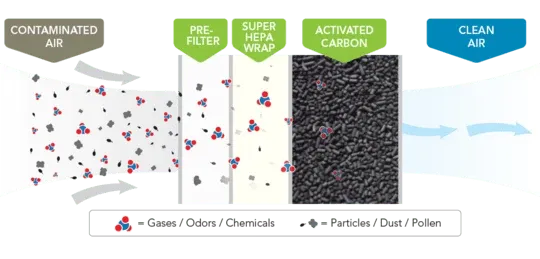
A good unit usually has three stages:
- Pre-filter: catches larger particles and protects the other filters
- True HEPA filter: captures at least 99.97% of fine particles such as dust and allergens
- Activated carbon filter: adsorbs chemicals, gases, and odors
Carbon is the stage that varies most. Think of it as a sponge. The more carbon the filter holds, the more it can absorb before it fills up. Thin carbon-coated sheets saturate quickly, while deeper carbon beds last longer and handle chemicals and odors better.
Match the Size to Your Room
An undersized unit is a common reason air cleaners disappoint. Check the manufacturer’s recommended room size and airflow rating (CFM or CADR), and compare it to the floor area. For open-plan offices or high ceilings, you may need a larger unit or more than one.
Think About Noise
A loud machine gets switched off, and an air cleaner only works while it runs. Look for models with low-noise settings, especially for meeting rooms and quiet workspaces.
Plan for Maintenance
Ask how often the filters need changing and what replacements cost. Pre-filters usually need regular cleaning or replacement, while HEPA and carbon filters last longer, depending on use and pollution levels.
Are Portable Models Enough?
For small offices, private rooms, and home offices, portable air cleaners home and office users can both rely on are often enough. They are easy to move, need no installation, and can be placed where the problem is worst. Larger spaces, such as open-plan floors, may need several units or a building-level solution, so it is worth talking to your facilities team.
Placement and Use Tips
- Leave space around the unit so air flows freely
- Keep it away from walls, curtains, and tall furniture
- Place it near the main source of pollution or where people sit most
- Run it continuously rather than only when the air feels bad
Keep doors and windows closed when smoke or outdoor pollution is high
Conclusion
You may need an office air cleaner if your workplace has poor ventilation, dust, odors, or smoke. Look for True HEPA plus a solid activated carbon stage, a size that fits the room, and a noise level people can live with. An air cleaner works best alongside good ventilation, regular cleaning, and moisture control, and it is not a cure for every indoor air problem.



















Sign in to leave a comment.