


Double body tiles can be a practical option for projects where the flooring has to cover a large area, maintain visual consistency, and remain easy to live with over time. They are often considered in residential and commercial spaces that need something more substantial than a purely decorative surface but do not necessarily require a fully homogeneous full-body tile.
In the Indian market, the term “double body” is not always used in exactly the same way by every manufacturer. Some products combine a supporting vitrified body with a deeper decorative upper section, while the exact construction, thickness, finish, and intended application can vary from range to range.
Because of that variation, double body tiles should be evaluated as a specific product rather than judged only by the category name.
As an architecture consultant, I find them most useful in projects where large floor areas need a stable visual language, straightforward maintenance, and sensible material planning from the start.
Use Double Body Tiles When Large Floor Areas Need a Calm, Consistent Look
Large floors behave differently from small rooms.
A tile that looks interesting as a single sample can become visually exhausting when repeated across hundreds or thousands of square feet.
This is why double body tiles often work best in restrained designs.
Fine-grain stone looks, subtle speckling, muted greys, beige tones, warm taupe, and soft granite-inspired surfaces can create enough visual movement to avoid looking flat while still remaining quiet across large areas.
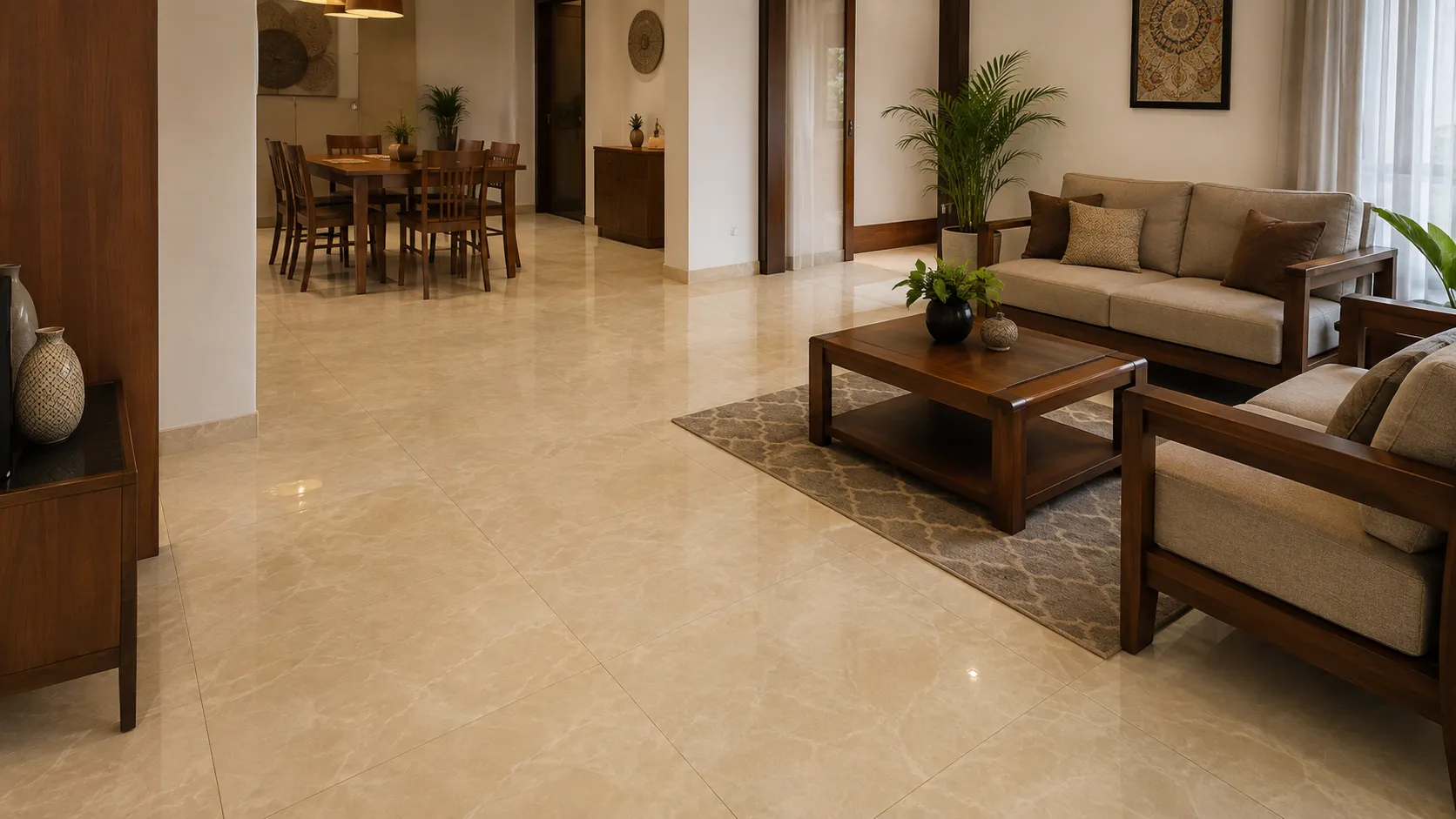
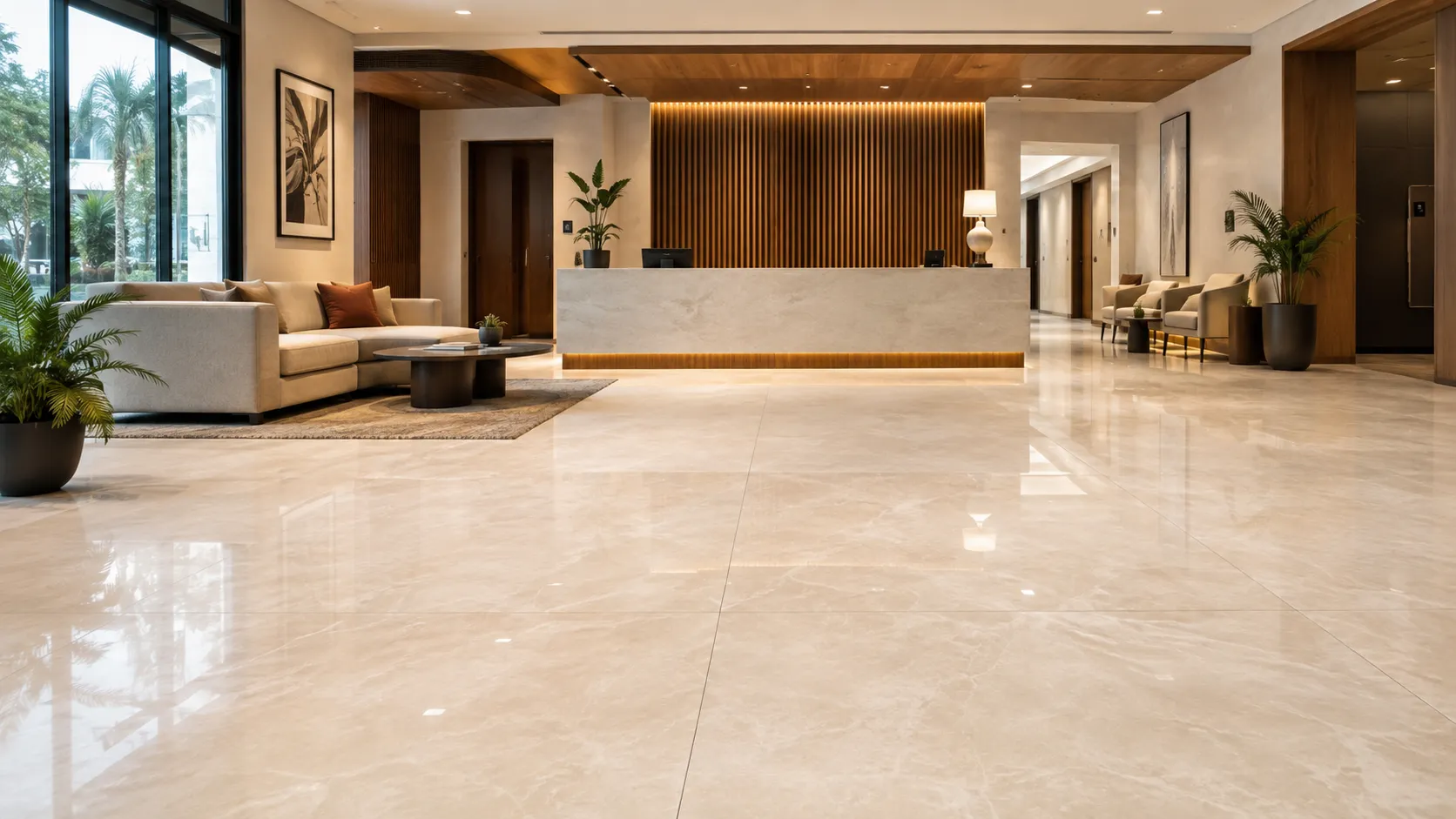
This makes them useful in living and dining zones, office floors, showrooms, corridors, reception areas, and similar spaces where the floor needs to support the interior instead of dominating it.
The pattern scale should be considered carefully.
A highly contrasted speckle may feel manageable on one tile but much stronger once installed across an entire hall.
A finer granular design usually gives a calmer result.
Colour also changes how a large floor behaves visually.
Light beige or ivory shades can help brighten residential spaces.
Mid-tone grey or greige can work well in offices and contemporary interiors.
Darker charcoal or brown shades create more visual weight and usually need stronger lighting.
The goal should be to choose a surface that still feels balanced when viewed from across the room, not only from close range.
Plan Tile Quantity, Layout, and Batch Before Ordering
Large projects are where planning becomes especially important.
Start with accurate measurements.
Room area alone is not enough.
Columns, doorways, wall offsets, service shafts, stair edges, and internal partitions all affect the amount of cutting required.
Once the site is measured, the tile size can be tested against the actual layout.
For example, a 600x600 mm format may work efficiently in a rectangular hall but create repeated narrow cuts in a room with irregular edges.
A different starting point may solve the problem without changing the tile.
This is why layout planning should happen before the order is finalised.
Batch consistency is equally important.
On a large continuous floor, even small shade differences can become visible.
The main project quantity should ideally come from the same production batch.
Boxes should be checked when they arrive rather than after installation starts.
Open material from different pallets or stacks and compare the colour, dimensions, and surface appearance.
Grout planning also matters.
A grout shade close to the main tile tone usually helps a large floor feel more continuous.
Strong contrast can turn the surface into a visible grid and reduce the sense of scale.
Extra quantity should be calculated according to project complexity.
Straight layouts may need less additional material.
Rooms with many corners, columns, or diagonal cuts may require more.
Keeping some spare material after completion is also useful because sourcing the same batch later can be difficult.
Think About Long-Term Use Before Choosing the Finish
The finish should match how the floor will actually be used.
A glossy double body tile may suit a dry living room, office reception, or formal commercial space where reflection is part of the design.
The same finish may be less suitable in areas that receive water, outdoor dust, or frequent wet cleaning.
Matte or softer finishes can reduce glare and make day-to-day marks less obvious, but matte should not automatically be treated as anti-skid.
Wet-area suitability needs to be confirmed for the exact product.
Cleaning behaviour should also be considered.
Plain dark floors can show pale dust.
Very light floors can reveal darker dirt.
Granular mid-tone designs can sometimes provide a practical balance by visually softening everyday marks.
Furniture movement is another factor.
Dining chairs, office chairs, display units, and movable cabinets can all place repeated stress on the floor.
The tile construction matters, but so does the substrate beneath it.
A strong tile installed on an uneven or weak base can still develop problems.
The floor should be properly prepared, stable, and suitable for the selected tile size.
Correct adhesive coverage, controlled joint spacing, and consistent levelling all influence the final result.
The long-term performance of a floor comes from the full system, not only the tile.
Conclusion
Double body tiles can be a practical choice for projects that need large-area flooring with controlled design, consistent appearance, and manageable maintenance.
Their value often becomes clearer in projects where material quantity, batch consistency, layout efficiency, and long-term usability matter just as much as the appearance of the tile itself.
Because the term “double body” can vary between manufacturers, buyers should always check the actual construction, finish, dimensions, application, and technical specifications of the specific product before placing a large order.
The TilesFinders marketplace helps homeowners, architects, builders, contractors, and commercial project teams explore double body tiles from verified dealers and suppliers, compare sizes, finishes, colours, designs, and applications, and shortlist options that fit both the scale and practical requirements of the project.
Written by Nisarg Patel
Architecture Consultant at TilesFinders





















Sign in to leave a comment.