


The Growing Need for a Unified Medicine Database in India
India's healthcare industry is undergoing a significant digital transformation. Online pharmacies, hospitals, telemedicine platforms, healthcare applications, insurance providers, and pharmaceutical companies increasingly depend on accurate and consistent medicine information. However, fragmented databases, inconsistent product names, outdated pricing details, and differences in medicine classifications continue to create challenges for digital healthcare systems.
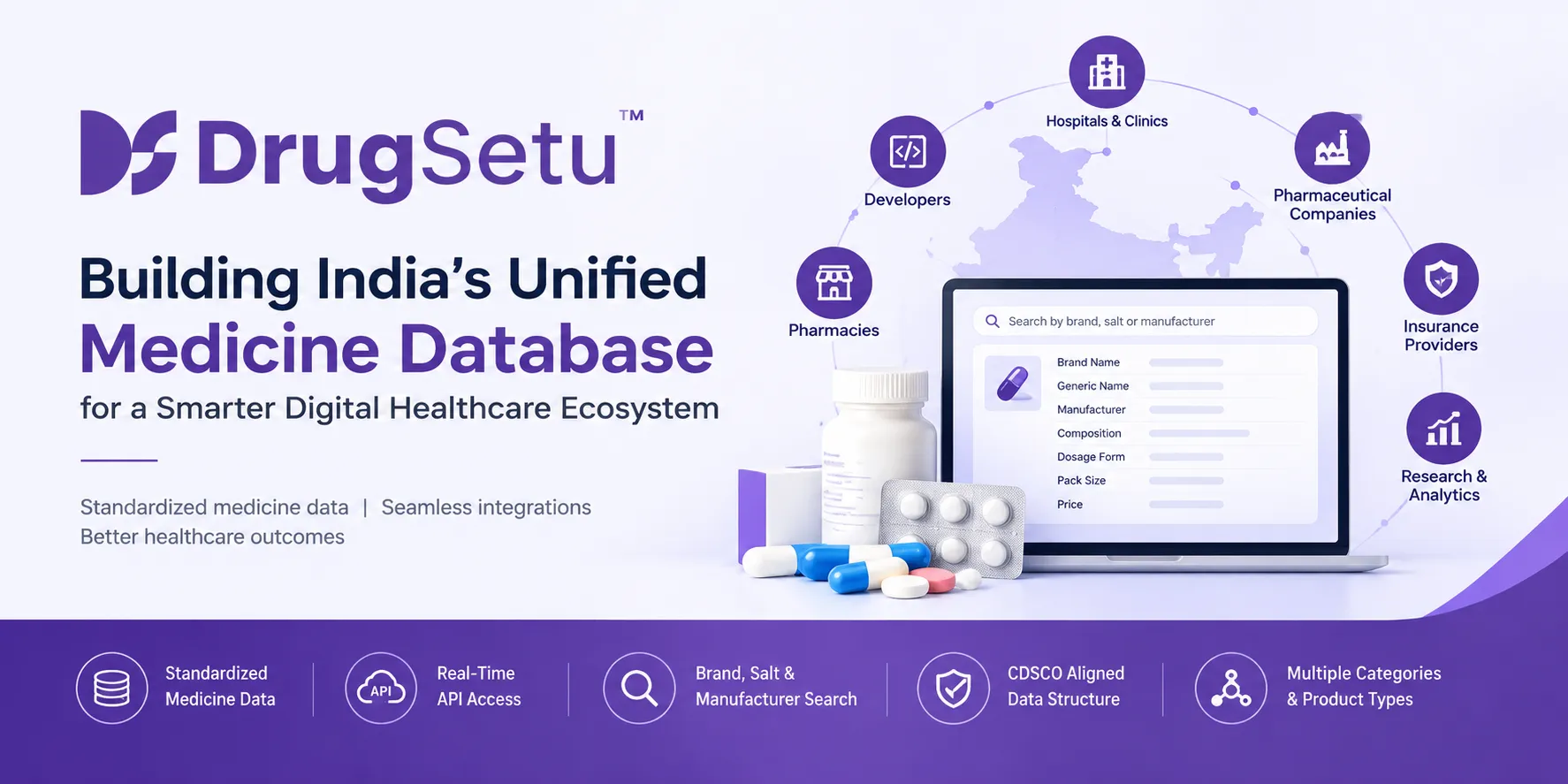
A standardized Indian medicine database can help address these challenges by bringing medicine information into a structured, consistent, and accessible format. DrugSetu aims to build a unified medicine data layer designed to support India's growing digital healthcare ecosystem.
With a focus on medicine data standardization, API based access, pharmaceutical product information, and structured medicine records, DrugSetu seeks to connect data providers with the digital platforms that depend on reliable medicine information.
Whether you are a healthcare technology developer, hospital administrator, pharmacy owner, pharmaceutical manufacturer, or digital health entrepreneur, understanding the role of a standardized medicine database can help you build more efficient healthcare workflows.
What Is DrugSetu?
DrugSetu is a medicine data infrastructure platform designed to organize Indian medicine information into a standardized and structured database. It aims to provide a common foundation for applications and organizations that need consistent medicine records.
The platform describes its database as covering multiple product categories, including prescription medicines, over the counter products, generic medicines, branded formulations, AYUSH products, nutraceuticals, and healthcare related FMCG products.
According to the information presented on its website, DrugSetu features more than 5,99,941 product records and an API first architecture intended for integration with digital healthcare platforms.
Its proposed ecosystem connects pharmaceutical companies and medicine data sources with hospitals, pharmacies, insurers, research platforms, and health applications.
The central objective is to reduce data fragmentation by creating a consistent structure for medicine names, compositions, manufacturers, product specifications, pricing fields, and pack details.
For organizations managing thousands of medicine records, this approach can simplify catalog management and improve consistency across interconnected systems.
Why Does India Need a Standardized Medicine Database?
Medicine information is used across numerous healthcare operations. A single product may appear differently in pharmacy software, hospital inventory systems, billing applications, distributor catalogs, and online medicine platforms.
These differences can create unnecessary operational complexity.
1. Inconsistent Medicine Names and Product Records
Different systems may use abbreviations, alternate spellings, brand names, or different descriptions for the same medicine. Such inconsistencies can make searching, matching, and reconciling records more difficult.
A standardized medicine database can help applications organize product information using consistent fields and structured identifiers where available.
This can support more reliable catalog matching and reduce repetitive manual data entry.
2. Outdated Pricing and Pack Information
Medicine pricing, packaging, and product details may change over time. When organizations maintain independent databases, keeping every record updated can require considerable effort.
A centralized data infrastructure with controlled update workflows can help connected platforms receive approved product information more consistently.
However, organizations should verify pricing fields, effective dates, and applicable regulatory requirements before using them for billing or commercial decisions.
3. Difficulties in Hospital and Pharmacy Integration
Hospitals and pharmacies often rely on separate software systems for prescriptions, billing, stock management, purchasing, and reporting.
When these systems use different medicine catalogs, staff may need to reconcile records manually.
A structured Indian drug database can provide a common reference layer for integration, helping software teams map product records between systems.
4. Challenges in Digital Healthcare Development
Developers building telemedicine applications, e pharmacy platforms, prescription tools, and healthcare management software need dependable medicine information.
Creating and maintaining a large medicine catalog independently can be time consuming. A medicine database API offers an alternative by allowing applications to retrieve structured records through software requests.
This can help development teams concentrate on application functionality instead of repeatedly building medicine catalogs from scratch.
Key Features of the DrugSetu Medicine Database
DrugSetu presents several capabilities intended to support medicine data management and digital healthcare integration.
1. Structured Indian Medicine Information
The platform aims to bring different medicine categories into one organized data environment. Depending on record availability, relevant fields may include brand names, generic names, salt compositions, manufacturer details, dosage forms, pack sizes, and pricing information.
A structured Indian medicine database can help healthcare businesses maintain more consistent product listings across their operational systems.
The completeness and verification status of individual fields should still be evaluated before clinical, financial, or regulatory use.
2. Medicine Database API for Developers
An API allows software applications to communicate with a database and retrieve information in a defined format.
DrugSetu describes a REST based API designed to support medicine searches by brand, salt composition, or pharmaceutical company.
For developers, a medicine database API can support applications such as:
- Medicine search and discovery tools.
- Pharmacy inventory management systems.
- Hospital billing and catalog software.
- Electronic health record integrations.
- Prescription management applications.
- Digital healthcare platforms.
- Medicine catalog matching and reconciliation tools.
API availability, access permissions, request limits, supported fields, and production requirements should be confirmed through the platform's official documentation.
3. Pharmaceutical Product Information Management
Pharmaceutical manufacturers need consistent ways to maintain product information across multiple digital channels.
DrugSetu describes a planned pharmaceutical dashboard through which companies will be able to submit and manage product information, including packaging details, images, compositions, pricing fields, and product classifications.
The company dashboard is identified on the website as being under development and not yet publicly available.
Once the relevant functionality becomes available, a centralized pharmaceutical database in India could help manufacturers manage product information through structured submission and review processes.
4. Structured Medicine Search
Searching for a medicine by brand name alone may not always be sufficient. Healthcare applications may also need to search by generic name, active ingredient, or manufacturer.
A structured medicine index can support more flexible search workflows and help applications identify relevant product records.
DrugSetu describes search functionality designed around brand names, salts, and pharmaceutical companies. Developers should assess the available matching logic and record quality before using search results in clinical or dispensing workflows.
5. Update Management and Version Control
Medicine records may require updates when product information changes or corrections are approved.
DrugSetu describes review gated update workflows, version control, and historical change tracking as part of its proposed data infrastructure.
These capabilities are relevant to organizations that need to understand when a record changed and which version their systems received.
A dependable update process should include appropriate validation, traceability, and safeguards against incorrect or unauthorized changes.
How a Medicine Database API Supports Different Industries
A unified medicine data layer can serve several types of organizations.
Online Pharmacies
Online pharmacies manage extensive product catalogs with different brands, strengths, formulations, and pack sizes.
A standardized medicine database API can help support product discovery, catalog normalization, and structured medicine listings.
Pharmacies should independently validate stock availability, current prices, prescription requirements, and product authenticity.
Hospitals and Clinics
Hospitals need consistent medicine records across pharmacy departments, billing systems, electronic medical records, and inventory management applications.
Using a common data reference can reduce duplicate records and make internal reconciliation more manageable.
Integration should also preserve clinically important distinctions, including ingredient, strength, dosage form, route of administration, and release characteristics.
Telemedicine and Digital Health Applications
Telemedicine platforms use medicine information for prescription workflows, medication lists, and product searches.
An Indian drug database can provide a structured starting point for building these features.
However, a medicine catalog is not a substitute for clinical decision support, professional prescribing judgment, or validated interaction and contraindication checking.
Insurance Companies and Third Party Administrators
Insurance companies and TPAs process claims that may contain medicine descriptions, product codes, and reimbursement details.
Standardized records can support claims matching, billing validation, and reconciliation between different systems.
Actual reimbursement decisions must also follow the applicable policy terms, documentation requirements, and regulatory rules.
Pharmaceutical Companies
Manufacturers can benefit from organized product information that can be maintained and distributed consistently.
A centralized pharmaceutical data management system may help companies reduce repetitive submissions and improve control over how product information is represented across participating platforms.
CDSCO Alignment and Medicine Data Standardization
Regulatory consistency is an important consideration when building healthcare data infrastructure in India.
DrugSetu describes its data structure as CDSCO aligned, with fields intended to support structured medicine information and the Indian pharmaceutical ecosystem.
For healthcare organizations, it is important to distinguish between a database structure designed with regulatory requirements in mind and formal regulatory approval or certification.
The presence of structured fields does not independently establish that every product record has been verified by a regulator.
Before adopting any CDSCO aligned medicine database, organizations should evaluate the data sources, verification procedures, update frequency, audit records, and evidence supporting individual product details.
They should also ensure that their use of the information complies with applicable Indian laws, licensing requirements, and healthcare regulations.
How Developers Can Get Started with DrugSetu
Developers interested in integrating medicine information into their applications can begin by identifying their data requirements.
Step 1: Define Your Use Case
Determine whether your application needs medicine search, ingredient matching, product catalog management, pack information, or pricing fields.
Document the required fields and the expected volume of API requests.
Step 2: Review the API Documentation
Visit DrugSetu to explore the available documentation, API access process, and integration information.
Review authentication requirements, endpoint specifications, response formats, error handling, and any applicable usage restrictions.
Step 3: Request API Access
Follow the platform's stated account creation and API access process. Confirm whether sandbox access is available and whether production access requires additional review.
Never expose private API keys in publicly accessible applications or source code repositories.
Step 4: Test Medicine Matching
Test the database against representative medicine records from your existing system.
Pay particular attention to generic names, brand variations, ingredient strengths, dosage forms, and pack sizes. Evaluate how the API handles missing information and duplicate or similar products.
Step 5: Establish Data Validation Procedures
Before deploying an integration, define how your application will validate records, handle updates, retain audit history, and respond to unavailable or incorrect information.
For clinical or dispensing use, implement appropriate professional review and safeguards.
DrugSetu and the Future of Digital Healthcare in India
India's digital healthcare ecosystem requires more than software applications. It also depends on reliable data foundations that allow different systems to exchange information consistently.
A standardized Indian medicine database represents one approach to addressing the fragmentation of medicine information across healthcare organizations.
By focusing on structured product records, API based integration, pharmaceutical data management, and controlled update workflows, DrugSetu aims to support a more connected digital healthcare environment.
Its long term value will depend on factors such as data completeness, verification quality, update reliability, interoperability, transparent governance, and adoption by participating organizations.
Healthcare businesses evaluating the platform should review its currently available features, service terms, security measures, and data quality before making implementation decisions.
Frequently Asked Questions
What is an Indian medicine database?
An Indian medicine database is a structured collection of medicine and healthcare product information relevant to the Indian market. Depending on its scope, it may contain brand names, generic names, ingredients, strengths, manufacturers, dosage forms, and packaging details.
What is a medicine database API?
A medicine database API allows software applications to retrieve structured medicine information programmatically. It can support medicine searches, pharmacy catalogs, hospital software, and digital healthcare applications.
Who can use DrugSetu?
DrugSetu identifies developers, startups, hospitals, pharmacies, pharmaceutical companies, insurers, TPAs, and digital health platforms as potential users of its medicine data infrastructure.
Does DrugSetu provide a pharmaceutical company dashboard?
DrugSetu describes a pharmaceutical product dashboard, but its website states that the dashboard is under development and not yet publicly available. Interested companies can visit the official website for early access information.
Is a standardized medicine database sufficient for clinical decisions?
No. A medicine database can support information retrieval and catalog management, but clinical decisions require appropriate professional judgment and validated clinical information. Product records should be checked for accuracy and suitability before being used in patient care.
Conclusion: Building a More Connected Medicine Data Ecosystem
Accurate medicine information is an essential component of modern healthcare technology. Fragmented product catalogs can create challenges for pharmacies, hospitals, insurers, manufacturers, and developers seeking to build interoperable digital systems.
DrugSetu aims to address these challenges through a standardized medicine data layer, structured product information, and API based access for India's digital healthcare ecosystem.
For organizations exploring medicine catalog integration, pharmacy software, healthcare applications, or pharmaceutical data management, DrugSetu is a platform worth evaluating against their operational and technical requirements.
As digital healthcare continues to develop, consistent medicine data, transparent verification, responsible integration, and reliable update processes will remain important foundations for a more connected healthcare environment in India.





















Sign in to leave a comment.