
 A website can claim to have industry experts. It can publish dozens of detailed blogs. It can even add an "Expert Advice" section to every page.
But none of that automatically makes the content trustworthy.
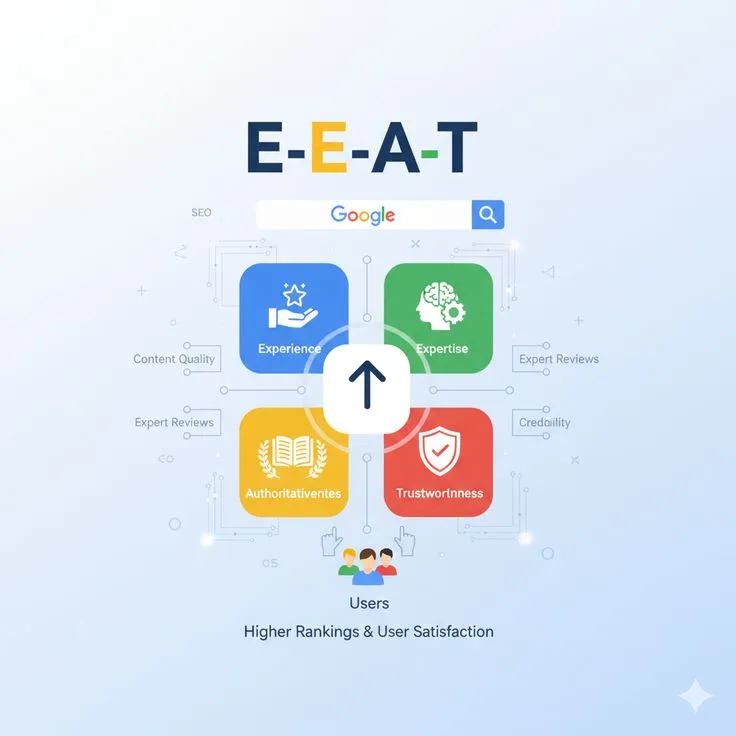
In 2026, Google's approach to E-E-A-T is less about simply displaying the right signals and more about whether a website consistently demonstrates useful, credible and first-hand knowledge. Google itself says E-E-A-T stands for Experience, Expertise, Authoritativeness and Trustworthiness, while also clarifying that E-E-A-T is not a single ranking factor. Instead, Google's systems use a mix of signals that can identify content demonstrating these qualities.
For an SEO Agency in Mumbai, this distinction matters. The old approach of publishing content around keywords is no longer enough. Businesses need to demonstrate why their content deserves to be trusted in the first place.
So, what does that actually look like in 2026?
E-E-A-T Is Not a Checklist You Can "Add" to a Website
One of the biggest misconceptions about E-E-A-T is that it can be fixed with a few website changes.
Add an author bio.
Add a few external links.
Mention the company's years of experience.
Add a "trusted by" section.
Done.
It does not work that way.
Google explicitly describes E-E-A-T as a collection of qualities that its systems try to recognise rather than a specific ranking signal. Trust is particularly important, while experience, expertise and authoritativeness can contribute to establishing that trust.
That changes how businesses should approach content.
Instead of asking:
"What E-E-A-T elements should we add?"
Ask:
"What evidence would make a real reader trust us on this subject?"
That is a much more useful question.
Experience Is Becoming More Important
The first "E" in E-E-A-T is Experience, and this is where generic content often falls short.
There is a difference between explaining something from research and explaining something because you have actually done it.
Consider two articles about SEO audits.
One explains what an SEO audit is, lists common technical issues and defines terms.
The other explains how an audit uncovered a broken internal-link structure, how the problem affected organic visibility, what was changed and what happened afterward.
The second piece demonstrates experience.
Google's guidance specifically encourages content that demonstrates first-hand expertise and depth of knowledge, including experience gained from actually using a product or service or visiting a place.
For businesses, this creates an opportunity.
Your real work can become part of your content.
Use:
- Original observations
- Client experiences, where appropriate
- Case studies
- Before-and-after examples
- Testing results
- Internal processes
- Industry-specific insights
- Original research
- Lessons learned from actual projects
This is much harder to replicate than generic AI-generated explanations.
Expertise Needs Evidence
Calling someone an expert is easy.
Demonstrating expertise is harder.
A page that says "Our team consists of SEO experts" does not tell a potential customer much.
What industries have they worked with?
What problems have they solved?
What type of experience do they have?
Have they published useful analysis?
Can readers verify who they are?
Google's guidance encourages clear information about who created content, including accurate bylines and author background where appropriate. It also recommends considering whether content is written or reviewed by someone who demonstrably knows the topic.
For businesses working with an SEO Company In Mumbai, this means author and reviewer information should be treated as part of the broader credibility structure.
A good author page might explain:
- Professional background
- Areas of specialisation
- Industry experience
- Relevant qualifications
- Published work
- Professional profiles
The purpose is not to decorate a blog with credentials.
It is to answer a basic reader question:
"Why should I trust this person to explain this?"
Authority Is Built Across the Web
Authority does not exist only on your website.
A business can publish excellent content but still have limited recognition outside its own domain.
This is why authority-building involves the wider digital ecosystem.
Relevant mentions, quality links, citations, professional profiles, industry publications, partnerships and credible references can all help establish the broader context around a business or author.
Google's SEO guidance notes that links can provide additional context about a topic and help demonstrate knowledge, provided that external resources are trustworthy.
But there is an important distinction.
The goal is not to collect as many backlinks as possible.
A hundred irrelevant links do not necessarily communicate meaningful expertise.
A few genuinely relevant references can tell a much stronger story.
For example, a manufacturing company mentioned by an industry publication, participating in a relevant professional association and publishing original technical insights is creating an authority footprint that extends beyond its own website.
Trust Is the Part Businesses Cannot Fake for Long
Of the four elements, Google specifically identifies trust as the most important.
And trust is built through consistency.
Does the website provide accurate information?
Are claims supported?
Are authors identifiable?
Are contact details clear?
Does the business explain its services honestly?
Are reviews genuine?
Does the company acknowledge limitations instead of making unrealistic promises?
These details may not feel like traditional SEO work, but they affect how users perceive a business.
They also become increasingly important as search experiences become more sophisticated.
A search engine trying to identify useful information has more context to work with when a website clearly establishes who is behind the content, what the organisation does and why its information should be considered credible.
Original Information Matters More Than Rewriting
Here's where things get interesting.
A large amount of online content is essentially the same information rewritten ten different ways.
One article says five SEO tips.
Another says seven.
Another says ten.
But the underlying advice is almost identical.
Google's people-first guidance asks whether content provides original information, research or analysis and whether it adds substantial value instead of simply rewriting what other sources already say.
This is particularly relevant in 2026 because AI has made content production dramatically easier.
The challenge is no longer producing content.
It is producing something worth reading.
A Digital Marketing Agency in Mumbai creating content for a client should therefore ask:
What can this business say that a competitor cannot simply copy from a generic article?
The answer might come from internal data, customer questions, project experience, original research or a strong point of view supported by evidence.
That is where content becomes genuinely differentiated.
AI Content Does Not Automatically Fail E-E-A-T
There is still confusion around AI-generated content and E-E-A-T.
Google's position is more nuanced.
Google says its systems focus on the quality of content rather than whether humans or AI produced it. However, using automation primarily to manipulate search rankings violates its spam policies. Google also recommends that creators focus on original, high-quality, people-first content demonstrating E-E-A-T.
So the problem is not simply:
"Was AI used?"
The bigger question is:
"What value does the finished content provide?"
AI can assist with research, organisation, editing and ideation.
But if the final article contains no original insight, no meaningful expertise, no evidence and no clear reason for existing beyond targeting a keyword, it has a fundamental quality problem.
AI can help produce content.
It cannot manufacture genuine business experience.
The "Who, How and Why" Framework Matters
Google has introduced a useful way to evaluate content through three questions:
Who created it?
Can readers understand who wrote the content? Are relevant bylines and author information available where appropriate?
How was it created?
Is there useful transparency around the content creation process when that information would reasonably matter to readers?
Why was it created?
Was the content created primarily to help people, or primarily to attract search engine traffic?
Google explicitly recommends using these questions as a way to stay aligned with what its systems seek to reward.
For content teams, this framework is surprisingly practical.
Before publishing an article, ask all three questions.
If the only convincing answer to "Why?" is "because we wanted to rank for this keyword," the content probably needs more work.
What Businesses Should Do Differently in 2026
E-E-A-T should influence the entire content process, not just the final article.
Start with expertise.
Identify the people inside the business who actually understand the subject.
Then build content around what they know.
Interview internal specialists.
Document customer questions.
Turn successful projects into case studies.
Add original data where possible.
Cite credible sources for factual claims.
Create meaningful author profiles.
Keep important business information transparent and current.
And most importantly, stop measuring content quality by word count.
Google explicitly states that it does not have a preferred word count.
A 900-word article that answers a question properly can be more valuable than a 2,500-word article that says the same thing repeatedly.
E-E-A-T Is Becoming a Business Credibility Issue
The biggest shift is that E-E-A-T should not be treated as an SEO trick.
It is increasingly a reflection of how credible a business appears online.
Search engines need reliable information. Customers do too.
A company with clear expertise, genuine experience, useful content, transparent information and a recognisable reputation has a stronger foundation than one relying entirely on keyword-targeted pages.
For businesses investing in SEO, this means the strategy needs to move beyond rankings.
A capable SEO Agency in Mumbai should be helping build the underlying credibility that makes those rankings sustainable.
At Bricks Media, that fits into a broader approach to digital growth. The focus is not simply on publishing more pages or chasing individual keywords. It is about building search visibility through structured SEO, useful content, technical foundations and systems connected to measurable business outcomes.
In 2026, Google's understanding of expertise is becoming harder to reduce to a checklist.
And that is probably a good thing.
The businesses that have genuinely useful knowledge, real experience and something valuable to say have an advantage that cannot be created by simply adding another keyword to a page.























Sign in to leave a comment.