ECCE Policies for Children – A Fair Chance for Every Child

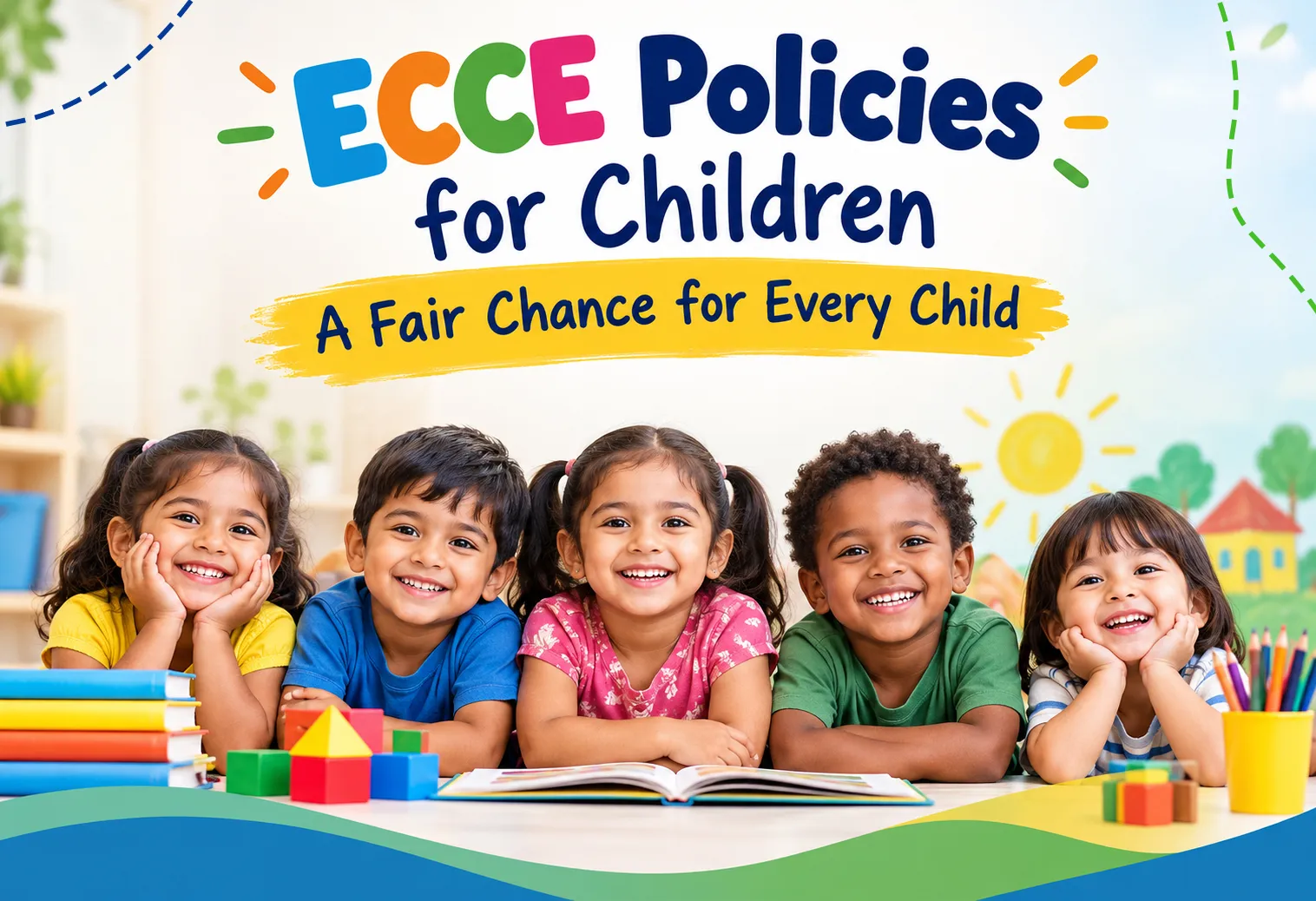
The initial 6 years of a child are not supposed to be spent waiting for "real" school. They are the foundational years when the brain develops curiosity, emotional control and social skills. Therefore, India's National Education Policy 2020 has decided to prioritise the early years of children because what happens in these years can decide the shape of the next fifty years for them. This is where Early Childhood Care and Education (ECCE) comes in the picture.
A well-defined ECCE policy helps children explore the opportunities they deserve and allows a country to bridge the gap between the rich and the poor. Continue reading to learn how ECCE policies help children.
Why the early years are crucial for a child’s development?
Research from around the world, suggests that investment in early childhood yields some of the highest returns of any education spending. The results often show up as better school performance, improved health, higher earnings and reduced dependency on welfare later in life.
All About Early Childhood Care and Education (ECCE)
ECCE gives a fair chance to every child to explore, learn and perform better at every stage of their life. The National Education Policy 2020 reorganised school education to include a five-year Foundational Stage, covering three years of preschool and Classes 1 and 2. It uses play-based, activity-based and discovery-based learning at the centre, and calls for ECCE to be universally available. Explore Mittsure’s LumaLearn, inspired by the NCF Jaadui Pitara and based on NEP 2020 that uses a play-based learning approach with fun books, lesson plans, learning videos and a holistic report card. Moreover, it is built on the Panchkosha Development Framework that not only helps children perform better academically but ensures their overall development from an early stage.
What can make the policy stronger & more efficient?
Here are some ways through which ECCE policy can be made more effective:
Make ECCE a right for every child
Extending legal entitlements to children under six years of age with clear accountability would give them required control and turn goodwill into guarantee. A right is harder to defund than a scheme.
Invest in the workforce
Educators are the heart of an ECCE framework. Dedicated, professional and well-trained preschool educators with fair salaries and constant mentoring will do more for quality than any new building.
Integrate care, nutrition & learning
Care, nutrition and learning-children need all the three together. Co-locating preschools or primary schools with health services ensures no area of a child's development is neglected. Creche facilities for working mothers, especially in informal sectors, extend this support from morning to evening.
Remove language barriers
Teaching in the mother tongue helps children understand better, boosts confidence, and makes a smoother bridge into formal schooling.
Engage parents and communities
Parents are a child's first teachers. Easy and interesting home-based activities, parenting sessions and community participation can multiply the effect of whatever happens in the centre.
Proper funding & monitoring
Public spending on early childhood remains low relative to its returns. Progress should be tracked by developmental outcomes such as language, motor skills, social-emotional growth and school readiness, not just enrolment numbers.
The Bottom Line
India’s ECCE policy vision, the grassroots network and increasingly the learning materials are exactly what is needed to give every child a strong start. However, the most essential thing needed right now is steady implementation: well-supported educators, safe and joyful spaces and a commitment that does not fade when the next scheme arrives. Since a country's real measure of equity is not what it offers to the children, but what it guarantees to its least. So, if we get the early years right for the children, we do not just help one child, we shift the odds for an entire generation.




Sign in to leave a comment.