
Artificial Intelligence for Edge Devices Market: Strategic Trends and Commercial Opportunities
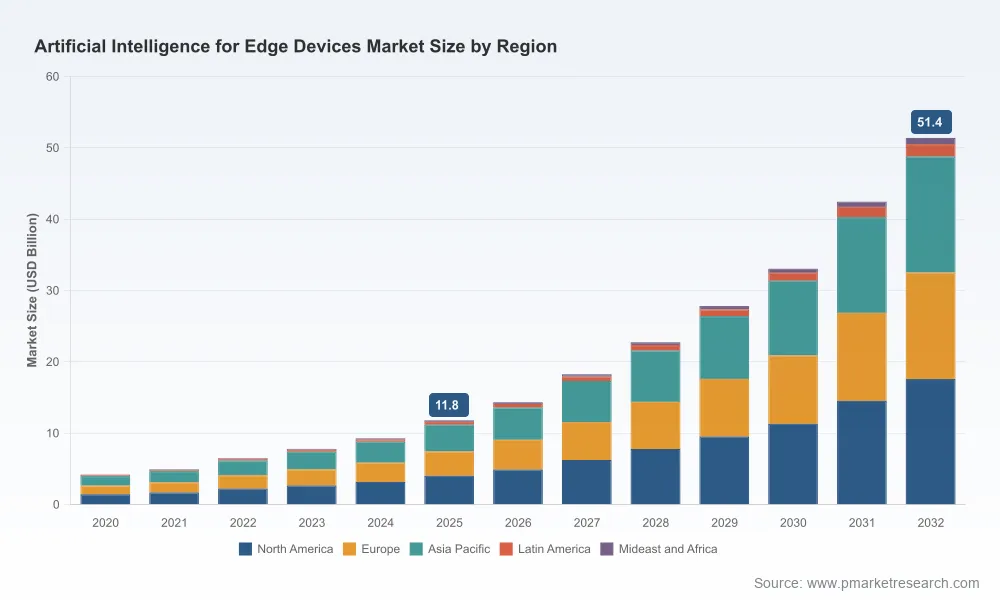
The artificial intelligence market for edge devices has crossed a critical inflection point. After years of experimentation and limited deployments, enterprise and consumer adoption is now accelerating at scale. The global market reached an estimated 11.8 billion in 2025, up from 4.2 billion in 2020, reflecting sustained momentum across hardware, software, and services. Forward projections indicate the market will surpass 51.4 billion by 2032, expanding at a compound annual growth rate of 23.5 percent through the forecast horizon. These figures reflect a structural shift rather than a temporary surge, driven by the convergence of advanced silicon, evolving computing paradigms, and mounting demand for low-latency, privacy-conscious AI processing at the point of action.
Buyers, investors, and manufacturers are navigating a market that is simultaneously broad and fragmented. Edge AI now touches applications ranging from smart home ecosystems and industrial automation to healthcare monitoring, retail analytics, and autonomous systems. The breadth of use cases creates expansive opportunity, yet it also complicates strategy. Business leaders must decide where to build, where to partner, and where to wait. Understanding the underlying forces shaping this market is essential for turning technical possibility into durable commercial advantage.
Market Snapshot: Growth on a Clear Trajectory
The market's expansion since 2020 reflects a compound trajectory that has accelerated through the middle of the decade. Revenue growth from 2020 through 2025 established a foundation of customer validation, cross-industry experimentation, and increasing integration of AI capabilities into products that were previously passive or only intermittently connected. The forward path projects continued acceleration, with the market expected to reach 14.3 billion in 2026, climb to 18.3 billion in 2027, and continue upward to 51.4 billion by 2032. This trajectory indicates that edge AI is transitioning from a specialized capability to a mainstream design requirement across multiple product categories.
The composition of the market is broad, with hardware, software, and services each representing substantial portions of total activity. Hardware remains a dominant share, reflecting the foundational role of processors, accelerators, and system-level integration in enabling on-device inference. Software and services together form the enabling layer that translates silicon capability into deployable intelligence for specific vertical needs. The market is not concentrated among a small number of incumbents; rather, it is relatively distributed, with top-three players accounting for roughly a third of total share and the top five holding just over two-fifths. That fragmentation signals room for specialization and differentiation even as consolidation pressures build around platform ecosystems.
Core Challenges and Inflection Points
For all its momentum, the market faces structural tensions that will define competitive outcomes over the next several years. The first tension is the widening performance gap between what enterprises expect from edge AI and what constrained devices can reliably deliver. Latency, power budgets, thermal limits, and memory constraints remain persistent design constraints. Organizations are discovering that simply porting cloud-based models to edge hardware is rarely viable. Success increasingly depends on model compression, efficient inference architectures, and hardware-software co-design tailored to specific workloads. Companies that treat edge AI as a general-purpose add-on rather than a workload-specific engineering discipline risk underperforming against more focused competitors.
A second challenge is the growing complexity of compliance and certification requirements. As edge AI systems proliferate across regulated environments, from industrial facilities to consumer devices and public-facing infrastructure, the stakes around data handling, energy disclosure, and interoperability have risen. Regulatory frameworks are evolving to require greater transparency about energy consumption, model documentation, and system-level security. These obligations are not uniform across jurisdictions, which creates a fragmented compliance landscape. Manufacturers and platform providers that proactively align their design and documentation practices with emerging standards will reduce time-to-market friction; those that wait for requirements to harden will face costly rework and delayed deployments.
A third inflection point is the maturity of the ecosystem. Edge AI is no longer a single market but a network of interdependent hardware platforms, software frameworks, developer tools, and integration services. Buyers increasingly evaluate edge AI not as isolated components but as solutions that must interoperate across devices, networks, management systems, and data pipelines. This shift places a premium on ecosystems that lower integration costs and shorten the path from prototype to production. The competitive advantage is moving toward firms that can offer cohesive stacks or credible partnerships across the full deployment chain, rather than those competing solely on a single chip specification or software feature.
Key Drivers Shaping the Market
Technology Innovation and Architectural Efficiency
Technical advances are reshaping what is practical at the edge. A central theme is the push toward more efficient inference without reliance on high-cost memory subsystems. Certain edge AI accelerators now enable DRAM-less architectures that reduce both bill of materials costs and power requirements by a substantial margin compared with conventional memory-based designs. This matters because power and cost are often the gating factors in edge deployments, particularly in vision applications, distributed sensors, and battery-constrained devices. As efficiency improves, previously uneconomical use cases become viable, expanding the addressable market beyond high-performance computing environments into everyday products and industrial endpoints.
Compute architectures are also evolving to support specialized edge workloads more directly. Processors and accelerators designed for on-device inference are becoming more integrated with system-level capabilities, including multimodal processing, vision pipelines, and agentic decision-making. The availability of frameworks that support autonomous agentic intelligence and low-latency edge decision-making illustrates how software and silicon are co-evolving. This convergence reduces the engineering burden on end users and broadens the scope of applications that can be deployed without continuous cloud dependency.
Policy and Regulatory Environment
Policy dynamics are shaping both the pace and the shape of adoption. In a notable move, the U.S. Department of State launched an edge AI package offering up to 200 million in foreign assistance for secure, high-quality edge AI-enabled smartphones in the Indo-Pacific. This initiative signals growing strategic interest in edge AI as part of broader digital infrastructure and security considerations, and it underscores the role of government action in seeding demand and setting quality expectations. Policy-driven programs like this can accelerate market formation in targeted geographies and segments while reinforcing emphasis on secure, reliable deployments.
At the same time, regulatory transparency requirements are becoming more defined. The EU has moved toward requiring providers of general-purpose AI models to report energy consumption for training and inference within technical documentation and transparency obligations. Alongside this, directives on energy efficiency have introduced performance indicators for large data center energy demands, reflecting broader scrutiny of the resource footprint of AI-driven infrastructure. These requirements are nudging manufacturers and platform providers to consider energy and documentation as first-order design attributes rather than afterthoughts.
Standardization activity is also intensifying. A recent assessment of AI standards development has been released to evaluate the effectiveness and utility of AI standards, including those applicable to edge AI. In parallel, the Edge AI Foundation has advanced a certification catalog and resources aimed at distributed systems, addressing security and interoperability challenges. Taken together, these efforts indicate that interoperability, security, and documentation are becoming more concrete expectations, and that compliance is increasingly tied to market access and customer trust.
Demand-Side Shifts in Enterprise and Consumer Behavior
On the demand side, behavior is shifting from experimentation toward embedded intelligence. Industrial real-time intelligence use cases are gaining traction as operators seek to reduce latency and improve responsiveness in environments where cloud round-trips are impractical. Multi-modal edge platforms integrated with physical AI stacks are emerging to meet these needs, enabling systems that combine vision, sensor data, and control loops in a single deployment context. The emphasis is on solutions that deliver immediate operational value rather than future-proof flexibility alone.
Consumer and commercial device markets are also evolving. On-device intelligence is increasingly expected in smartphones, personal computers, and connected products, where responsiveness, privacy, and offline capability are differentiators. This demand pattern reinforces the importance of processors and platforms that can support advanced inference within tight thermal and power envelopes. As customers come to expect local AI capability as a baseline, product strategies that fail to incorporate edge intelligence risk losing relevance in competitive segments.
Supply Chain and Cost Structure Dynamics
Cost dynamics are changing as efficiency improvements intersect with demand growth. The ability to reduce memory dependency and power consumption lowers total cost of ownership for many edge deployments, making AI more accessible in price-sensitive segments. At the same time, the broadening of developer ecosystems and expansion of prototype-to-deployment tools is reducing the friction of adoption. When integrated toolchains and reference designs shorten development cycles, the economic case for edge AI strengthens beyond technically capable organizations to a wider base of adopters.
AI Learning Devices for Kids Market
Supply-side competition is also pushing differentiation toward specialized workloads. Rather than competing solely on raw throughput, many providers are refining their offerings for vision, embedded control, automotive, and industrial use cases. This specialization creates more tailored paths to value, but it also increases the importance of selecting the right platform for the right application. A platform that excels in one context may be suboptimal in another, so procurement and architecture decisions are increasingly workload-specific rather than generic.
Competitive Landscape and Leading Strategies
Platform Leaders and Specialized Challengers
The competitive field includes large platform companies with broad silicon footprints as well as focused specialists targeting particular edge AI strengths. NVIDIA has built a recognizable position in edge AI inference for robotics, industrial, and autonomous systems through platforms such as the Jetson series and IGX Orin. Its strength lies in combining hardware with a mature ecosystem and development stack that supports demanding workloads in physical AI contexts. Qualcomm Technologies has extended its reach through Snapdragon and Dragonwing processors for smartphones, automotive, and IoT devices with on-device inference, and has expanded its developer ecosystem to streamline the path from prototype to deployment. Its advantage is rooted in breadth across consumer and embedded contexts and an emphasis on ecosystem enablement.
Intel contributes through edge AI systems, accelerators built on prior architectural investments, and processors optimized for edge AI workloads, positioning itself across industrial and embedded environments. Samsung leverages Exynos and custom edge AI processors for smartphones and IoT with on-device capabilities, aligning silicon with device ecosystems and consumer-facing intelligence. Apple continues to differentiate through its A-series and M-series processors with on-device inference in iPhones, Macs, and related intelligence features, emphasizing tight integration between silicon, software, and user experience.
Several specialists are competing on power efficiency, vision, or domain-specific acceleration. Hailo AI offers accelerators designed for low-power, DRAM-less edge inference in vision and edge devices, targeting cost and energy reduction as core value propositions. Ambarella focuses on edge AI processors for automotive, security, and vision applications, where specialized imaging and inference pipelines matter. NXP Semiconductors provides processors and automotive system-on-chips with integrated edge AI acceleration, alongside discrete NPUs, and has introduced agentic AI frameworks to support autonomous edge decision-making. Microchip Technology addresses industrial and embedded applications with microcontrollers and edge AI solutions featuring machine learning acceleration. Synaptics targets multimodal edge AI processors for automotive and industrial use cases, while SiMa.ai and Axelera AI focus on low-power embedded vision and high-throughput edge vision inference respectively.
Strategic Positioning and Differentiation
The market is not being won on a single dimension. Some leaders compete on ecosystem breadth and integration, others on power and cost efficiency, and still others on domain-specific optimization for vision, automotive, or industrial workloads. The most effective positions tend to combine a clear technical advantage with a credible route to deployment. A low-power accelerator, for example, is most valuable when paired with development tools, reference designs, and support that reduce implementation risk. A broad platform is most compelling when it can demonstrably support diverse applications without excessive integration overhead. Differentiation is increasingly tied to how well a provider reduces the total effort required to move from concept to operational deployment.
Recent activity illustrates this dynamic. One industrial technology provider launched a multi-modal AI edge platform integrated with a physical AI stack for real-time industrial intelligence, reflecting the demand for tightly coupled solutions that address latency-sensitive operational environments. A hardware manufacturer announced a collaboration to deliver secure edge AI systems compliant with a major cyber resilience requirement, highlighting how security and regulatory readiness are becoming part of the product value proposition. A semiconductor company introduced an agentic AI framework for autonomous edge decision-making, pointing to the shift from static inference toward more autonomous local intelligence. Another processor company expanded its developer ecosystem for edge AI prototype-to-deployment, reinforcing the importance of toolchains in accelerating adoption.
Directions of Market Evolution
The competitive landscape is evolving along several axes. Consolidation is likely around platform ecosystems where hardware, software, tools, and support form a coherent offering, especially in verticals where integration complexity is high. At the same time, differentiation and fragmentation will persist in specialized niches where workload-specific efficiency, security, or domain fit matters more than general-purpose scale. New entrants can still find room by targeting underserved use cases, improving cost-power-performance trade-offs, or solving integration and compliance friction that larger platforms do not fully address. The net effect is a market in which both ecosystem strength and specialized excellence can be viable strategies, depending on the segment and the application.
Future Trends and Commercial Implications
Efficiency as a Primary Design Constraint
Over the next three to five years, efficiency is likely to become an even more central design constraint than raw capability. As deployments scale into cost-sensitive and power-constrained environments, solutions that reduce memory dependency, lower energy consumption, and maintain adequate inference quality will capture a growing share of practical use cases. This trend creates commercial opportunities for providers that can demonstrate measurable reductions in total cost of ownership, not just benchmarks in idealized conditions. It also raises the stakes for buyers, who will need to evaluate edge AI proposals against real deployment constraints rather than headline performance figures.
Edge Computing Chips Market
One implication is that business models may shift toward solution-level value rather than component-level specifications. Providers that package efficient silicon with enabling software, integration support, and compliance documentation will be better positioned to capture value across the deployment lifecycle. Buyers that build in-house capabilities around model optimization, workload profiling, and system integration will be better equipped to extract value from increasingly efficient hardware.
Regulatory Readiness as a Market Access Factor
Regulatory and standards activity is poised to become a more direct factor in market access and procurement decisions. Transparent energy reporting, security certification, and interoperability expectations will increasingly influence which solutions are eligible for enterprise, public-sector, and regulated-industry deployments. Providers that proactively align with emerging documentation and certification practices will gain an advantage in tender processes and customer evaluations. Conversely, those that treat compliance as an afterthought may face longer sales cycles, additional redesign costs, and reduced competitiveness in demanding segments.
For investors and manufacturers, this trend suggests that compliance readiness should be assessed as part of the product strategy, not as a separate legal exercise. Documentation, security posture, and energy transparency are becoming part of the commercial narrative, especially in markets where customers must justify lifecycle costs and risk.
From Inference to Local Autonomy
A third trend is the gradual shift from on-device inference toward more autonomous local decision-making. Agentic frameworks and integrated stacks that enable low-latency edge decision-making point toward systems that can act locally with less continuous cloud dependency. This evolution expands the role of edge AI from analysis and classification to real-time control and adaptive behavior in settings such as industrial operations and distributed sensing. The commercial opportunity lies in solutions that make local autonomy reliable, safe, and cost-effective, while preserving the ability to coordinate with broader systems when needed.
PW Consulting
Risks remain. Autonomous local behavior raises the stakes for safety, validation, and fail-safe design, particularly in environments where mistakes have operational or safety consequences. Standardization and certification frameworks will need to mature to provide confidence in these systems. Buyers should weigh the benefits of reduced latency and cloud dependence against the added complexity of verifying and managing autonomous edge behavior.
Actionable Guidance for Decision Makers
For Device and System Manufacturers
Manufacturers should prioritize workload-specific evaluation over generic specification comparisons. The most appropriate platform depends on the application's latency, power, memory, and integration requirements, not on a single performance number. Building internal capability in model optimization, system integration, and compliance documentation will reduce dependence on external partners and shorten deployment timelines. Manufacturers should also treat efficiency and security as product features that customers will evaluate directly, especially as transparency requirements and certification expectations become more visible in procurement processes.
For Investors and Strategic Planners
Investors should look beyond headline growth rates and assess where value is being created across the stack. Efficiency-driven differentiation, developer ecosystem strength, and compliance readiness are likely to be durable advantages, while undifferentiated chip-level competition may face margin pressure. Mapping exposure across hardware, software, and services can reveal where a company benefits from ecosystem integration versus where it remains dependent on commoditizing components. Given the breadth of applications and the speed of regulatory and technical change, detailed segment intelligence is valuable for identifying where adoption is accelerating and where differentiation is still contestable.
For Procurement and Technology Leaders
Procurement and technology leaders should evaluate edge AI solutions against real deployment constraints and lifecycle considerations, including power budgets, memory architecture, integration effort, and compliance documentation. A lower-specification system that fits the workload and reduces integration risk may outperform a more capable but harder-to-deploy alternative. Buyers should also incorporate standards and certification status into evaluation criteria, since these factors are increasingly tied to security assurance and market eligibility. Where possible, organizations should plan for evolution from static inference toward more autonomous edge behavior, while establishing the validation and governance frameworks needed to manage it safely.
The edge AI market is expanding rapidly, but the real strategic question is not whether to engage; it is where and how to engage with the greatest confidence. For leaders who need segmented data, scenario analysis, and tailored guidance across regions, applications, and company positioning, the full research report provides a more detailed basis for planning and investment decisions.
For detailed analysis of this topic, please visit the official page: Artificial Intelligence for Edge Devices Market
Lacy Lee
Senior Marketing Manager
[email protected]
PW Consulting: www.pmarketresearch.com



























Sign in to leave a comment.