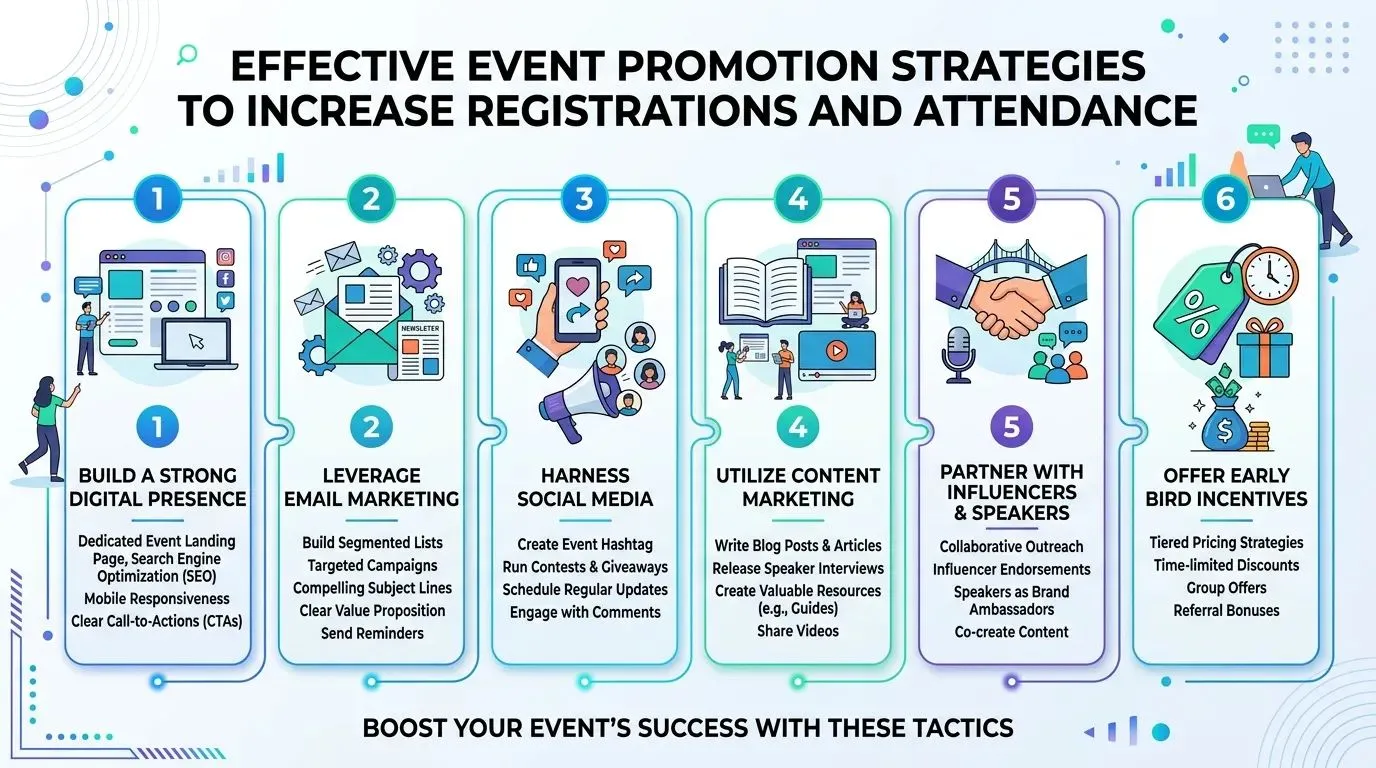

Successful events rarely fill themselves. Whether the event is a business conference, networking session, workshop, product launch, virtual summit, or webinar, attracting the right audience requires a well-planned marketing strategy. The event may have excellent speakers and valuable content, but without effective promotion, potential attendees may never discover it.
Effective event promotion combines creative content, social media, email marketing, partnerships, paid advertising, branding, and audience engagement. Instead of relying on one promotional channel, businesses can create a connected campaign that introduces the event, communicates its value, encourages registration, and keeps attendees interested until the event begins.
The most useful event marketing strategies also continue after registration. Reminder campaigns, personalized communication, live engagement, and post-event follow-up can help turn a single event into a longer-term marketing opportunity.
Start With a Clear Event Marketing Goal
Before choosing promotional tactics, define what the event is expected to achieve. Different events require different marketing approaches.
A business conference may focus on registrations and qualified leads, while a product launch may focus on awareness and customer engagement. A virtual workshop may be designed to educate prospects, whereas a networking event may prioritize relationship building.
A clear objective makes it easier to choose the right audience, promotional channels, messaging, and performance metrics. It also prevents marketers from spending money on tactics that do not contribute to the main purpose of the event.
Once the objective is defined, identify the audience most likely to benefit from attending. Understanding their interests, challenges, professional roles, and preferred communication channels can make the campaign more relevant.
Build Interest Before the Event
Event promotion should begin before the registration deadline becomes urgent. Creating anticipation gives potential attendees time to understand the event and decide whether it is relevant to them.
Teaser content can introduce the event without revealing every detail at once. A speaker announcement, behind-the-scenes video, interesting question, short industry insight, or countdown post can create curiosity.
The event's central message should also focus on value. Instead of simply announcing the date and location, explain what attendees can learn, who they can meet, or what experience they can expect.
A memorable event theme can make promotional content easier to recognize across different channels. Consistent messaging also helps audiences understand that different posts, emails, and advertisements are connected to the same event.
Create a Strong Event Registration Page
The event registration page is often the point where interest becomes an actual registration. It should therefore provide enough information for visitors to make an informed decision without making the process unnecessarily complicated.
A useful registration page should clearly communicate the event name, date, time, location or access details, speakers, main benefits, and registration process. A simple form can make it easier for interested visitors to complete the process.
Social proof can also support registration. Testimonials, previous attendee feedback, speaker credentials, event photos, or information about previous events can provide additional context.
For paid events, the page should clearly explain ticket options, pricing, included benefits, refund policies where applicable, and any early-registration opportunities.
Businesses planning webinar-based events can also review Event Marketing Ideas for additional approaches to building awareness, increasing registrations, and encouraging audience participation.
Use Email Marketing to Drive Registrations
Email remains a useful channel for reaching people who already know a business or organization. A single announcement can introduce the event, but a complete email sequence can maintain interest throughout the promotional period.
The first message should introduce the event and communicate its primary value. Follow-up emails can highlight individual speakers, important sessions, attendee benefits, or registration deadlines.
Audience segmentation can make these messages more relevant. Existing customers, previous event attendees, new prospects, and partners may have different reasons for attending.
Reminder emails should also be sent to registered participants. These messages can include the event schedule, access information, calendar details, preparation instructions, and important reminders.
The goal is to maintain awareness without overwhelming recipients with repetitive messages.
Use Social Media to Build Event Awareness
Social media provides an opportunity to promote an event through both organic and paid content. Different formats can be used throughout the campaign rather than publishing the same registration message repeatedly.
Speaker introductions, short videos, event countdowns, behind-the-scenes photographs, educational posts, questions, polls, and attendee testimonials can all contribute to event promotion.
A dedicated event hashtag can also help organize conversations and encourage attendees to share content. When participants use the hashtag before and during the event, organizers can gain additional visibility through user-generated content.
Platform selection should depend on the intended audience. Professional events may benefit from LinkedIn content, while visually focused consumer events may find opportunities through Instagram, TikTok, or other visual platforms.
Create Referral Opportunities
People often pay attention to recommendations from colleagues, friends, and professional contacts. Referral campaigns can therefore encourage existing registrants or community members to introduce the event to others.
For example, an organizer can offer a discount, upgrade, exclusive resource, or other benefit to participants who successfully refer another attendee.
Referral campaigns should make sharing simple. Provide a registration link, suggested message, social media content, or email template so participants do not have to create promotional material from scratch.
The referral process should also be easy to track so organizers can identify which channels and participants generate registrations.
Work With Speakers, Sponsors, and Partners
Event speakers and business partners can significantly expand promotional reach because they may already have relevant audiences.
Give speakers promotional materials that they can easily share. These can include social media captions, speaker graphics, email copy, event descriptions, and registration links.
Sponsors and exhibitors can also promote their involvement through their own communication channels. This creates additional exposure while giving partners an opportunity to demonstrate their participation.
A coordinated partner campaign can be particularly useful for conferences, industry events, professional workshops, and collaborative online events.
Use Content Marketing to Support Event Promotion
Content marketing can help attract people who are interested in the subject of the event but are not yet familiar with the organization hosting it.
Before the event, businesses can publish articles, videos, interviews, research summaries, or educational resources related to the event topic. These pieces can naturally introduce the event as an opportunity to explore the subject in greater detail.
For example, a marketing conference could be supported by articles discussing customer acquisition, content strategy, branding, or marketing technology. These resources provide value independently while also creating opportunities to introduce the event.
After the event, presentations and discussions can be transformed into additional articles, videos, newsletters, and downloadable resources.
Consider Paid Event Advertising
Paid advertising can extend an event campaign beyond an existing audience. Search advertising, social media advertising, display campaigns, and retargeting can all be considered depending on the event and audience.
Targeting should be based on relevant audience characteristics rather than simply maximizing impressions. Businesses can consider factors such as industry, job role, interests, location, previous website activity, or engagement with earlier event content.
Retargeting can be particularly useful for visitors who viewed the registration page but did not complete the form. Additional messaging can remind them about the event or highlight a different benefit.
Advertising creative should also change as the event approaches. Early campaigns can focus on awareness, while later campaigns can emphasize registration deadlines, speaker information, or limited availability where those claims are accurate.
Make Virtual Events More Interactive
Virtual events remove geographical barriers, but they also create unique engagement challenges. Attendees may be joining from different locations and may have numerous distractions around them.
Promotion should therefore communicate what makes the online experience worth attending live. Mention interactive sessions, Q&A opportunities, live demonstrations, networking rooms, polls, or other features that distinguish the event from a passive recording.
Digital welcome materials can also help build anticipation. Organizers can provide an agenda, speaker information, preparation checklist, downloadable resources, or other useful materials before the event.
For paid virtual events, businesses should also explain exactly what attendees receive from their registration. Clear information about sessions, resources, access duration, and additional benefits can help potential attendees understand the value.
Choose the Right Webinar or Event Platform
Technology can affect both the marketing experience and the attendee experience. A platform should support the event format, audience size, interaction requirements, registration process, and reporting needs.
Before selecting a platform, consider features such as registration management, audience interaction, recording, analytics, integrations, payment support, networking functionality, and access control.
Businesses hosting paid online events should also consider the relationship between platform capabilities and the attendee journey. A useful resource on how to choose a paid webinar platform can help organizers think through platform requirements, registration experience, monetization, and audience needs.
Keep Attendees Engaged Before the Event
Engagement should begin before attendees enter the venue or join the virtual session. Asking registrants questions about what they want to learn can create involvement before the event begins.
Pre-event polls can reveal audience interests and provide information that presenters can use when preparing their sessions. Attendees can also be invited to submit questions for speakers in advance.
Personalized communication can further improve the experience. Someone attending a particular workshop may receive information specifically related to that session rather than receiving generic event messaging.
These small interactions can make attendees feel more involved and provide organizers with useful information about audience expectations.
Create Engaging Experiences During the Event
Event marketing does not stop once people arrive. The actual event experience influences whether attendees remain engaged, recommend the event, or return in the future.
Live polls, Q&A sessions, networking opportunities, demonstrations, interactive workshops, and audience discussions can make the experience more participatory.
For physical events, signage, branded environments, networking spaces, photo opportunities, and clear navigation can improve the attendee experience.
For virtual events, chat functions, breakout rooms, live questions, polls, and interactive presentations can help maintain attention.
The objective is to make participation feel worthwhile rather than simply delivering information.
Encourage Attendee-Generated Content
Attendees can become an additional source of event visibility when they share their experiences online.
Create opportunities that are naturally shareable, such as branded photo areas, speaker quotes, useful statistics, event highlights, audience questions, or short video moments.
Make it easy for attendees to participate by providing the official event hashtag and social handles. Organizers can then reshare appropriate attendee content to extend the event's reach.
User-generated content can also provide authentic material for future promotional campaigns, provided the appropriate permissions are obtained.
Continue Marketing After the Event
The relationship with attendees should not end when the event closes.
A post-event email can thank participants and provide useful materials such as recordings, presentations, key takeaways, photographs, or additional resources.
Feedback surveys can help organizers understand what attendees found useful and where improvements may be needed. Questions can cover session quality, organization, content, networking, technology, and overall experience.
Post-event communication can also introduce related products, services, future events, or educational resources when they are relevant to the audience.
This transforms event marketing from a single registration campaign into an ongoing relationship-building process.
Repurpose Event Content
Events often produce a large amount of useful content that can continue working after the event.
A keynote presentation can become a blog article. A panel discussion can become several short videos. Audience questions can become FAQ content. Speaker interviews can become social media posts or podcast episodes.
Repurposing allows businesses to reach people who were unable to attend and gives previous attendees additional ways to interact with the content.
It can also reduce the amount of new content required for future marketing campaigns because existing event material can be adapted into multiple formats.
Measure Event Marketing Performance
Measuring performance helps organizers understand which parts of the campaign generated meaningful results.
Useful metrics can include registration volume, registration conversion rate, website traffic, email opens and clicks, advertising performance, social engagement, attendance, attendee participation, and post-event conversions.
For paid events, revenue and cost per acquisition may also be important. For B2B events, marketers may track qualified leads, meetings, opportunities, or other business outcomes.
The most useful metrics depend on the original event objective. An awareness-focused event may prioritize reach and engagement, while a lead-generation event may place greater emphasis on registrations and qualified leads.
Common Event Marketing Mistakes to Avoid
Starting promotion too late can reduce the amount of time available to build awareness and registrations. Event organizers should create a promotional timeline that gives potential attendees enough time to discover and evaluate the event.
Another common issue is unclear messaging. If visitors cannot quickly understand who the event is for and why they should attend, they may leave without registering.
Using the same content across every channel can also make campaigns less effective. Social media, email, search advertising, and event websites each have different formats and audience expectations.
Ignoring registered attendees is another mistake. Registration does not automatically mean attendance, so reminders and useful pre-event communication should be included in the campaign.
Finally, failing to review results makes it harder to improve future events. Campaign data should be analyzed after the event so organizers can identify useful patterns and opportunities for improvement.
Build a Repeatable Event Marketing System
Successful event promotion becomes easier when businesses develop a repeatable process.
Start by defining the event objective and audience. Create the registration page and core messaging, then prepare email, social media, partner, content, and advertising campaigns.
As the event approaches, use reminders and personalized communication to maintain interest. During the event, focus on participation and audience experience. Afterward, distribute useful content, collect feedback, analyze performance, and continue relevant follow-up.
Over time, this process can become an event marketing system that supports different event formats and audiences. Instead of starting from scratch for every event, marketers can improve an established framework based on previous results.
Frequently Asked Questions
What are effective event marketing strategies?
Effective strategies can include email marketing, social media promotion, content marketing, referral campaigns, partner promotion, paid advertising, and post-event communication.
How early should an event be promoted?
The appropriate timeline depends on the event size, audience, ticket price, and complexity. Smaller events may need several weeks, while large conferences may require several months of promotion.
How can I increase event registrations?
Use a clear registration page, communicate the event's benefits, promote through multiple channels, work with relevant partners, and make registration simple.
What social media content works for event promotion?
Speaker introductions, countdowns, behind-the-scenes content, short videos, educational posts, attendee stories, event highlights, and interactive questions can all support promotion.
How can email marketing promote an event?
Email can introduce the event, highlight speakers and benefits, remind potential attendees about registration, and provide important information to confirmed participants.
Should I use paid advertising for an event?
Paid advertising can help expand reach when an event needs to reach audiences beyond an existing database. Campaigns should be monitored to evaluate traffic, registrations, and costs.
How can I promote a virtual event?
Virtual events can be promoted through email, social media, content marketing, partnerships, paid advertising, and referral campaigns. Highlighting interactive features can also communicate the value of attending live.
How can speakers help promote an event?
Speakers can share event announcements, create promotional videos, publish social posts, send information to their audiences, and participate in interviews or teaser content.
How do I measure event marketing success?
Measure performance according to the event's objectives. Common metrics include registrations, attendance, engagement, website traffic, advertising results, leads, conversions, and revenue.
What should happen after an event?
Send follow-up communication, share relevant resources, collect attendee feedback, analyze campaign performance, and continue nurturing relevant audiences.
What are some creative event marketing ideas?
Creative approaches include teaser campaigns, countdowns, speaker reveals, interactive social content, referral programs, attendee-generated content, contests, and behind-the-scenes material.
How can event marketing improve brand awareness?
Consistent messaging, recognizable branding, valuable content, social sharing, partner promotion, and attendee-generated content can increase exposure and help audiences remember the event and organization.
How can I promote an event with a limited budget?
Focus on owned and low-cost channels such as email, organic social media, partnerships, referrals, content marketing, and speaker promotion before adding paid campaigns.
How can I keep attendees engaged?
Use interactive sessions, polls, Q&A, networking, gamification, personalized communication, and useful resources to encourage participation before and during the event.
Can event content be reused after the event?
Yes. Presentations, interviews, discussions, recordings, questions, and event highlights can be transformed into articles, videos, social posts, newsletters, podcasts, and downloadable resources.
Final Thoughts
Effective event marketing is a combination of planning, communication, creativity, and consistent audience engagement. A successful campaign does not depend on one promotional tactic. Instead, it connects registration pages, email campaigns, social media, partnerships, content, advertising, attendee communication, and post-event follow-up.
The key is to understand the audience and communicate a clear reason to attend. Once the event begins, continue providing a useful and engaging experience, then use the resulting content and performance data to strengthen future campaigns.
With a repeatable promotional process and consistent measurement, businesses can create event campaigns that support registrations, audience relationships, brand visibility, and long-term marketing goals.















Sign in to leave a comment.