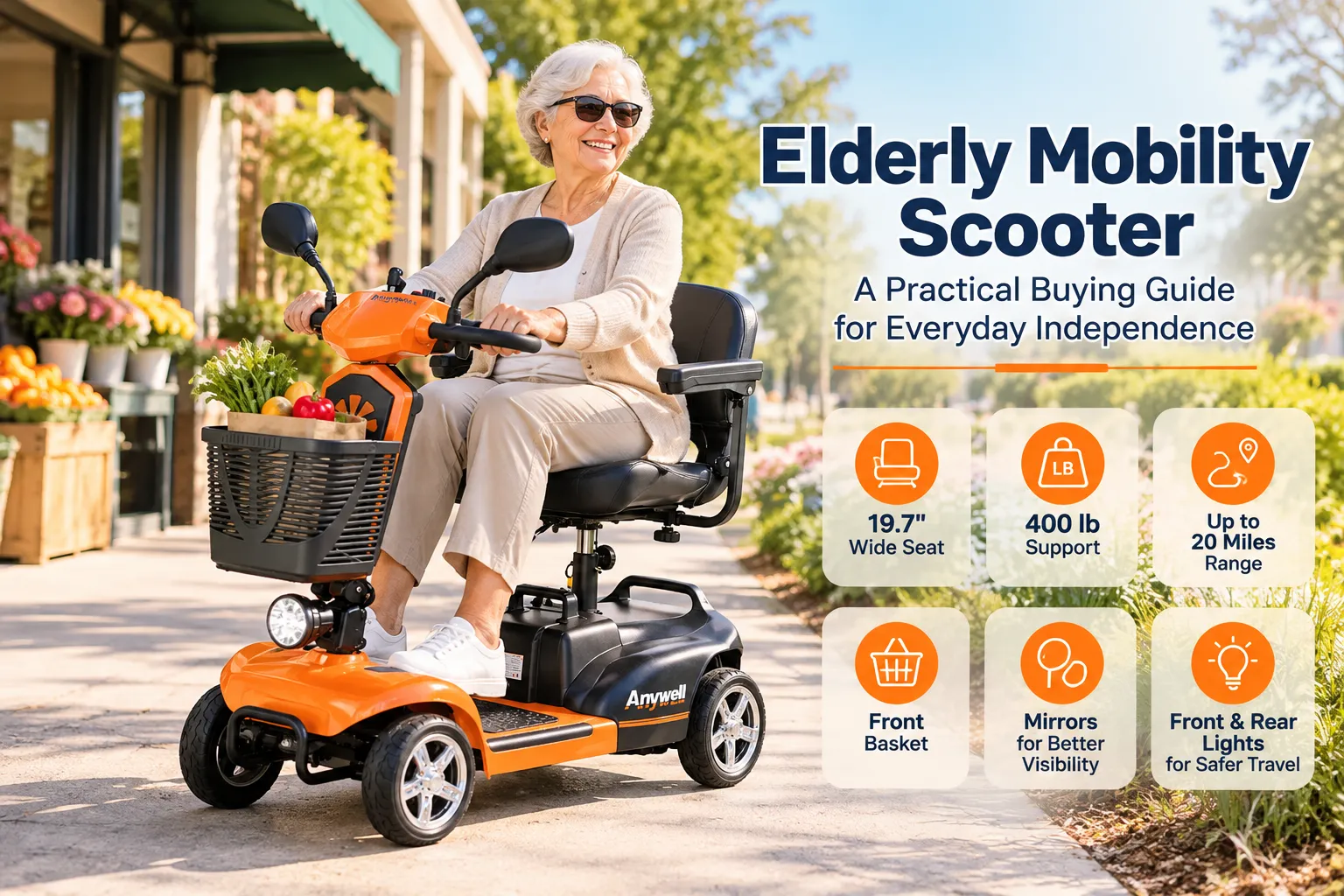


Choosing an X-024 scooter for everyday errands rather than a wide-seat electric wheelchair starts with a simple question: how will the mobility device actually be used from morning to evening?
For many older adults, the goal is not maximum speed or the longest specification sheet. It is being able to get to the mailbox, move around a retirement community, visit a nearby store, shop for groceries, or spend time outdoors without turning every trip into a tiring project.
That makes buying an elderly mobility scooter less about finding the model with the biggest numbers and more about matching seat fit, controls, range, stability, storage, and transport requirements to a real daily routine.
Start With the Trips the Scooter Needs to Handle
Before comparing models, write down several trips the rider expects to make regularly.
A typical list might include:
- Riding from an apartment to a community dining area
- Going to a nearby supermarket or pharmacy
- Traveling along paved neighborhood paths
- Moving around a shopping center
- Carrying a small bag of groceries home
- Visiting friends within the neighborhood
- Spending an afternoon at a park with paved paths
This exercise quickly separates useful features from impressive-sounding specifications.
Someone who mainly travels half a mile around a residential community may care more about easy controls, comfortable seating, and maneuverability than maximum range. Someone planning longer shopping trips may put more weight on battery reserve, storage, mirrors, and lighting.
The best starting question is therefore not, “How far can this scooter go?”
It is, “What does my normal day look like?”
Seat Fit Is More Important Than It Looks
Seat width is one of the first specifications buyers notice, but the number needs context.
A wider seat does not automatically mean a better fit. The rider should be able to sit in a stable position without feeling squeezed between the armrests or sliding around excessively.
Measure seated hip width while wearing normal clothing. Then compare that measurement with the actual seat cushion width, not simply the overall width of the scooter.
Armrest clearance should also be checked separately.
For example, the Anywell X-024 lists a 19.7-inch seat cushion width, while its armrests can be adjusted outward to provide additional space. The manufacturer specifically distinguishes cushion width from the space between the armrests, which is an important detail when comparing fit.
Consider seat depth and back support as well. A scooter can have enough width and still feel uncomfortable if the rider cannot sit upright, reach the tiller naturally, or position their feet comfortably.
If the user has significant postural, transfer, or medical needs, individual guidance from an appropriate clinician or mobility professional is more useful than choosing solely from online dimensions.
What Does “400 lb Capacity” Actually Mean?
A common search is mobility scooter 400 lb capacity, especially when buyers want a more substantial scooter for daily outdoor use.
Weight capacity is a rated limit, not a target.
If a scooter is rated to support up to 400 lb, the user and anything the manufacturer says should be included in the load calculation should remain within the specified limit. Buyers should not assume that being close to the maximum will produce the same range and performance seen under lighter conditions.
The X-024 is currently listed with up to 400 lb rated support.
Capacity can also affect the type of scooter a buyer considers. Many heavy duty mobility scooters for adults emphasize larger seating, stronger frames, and outdoor-oriented designs, but these features may come with additional weight and greater transportation requirements.
That trade-off matters.
A heavier scooter may feel appropriate for regular paved outdoor routes, yet become inconvenient if the owner expects to lift it into a vehicle several times per week.
Treat Maximum Range as a Planning Number, Not a Promise
Battery range is another specification that is easy to misunderstand.
Suppose a scooter is advertised for up to 20 miles. That does not mean every rider should plan a 19-mile round trip.
Real-world range can change because of:
- Rider and cargo weight
- Hills and slopes
- Frequent starts and stops
- Surface conditions
- Battery condition
- Temperature
- Driving behavior
Anywell lists the X-024 for up to a 20-mile rated range and explicitly notes that actual distance varies with factors such as load, terrain, slope, temperature, battery condition, and driving behavior.
A better habit is to build in a reserve.
Imagine an older rider traveling two miles to a shopping area. The theoretical round trip is four miles, but there may also be movement between stores, a detour, or an unexpected stop.
Planning around the entire day rather than the straight-line distance gives the rider more margin.
For the first few trips with any new scooter, short and familiar routes are sensible. They help the owner understand how the battery behaves under their particular combination of rider weight, terrain, temperature, and driving style.
Four Wheels Can Be Useful, but Turning Space Still Matters
Many scooters designed for errands use a four-wheel configuration.
Four wheels can provide a reassuring platform for people whose routine includes sidewalks, paved community paths, parking areas, and shopping environments. But shoppers should avoid reducing the decision to “four wheels equals better.”
A scooter still needs enough room to turn.
Think about the narrowest places the rider encounters:
- Apartment entrances
- Elevators
- Store aisles
- Hallways
- Restaurant entrances
- Garage spaces
- Paths around furniture
If indoor maneuverability is critical, overall dimensions and turning space deserve just as much attention as outdoor stability.
This is especially relevant when comparing a larger heavy-duty scooter with a compact scooter or power wheelchair. The device that feels comfortable on an open sidewalk may require more planning inside a small home.
Controls Should Feel Natural Before Speed Matters
An elderly mobility scooter should not require the rider to stretch forward or maintain an uncomfortable posture just to operate it.
Check whether the rider can:
- Sit upright comfortably.
- Reach the tiller without leaning excessively.
- Operate the throttle or speed controls reliably.
- Turn their head or use mirrors to observe surroundings.
- Get on and off the scooter safely.
The X-024, for example, is listed at approximately 5 mph maximum speed, but speed is only one small part of daily usability.
For errands, predictable control at low speeds can matter far more than maximizing top speed.
The FDA recognizes technical standards covering powered wheelchairs and scooters, including requirements relating to power and control systems. That is a useful reminder that mobility-device controls are functional safety components, not merely conveniences.
Basket, Mirrors, and Lights Make More Sense in Real Scenarios
Accessories are easiest to evaluate when you imagine an actual trip.
The basket
A front basket can be useful for lightweight everyday items such as a small shopping bag, water bottle, or personal belongings.
It does not turn the scooter into a cargo vehicle, but it can eliminate the need to hold items while steering.
Mirrors
Mirrors can help a rider check the area behind them without repeatedly twisting their upper body. They do not replace looking carefully before changing direction, but they can add useful visibility during neighborhood travel.
Lighting
Lights become more relevant when the rider passes through parking areas, shaded paths, garages, or lower-light conditions.
The X-024 product information shows a front basket, mirrors, headlight, and rear lighting, features that fit naturally with its intended use for paved community routes and everyday errands.
These are not reasons by themselves to buy a particular scooter. They are simply examples of features that become meaningful when matched to a real routine.
Think About the Surface Under the Wheels
The phrase “outdoor mobility scooter” can create unrealistic expectations.
Outdoor use does not mean every outdoor surface is appropriate.
There is a major difference between riding on:
- Smooth sidewalks
- Paved community paths
- Parking areas
- Uneven broken pavement
- Loose gravel
- Grass
- Mud
- Steep slopes
For a scooter primarily intended for daily errands, hard, relatively level surfaces are the more relevant environment to evaluate.
The X-024 is positioned for errands and everyday paved routes. Buyers planning frequent use on unusually steep, loose, or rough terrain should check the manufacturer's limitations rather than assuming a heavy-duty label makes a scooter suitable for every surface.
Route planning matters too. A slightly longer trip using smooth curb cuts and accessible crossings may be far easier than a shorter route containing steep transitions or damaged pavement.
Do Not Forget How the Scooter Gets Into the Car
This is one of the most commonly overlooked buying questions.
A scooter might work extremely well once the rider arrives at a shopping center, but someone still has to transport it there.
The X-024 weighs approximately 106 lb fully assembled. Its seat and battery can be removed, but the remaining vehicle-loading base is listed at 61 lb. Anywell advises using suitable assistance or a ramp if that weight is not manageable for the person loading it.
That distinction is important.
“Removable” does not necessarily mean “lightweight.”
Before choosing a scooter, consider:
- Who will load it?
- How high is the vehicle's cargo area?
- Is a ramp available?
- Is there enough trunk or cargo space?
- Will loading happen occasionally or every day?
If solo vehicle transport is one of the highest priorities, the heaviest remaining component may matter more than the scooter's total weight.
A Practical Errand Scenario
Consider an older adult who lives in a planned community and wants to make independent trips to a nearby supermarket.
The route is mostly paved and relatively level. The rider travels about one mile each way and usually buys a small amount of groceries.
For this person, the buying priorities might look like this:
First: comfortable fit.
The seat and armrest spacing need to accommodate the rider without pressure or excessive movement.
Second: easy operation.
The rider must be comfortable controlling the tiller, slowing down, stopping, and turning.
Third: practical storage.
A front basket provides a place for a few small items rather than requiring the rider to carry them while steering.
Fourth: visibility.
Mirrors and lights may be useful when moving through parking areas or shaded neighborhood routes.
Fifth: battery reserve.
Even though the planned trip is short, the rider should not calculate battery needs based only on the absolute minimum distance.
For that kind of routine, specifications such as the X-024's 19.7-inch seat, 400 lb rated support, basket, mirrors, lighting, and up-to-20-mile rated range become relevant because they answer particular practical questions.
The numbers matter only after the use case is clear.
Scooter or Power Wheelchair?
A mobility scooter and a power wheelchair can overlap in purpose, but they are not interchangeable for every user.
A scooter typically uses tiller steering and usually expects the rider to be able to transfer onto the seat and operate the controls comfortably. A power wheelchair normally uses a joystick-style control system and may suit a different set of mobility needs.
That means a person who wants assistance mainly for longer outdoor walking distances may evaluate the devices differently from someone who depends on powered mobility throughout much of the day.
In the United States, Medicare also treats power-operated scooters and wheelchairs as durable medical equipment when specific medical-necessity and eligibility requirements are met. Coverage rules should therefore be checked separately rather than assuming that buying any scooter automatically qualifies for reimbursement.
Common Buying Mistakes to Avoid
One mistake is choosing entirely by maximum range. Range ratings need to be interpreted with real conditions and a sensible reserve.
Another is confusing seat width with total seating clearance. Cushion dimensions and armrest spacing can be different measurements.
A third is ignoring transport weight. If a scooter cannot realistically be loaded into the family's vehicle, its usefulness may be limited even if it performs well at the destination.
A fourth is buying for occasional extreme situations rather than normal use. If 95% of trips involve paved neighborhood routes and grocery errands, those conditions should drive the decision.
Finally, avoid assuming that a high weight rating automatically means a scooter is suitable for rough terrain, steep slopes, or every outdoor environment. Capacity, stability, terrain limits, maneuverability, and braking are separate considerations.
Frequently Asked Questions
Is a 400 lb mobility scooter only for someone who weighs close to 400 lb?
No. A 400 lb rating describes the model's stated maximum supported load; it does not mean the intended rider needs to be close to that limit. Buyers should choose based on fit, intended use, transportation needs, and the manufacturer's operating requirements.
Is an up-to-20-mile range enough for errands?
It can be more than enough for many short routines, but the answer depends on the complete trip. Calculate the distance out and back, additional movement at the destination, and a reasonable battery reserve. Remember that real-world range varies.
Is a four-wheel mobility scooter suitable for indoor use?
It depends on its dimensions and the available turning space. Measure doorways, hallways, elevators, and other tight spaces before purchasing.
What should an older adult measure before buying a scooter?
At minimum, check seated hip width, comfortable arm position, the rider's ability to reach and operate the controls, available storage space, and any vehicle cargo area used for transportation.
Are mobility scooters only for people who cannot walk?
No. Mobility scooters may be used by people with limited walking ability for many different reasons. Medicare describes wheelchairs and scooters as mobility devices that can help people who have limited ability to walk, although medical coverage has additional eligibility requirements.
Final Takeaway
Choosing an elderly mobility scooter is easier when the decision starts with everyday life instead of a specifications table.
Map the usual routes. Measure the rider. Check how the controls feel. Think about pavement, turning space, storage, battery reserve, and vehicle loading.
For someone whose routine centers on neighborhood errands and hard-surface routes, a configuration such as the X-024's 19.7-inch seat, 400 lb rated support, practical basket and visibility features, and up-to-20-mile rated range may be worth comparing with other options.
But the most useful mobility scooter is ultimately the one whose dimensions, controls, range, and transportation requirements fit the trips the rider actually wants to make.

























Sign in to leave a comment.