
The Electric Dump Truck Market: Strategic Trends and Commercial Opportunities
The shift from diesel to battery-electric haulage is moving from pilot phase to commercial scale. Electric dump trucks now represent a high-growth segment within heavy mobile equipment, driven by tightening emissions rules, falling battery costs, and the economic realities of large-scale mining and construction operations. This transformation is reshaping demand curves, competitive dynamics, and where value will accrue over the next decade.
Market Snapshot and Core Challenges
The electric dump truck market has expanded rapidly from a niche addressable base, reflecting early adoption in mining and municipal sectors. Revenue growth over the past five years has outpaced broader heavy equipment categories, with the segment reaching a materially larger base in the current year. Forward projections point to sustained double-digit expansion through the end of the decade, with the trajectory steepening as production scales and total cost of ownership advantages improve for higher-utilization applications. The compound annual growth rate implied by the current forecast period exceeds 30 percent, signaling that electrification is no longer an edge case but a structural reallocation of capital in haulage fleets.
Three challenges are shaping how quickly this growth translates into durable commercial wins:
Worldwide Driverless Dump Truck Market
- Total cost of ownership volatility. While battery-electric haulage is increasingly competitive with diesel on operating cost, raw material price swings can compress margins and delay returns. Recent movements in lithium carbonate pricing have reminded operators and OEMs that energy storage supply chains remain sensitive to demand spikes and logistics constraints, even as average battery pack costs for heavy-duty applications continue trending downward.
- Infrastructure and operational readiness. Electric dump trucks deliver the strongest economics where duty cycles are predictable and energy can be managed within site operations. Mines and large construction sites must plan charging or opportunity-topup strategies, manage thermal performance in remote conditions, and integrate electric assets with existing site logistics. The equipment may be ready; site-level readiness often lags.
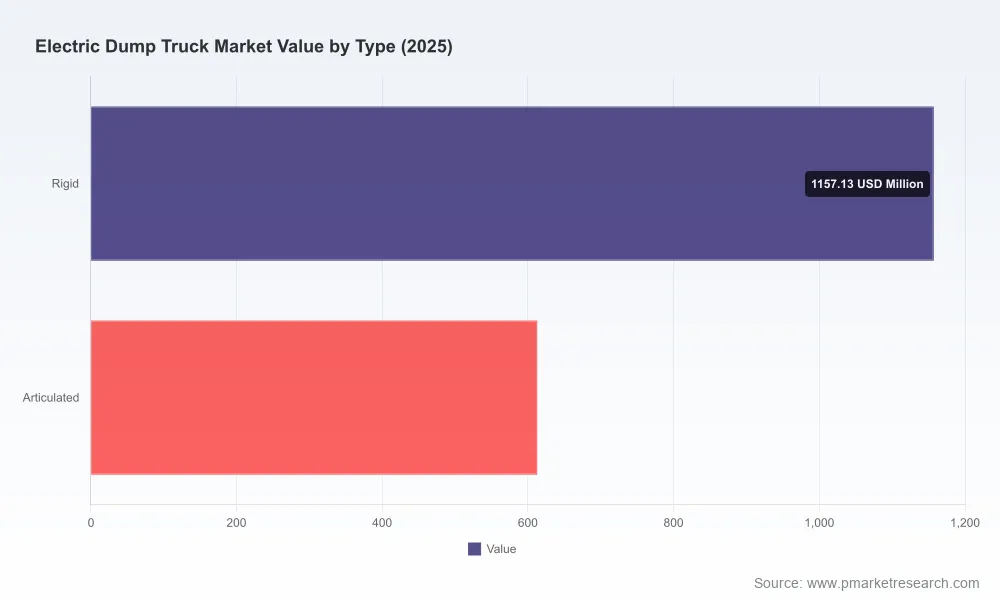
- Segment divergence and application fit. Not all electric dump truck use cases mature at the same pace. Rigid and articulated formats serve different site profiles, and the balance of deployment across mining, construction, and other applications will hinge on payload requirements, route characteristics, and regulatory exposure. Companies that treat the segment as a single category risk misreading where near-term volume and margin will appear.
These challenges are not blockers; they define where execution discipline creates advantage. The market is large enough to absorb multiple solutions, but winners will be those that match vehicle architecture to application realities and manage the cost curve without overreliance on any single input.
Key Drivers Reshaping the Market
Technology Innovation and Breakthroughs
Battery-electric haulage is benefiting from a convergence of improvements in energy storage, power management, and vehicle platforms. Heavy-duty battery costs have been trending toward a range that materially improves the economic case for electric dump trucks relative to diesel, especially in high-utilization roles where fuel and maintenance savings compound. Equally important, OEMs are increasingly designing platforms that can accommodate different powertrains, allowing customers to phase in electrification without abandoning existing operational flexibility. For mining, this means haul trucks that can operate today with conventional or hybrid configurations and transition toward battery-electric setups as site energy strategies mature. In construction and municipal settings, smaller rigid and articulated formats are reaching serial production with practical runtime and payload envelopes suited to daily cycles.
A useful lens is how product milestones are translating into commercial availability. Recent production starts for articulated electric haulers in European facilities mark a shift from limited runs to repeatable serial manufacturing. At the same time, large mining-class trucks are advancing through customer trials, with battery-electric prototypes in the 240-tonne class being tested at operating mine sites. These activities indicate that electrification is progressing on two parallel tracks: nearer-term volume in mid-size construction and quarry applications, and longer-cycle but high-value deployments in large-scale mining.
Policy and Regulatory Environment
Regulation is acting as both a floor and a catalyst. In major markets, zero-emission vehicle requirements, fleet procurement rules, and site-level emissions constraints are increasing the cost of continuing with diesel-only operations. In China, demand-side policies have supported a meaningful zero-emission share in dump truck sales during the first half of the year, reflecting a combination of local procurement incentives and total cost advantages for battery-electric models. Elsewhere, mining houses are setting decarbonization targets that cascade into haulage decisions, and construction projects in constrained urban or environmental zones are increasingly factoring emissions into bid eligibility and operating approvals.
The strategic implication is that policy is no longer just about compliance; it is becoming part of the purchasing logic. Where operators can demonstrate lower emissions without sacrificing productivity, electric dump trucks move from a sustainability narrative to an operational and commercial choice. This is particularly visible where site operators are willing to integrate energy planning into haulage contracts and fleet specifications.
Mining Dump Trucks Market
Demand-Side Behavior and Application Economics
Demand is shifting as operators reassess total cost, uptime, and site constraints rather than focusing solely on sticker price. In mining, the highest-value deployments are emerging where haulage is a major cost center and electrification can reduce exposure to fuel logistics, maintenance intensity, and emissions-related operational limits. Large orders for zero-emission mining trucks in the 240-tonne class illustrate how decarbonization strategies are becoming concrete procurement decisions, with multiple OEM relationships and site-specific engineering support playing a decisive role.
In construction and municipal use, electric dump trucks are appealing where routes are shorter, utilization is consistent, and noise or local emissions restrictions matter. Smaller electric dump trucks for vocational, municipal, and business applications are expanding the addressable base beyond traditional mining and heavy construction, creating additional volume pathways and brand visibility. The broader trend is that buyers are becoming more comfortable specifying electric where the duty cycle fits, and less willing to wait for perfect solutions when good-enough ones already deliver operational benefits.
Supply Chain and Cost Structure Dynamics
The cost structure for electric dump trucks is improving, but not in a straight line. Battery pack costs for heavy-duty applications have been declining toward levels that make electric haulage more competitive on ownership cost, yet raw material markets can still introduce volatility. Lithium carbonate prices have rebounded in recent months amid tightening supply and demand from both vehicle electrification and mining activity, reminding stakeholders that the cost curve can be interrupted even as the direction remains favorable. This means planning assumptions need to account for both the secular decline in storage costs and the cyclical behavior of key inputs.
At the same time, supply chain maturity is improving the feasibility of larger programs. OEMs with broader component access, established manufacturing footprints, and experience integrating battery systems are better positioned to scale volume and manage program risk. For customers, this reinforces the importance of vendor selection criteria that go beyond specifications to include production readiness, service coverage, and energy-system support.
Competitive Landscape and Leading Strategies
The market is contested by established heavy equipment manufacturers and a set of focused entrants, with strategies that diverge by application emphasis, geography, and powertrain philosophy. The competitive picture is not simply a race to electrification; it is a race to the right combination of payload, runtime, site integration, and service model.
Volvo Construction Equipment has moved articulated electric haulers into serial production, reflecting a construction and quarry-focused approach with practical runtime targets for daily operations. This positions the company to capture near-term volume in mid-size applications where site logistics and duty cycles are well suited to battery-electric use. Caterpillar is taking a more mining-centric path, developing and testing large battery-electric mining trucks with customer trials in Australia and other regions, emphasizing learnings from real operating environments before broader rollout. Komatsu’s strategy leans toward power-agnostic platforms, offering electric drive mining trucks that can support future battery-electric configurations, which reduces transition risk for customers planning gradual decarbonization.
Chinese manufacturers are expanding their presence in zero-emission mining haulage with substantial volume programs. XCMG has secured major orders for large electric mining trucks, including significant allocations for decarbonization-focused projects, while SANY Group is bringing electric off-highway mining trucks to open-pit operations with sizeable battery capacities for site-intensive work. Liebherr is collaborating on battery-electric mining trucks designed for autonomous, zero-emission haulage, pairing vehicle development with autonomy and site-level energy planning. Hitachi Construction Machinery is testing full battery rigid dump trucks at mine sites with external battery technology partners, indicating a focus on validating performance under actual operating conditions. In North America, RIZON Truck is addressing Class 4-5 all-electric dump truck needs for municipal, business, and vocational applications, highlighting a different segment where smaller electric formats can gain traction.
A notable development outside the core OEM set is the emergence of electric vocational vehicles configurable with dump bodies, showcased in North American industry events. This signals that the commercial vehicle ecosystem is also contributing to the electric dump truck opportunity, especially where vocational and municipal usage patterns align with smaller battery-electric platforms.
Several strategic themes stand out:
- Application specialization. Leading players are differentiating by where they expect volume and value to concentrate, whether in mining-class haulage, articulated construction haulers, or smaller vocational formats.
- Platform flexibility versus dedicated electrification. Some OEMs emphasize architectures that can adapt over time, while others are pushing dedicated battery-electric products into serial production for specific applications. Both approaches can win, but they create different customer value propositions.
- Commercial model innovation. Large mining orders and site-specific trials suggest that success increasingly depends on integrating equipment with energy planning, service support, and operational validation, not just hardware specifications.
- Regional relevance. Competitive positioning is being shaped by local policy, mining activity, and manufacturing proximity, meaning global strategies must be translated into regional execution.
The market is likely to see further consolidation of capability, not necessarily through mergers alone, but through partnerships, selective supplier relationships, and the emergence of companies that can deliver a credible combination of vehicle, energy, and service. At the same time, new entrants with focused product concepts can still carve out positions in under-served segments, especially where incumbents are slower to meet specific duty-cycle requirements or regional demand.
Future Trends and Commercial Opportunities
Electrification Will Segment by Application Economics, Not Just by Technology
Over the next three to five years, the strongest growth will likely concentrate where duty cycles, payload needs, and energy access align with electric dump truck economics. Mining will remain a high-value arena, especially for larger haul trucks where decarbonization targets and operating cost pressures reinforce electrification. Construction and quarry operations will see growing adoption of mid-size rigid and articulated formats, particularly where runtime and payload targets fit daily cycles. Municipal and vocational applications will expand the addressable base for smaller electric dump trucks, creating volume and brand effects that can feed broader portfolio strategies.
The commercial opportunity here is to align product planning and go-to-market with application-specific economics rather than treating electrification as a uniform shift. Companies that can quantify where electric dump trucks outperform diesel on total cost under realistic site conditions will be better placed to win specifications and repeat orders.
Energy Integration Is Becoming Part of the Product
As electric dump trucks scale, site energy strategy is moving from an afterthought to a core part of the value proposition. Charging approaches, opportunity top-up, thermal management, and integration with site power systems will increasingly differentiate offerings. In mining, the link between haulage electrification and broader site decarbonization planning creates opportunities for OEMs and service providers that can support energy architecture, not just vehicles. In construction and municipal settings, simpler energy setups can still matter if they reduce downtime and make electric assets easier to adopt.
This trend creates opportunities for providers that can bundle equipment with practical energy solutions, remote monitoring, and service models that reduce operational uncertainty. It also raises the bar for entrants that offer vehicles without a credible plan for site-level deployment.
Cost Curve Progress Will Continue, but Input Volatility Will Require Smarter Planning
Battery and component costs are expected to remain on a favorable trajectory, strengthening the economic case for electric dump trucks over time. However, raw material cycles and supply constraints can still create periods of pressure, especially for larger battery packs and specialized systems. Operators and manufacturers that build flexibility into procurement, design, and service planning will be better positioned to manage these swings.
For commercial strategy, the implication is to treat cost improvement as a baseline assumption while preparing for short-term volatility. This may mean broadening supplier options, designing for modularity, and structuring fleet plans so that electrification can proceed in phases where returns can be validated before larger commitments.
PW Consulting Automotive & Machinery Research Center
Strategic Implications for Decision Makers
Different stakeholders face distinct priorities, but several actions are broadly relevant across the market.
For Manufacturers and Technology Providers
- Focus product roadmaps on the applications where electric dump trucks already make economic sense, and sequence scale-up accordingly. Near-term volume in construction, quarry, and municipal formats can fund learning that supports later mining-class programs.
- Invest in site-integration credibility. Customers are increasingly evaluating electric dump trucks on deployment practicality, energy compatibility, and service support, not just specifications.
- Manage the battery supply and cost challenge proactively. Design flexibility, supplier diversification, and modular architectures can help preserve margin and program stability during input price swings.
For Investors and Corporate Development Teams
- Assess opportunities by application rather than by broad category. The value pools in mining haulage, mid-size construction, and vocational electric dump trucks are developing at different speeds and with different margin profiles.
- Look for evidence of production readiness and repeatable deployment, not just prototypes. Serial production milestones, customer trials at operating sites, and large order intake are indicators of commercial traction.
- Track energy and service as potential value centers. Businesses that can capture recurring value through energy planning, monitoring, and service may have more durable economics than hardware-only models.
For Fleet Operators and Procurement Leaders
- Start with duty-cycle fit. The strongest near-term gains from electric dump trucks will come where routes, payload requirements, and energy access match vehicle capabilities. A disciplined application selection process reduces adoption risk.
- Plan energy and service together with vehicle procurement. Even capable electric trucks can underperform if site energy strategy and maintenance coverage are not aligned, so treat deployment as a system decision.
- Stage commitments to validate total cost performance. Phased adoption in suitable applications allows operators to confirm real-world economics before scaling, while still capturing early operational benefits.
The pace and shape of electrification in dump trucks will be determined by how well stakeholders connect technology, application economics, and site-level execution. Markets are moving quickly enough that assumptions made today can become outdated within planning cycles, especially as production scales, policy evolves, and energy cost dynamics shift. For decision makers who need more granular segmentation, regional detail, and customized scenario planning, the full PW Consulting report provides the deeper data set and application-specific analysis required to convert these trends into actionable strategy.
For detailed analysis of this topic, please visit the official page: Electric Dump Truck Market
Lacy Lee
Senior Marketing Manager
[email protected]
PW Consulting: www.pmarketresearch.com
































Sign in to leave a comment.