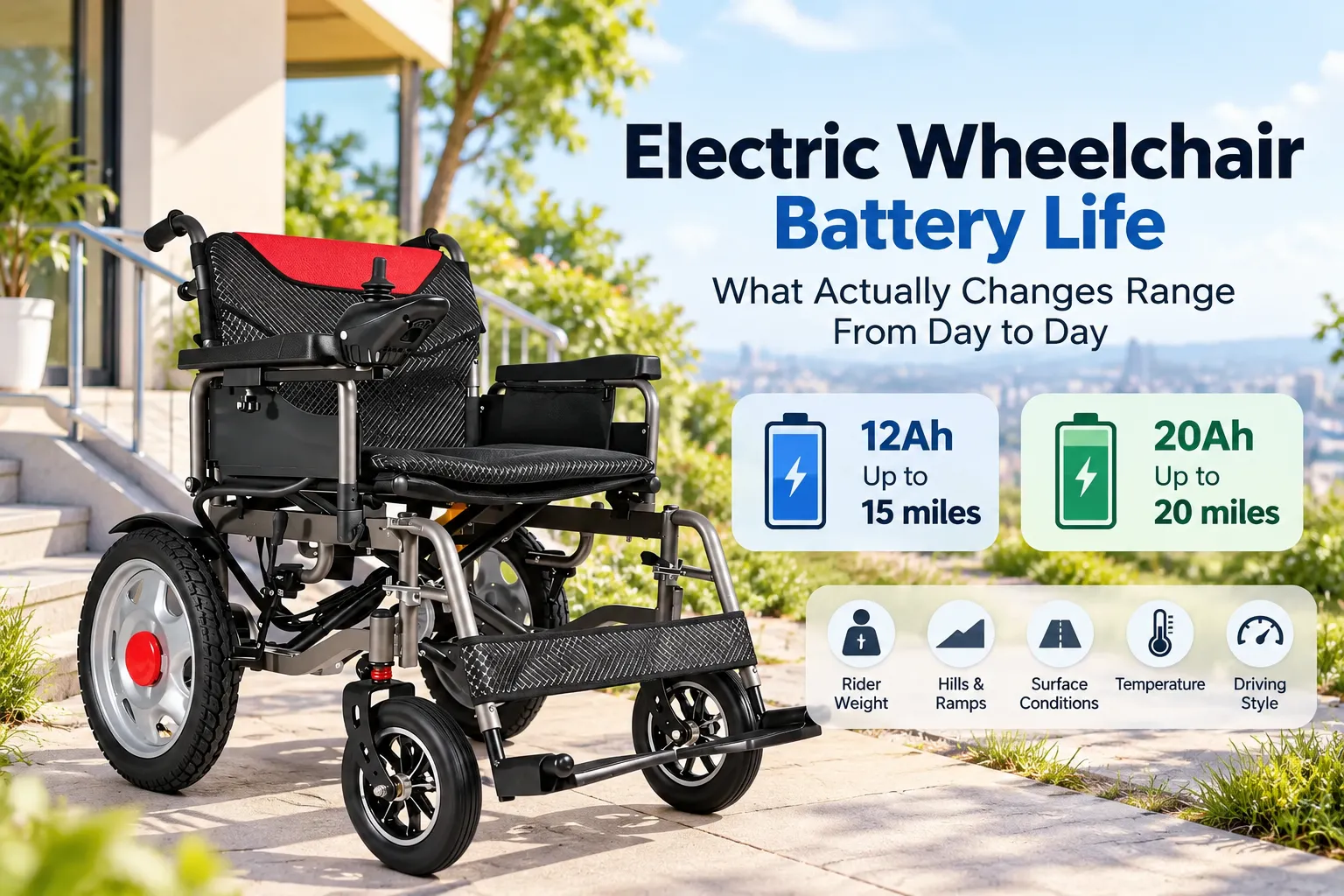

Choosing between Anywell 12Ah and 20Ah options and another 20Ah mobility setup such as the mobility scooter makes more sense when you treat electric wheelchair battery life as a route-planning question rather than a single mileage number.
A wheelchair may have a published range per charge, but that figure should not be treated as a guarantee that every rider will travel exactly that distance. Rider and cargo weight, hills, surface conditions, temperature, battery condition, stop-and-start driving, and even tire condition can change the distance available on a particular day.
That is why the more useful question is not simply, “How long does an electric wheelchair battery last?” It is: How much dependable range do I need for the routes I actually travel?
Electric Wheelchair Battery Life Means Two Different Things
People often use “battery life” to describe two separate things.
The first is range per charge: how far the wheelchair can travel before it needs to be recharged.
The second is battery service life: how long the battery itself continues to perform adequately before aging eventually makes replacement necessary.
For day-to-day mobility planning, range per charge is usually the immediate concern. Battery age still matters because an older or poorly maintained battery may no longer deliver the same usable distance it did when newer.
Manufacturers make the same distinction indirectly in their range specifications. Pride Mobility, for example, notes that power-chair range can vary with user weight, terrain, battery amp-hour capacity, state of charge, battery condition, and tire condition.
So a listed range is best considered a planning benchmark, not a promise.
What Does 12Ah vs. 20Ah Actually Mean?
“Ah” means amp-hours, a measure of battery capacity.
If two battery systems operate at the same voltage, a higher Ah rating generally means more stored electrical energy is available. For example:
| Battery setup | Nominal voltage | Capacity | Approx. nominal energy |
|---|---|---|---|
| 12Ah | 24V | 12Ah | 288Wh |
| 20Ah | 24V | 20Ah | 480Wh |
The watt-hour figures above are simple nominal calculations: volts × amp-hours. They do not mean every watt-hour is available for propulsion or that range increases in a perfectly linear way.
This matters when comparing real products.
The Anywell YS16-1 MAX 12Ah configuration uses a 24V 12Ah lead-acid battery and is currently listed for up to 15 miles of rated range. Its 20Ah version uses a 24V 20Ah lead-acid battery and is listed for up to 20 miles. Anywell also states that actual range varies with load, terrain, slope, temperature, battery condition, and driving behavior.
Notice that moving from 12Ah to 20Ah does not turn the published 15-mile figure into 25 miles simply because capacity increased by about two-thirds. Wheelchair efficiency, motors, control systems, battery characteristics, testing conditions, and real-world resistance all matter.
That is why comparing batteries only by Ah can be misleading.
Why Your Actual Electric Wheelchair Range Changes
Imagine taking the same electric wheelchair on two trips.
On Monday, the route is mostly level pavement, the battery is fully charged, the weather is mild, and there are few stops.
On Saturday, the chair carries shopping bags, travels over rough sidewalks, climbs several ramps, repeatedly accelerates from stops, and spends part of the day in colder or hotter conditions.
The battery did not suddenly become a different battery. The energy demand of the trip changed.
Here are the main factors worth considering.
1. Rider and Cargo Weight
Moving more mass requires more energy, particularly when starting, climbing, or travelling over surfaces with higher rolling resistance.
This is easy to overlook because your daily load may change. A trip to the mailbox and a trip home with groceries are not necessarily equivalent from the battery's perspective.
Published specifications from other power-chair manufacturers also illustrate the effect. Pride's Jazzy Elite 14, for example, lists different maximum ranges at 200 lb and 300 lb rider loads.
The practical lesson is simple: plan around your normal occupied load, not an empty wheelchair.
2. Hills and Ramps
Climbing requires substantially more work than travelling on level ground.
A route with repeated driveway slopes, curb ramps, parking-garage inclines, or neighborhood hills can consume more battery than its mileage alone suggests.
A two-mile hilly route may therefore be more demanding than a longer flat route.
When planning regular journeys, map the elevation changes, not just the distance.
3. Surface Conditions
Smooth indoor flooring and good pavement generally create less rolling resistance than rough asphalt, damaged sidewalks, thick carpet, gravel, or other uneven surfaces.
More resistance means the motors need to work harder.
This is one reason “electric wheelchair range” should always be considered together with where you intend to drive.
4. Stop-and-Start Driving
Maintaining a steady speed on a clear path is different from repeatedly accelerating, slowing, turning, and stopping.
A shopping center, crowded neighborhood, medical campus, or busy sidewalk may involve far more speed changes than a straightforward outdoor path.
Your five-mile city route may therefore use energy differently from someone else's five-mile suburban route.
5. Temperature
Battery performance is temperature-sensitive.
Very hot conditions can affect battery health, while cold conditions can reduce available performance. Pride Mobility also cautions that excessive heat can negatively affect mobility-device batteries and recommends protecting them from high-temperature exposure.
For someone who stores a wheelchair in an unconditioned garage, temperature deserves particular attention.
Permobil recommends storing and charging its wheelchair batteries in a dry indoor environment around room temperature and notes that very hot, cold, or humid garages may not be suitable. Always follow the instructions for your own wheelchair and battery system rather than applying another manufacturer's charging instructions directly.
6. Battery Condition
Battery performance changes with age and use.
If a familiar trip that once left plenty of reserve starts using nearly all available charge, investigate the battery, charger, connections, tires, and wheelchair condition rather than assuming the published range was simply inaccurate.
A gradual loss of usable range can be an early sign that the battery system needs attention.
7. Driving Style
Frequent rapid acceleration, constant speed changes, and demanding maneuvering can increase energy consumption.
You do not need to drive artificially slowly everywhere, but smooth operation makes range easier to predict.
For regular routes, consistency is useful because it gives you a more realistic personal baseline.
How Long Does an Electric Wheelchair Battery Last on a Normal Day?
There is no single answer because “a normal day” varies enormously.
Instead, create a basic route budget.
Suppose your typical outing includes:
- 1.5 miles from home to a shopping area
- 0.5 mile moving between stores
- 1.5 miles returning home
- another 0.5 mile for unexpected detours
Your expected travel distance is about four miles.
You should not choose a wheelchair simply because its published specification exceeds four miles. You also need reserve for slopes, surface conditions, battery aging, temperature, extra stops, or a route change.
A better planning approach is:
Expected route + return trip + realistic reserve
The reserve is the important part.
If completing the trip requires using almost the entire theoretical maximum range, the route leaves little room for normal variation.
12Ah or 20Ah: Which Fits Different Daily Routines?
The better choice depends less on which number sounds larger and more on how the wheelchair will actually be used.
A 12Ah setup may make sense when:
- Most trips are relatively short.
- Charging access is predictable.
- The rider rarely spends an entire day away from charging.
- Typical routes are familiar and easy to estimate.
- Extra range is less important than other practical considerations.
The YS16-1 MAX 12Ah, for example, is currently rated for up to 15 miles under suitable conditions.
A 20Ah setup may make sense when:
- Outings routinely cover longer distances.
- The user spends more time away from home.
- Routes include more slopes or demanding surfaces.
- Unexpected detours are common.
- Having more route reserve is a priority.
The corresponding YS16-1 MAX 20Ah configuration is currently listed for up to 20 miles, again with the manufacturer explicitly noting that real distance varies with operating conditions.
The key word in both specifications is “up to.”
A higher-capacity battery can provide additional flexibility, but it should not encourage planning trips right to the published limit.
Do Not Compare Ah Without Comparing the Whole Chair
Battery size is useful, but it is only one specification.
Two wheelchairs can both use 20Ah batteries and still deliver different real-world ranges because their motors, controller tuning, total weight, wheel size, drivetrain efficiency, speed, and other design choices differ.
You can see this across the broader power-chair market. Pride's Jazzy Ultra Light offers both 10Ah and 20Ah batteries, yet its listed range changes not only with battery size but also with user weight.
So when comparing models, look at:
- battery capacity
- battery chemistry
- manufacturer's rated range
- rider/load assumptions
- chair weight
- intended surfaces
- tire condition and design
- charging requirements
- the route you actually expect to travel
Ah is one part of the range equation, not the final answer.
A Better Way to Test Your Real-World Range
Once you own the wheelchair, your own repeatable observations become extremely useful.
Start with a fully charged battery and choose a familiar, relatively short route.
Track:
- approximate distance travelled
- hills or ramps
- surface type
- rider plus cargo load
- weather conditions
- starting and ending battery indication
Repeat the route several times under similar conditions.
You are not trying to conduct a laboratory test. You are building a personal reference point.
If the wheelchair consistently completes your routine with substantial reserve, you can gradually understand what longer outings are reasonable.
Avoid using one unusually successful trip as proof that the wheelchair will always deliver the same distance.
Common Battery-Range Planning Mistakes
Treating the maximum range as your target route
If a wheelchair says “up to 20 miles,” planning a 19- or 20-mile outing gives very little margin for real-world variation.
Assuming 20Ah automatically means a specific mileage
Battery capacity helps, but chair design and operating conditions also determine range.
Forgetting the return journey
An outward trip that feels easy can become a problem if there is insufficient battery reserve to get home.
Ignoring a gradual drop in range
A noticeable change deserves investigation. Battery condition, charging, tires, electrical connections, or other mechanical factors may be involved.
Comparing specifications from different models as though testing conditions are identical
Manufacturer range figures are useful references, but unless products are tested under identical conditions, direct mileage comparisons should be treated cautiously.
FAQ
How long does an electric wheelchair battery last per charge?
It depends on the wheelchair, battery size, rider and cargo weight, terrain, temperature, battery condition, driving behavior, and other factors. Use the manufacturer's rated range as a reference and leave additional reserve when planning real trips.
Does a 20Ah battery last longer than a 12Ah battery?
When voltage and other conditions are comparable, 20Ah represents greater nominal battery capacity than 12Ah. However, it does not guarantee a fixed percentage increase in actual driving range.
Why is my electric wheelchair range lower than advertised?
A published range is normally achieved under specified or suitable conditions. Hills, heavier loads, frequent stops, rough surfaces, temperature, tire condition, and battery condition can all reduce real-world distance.
Should I completely drain the battery before charging?
Do not apply generic battery advice without checking the manual for your specific wheelchair, battery chemistry, and charger. Charging requirements differ between battery systems. Follow the wheelchair manufacturer's instructions.
Is a bigger battery always better?
Not necessarily. More range can be useful, but battery capacity should be considered alongside the wheelchair's total weight, portability, fit, charging requirements, route needs, and transport plan.
Final Takeaway
The most useful way to think about electric wheelchair battery life is not “How many miles can this battery theoretically deliver?” but “How much dependable range does my normal routine require?”
A 12Ah configuration may provide ample reserve for shorter, predictable outings. A 20Ah configuration can make more sense when longer routes or extra flexibility matter. But neither battery size eliminates the effects of hills, load, temperature, driving conditions, battery age, and unexpected detours.
Start with the manufacturer's range specification, then plan conservatively around your own routes. Once you understand how the wheelchair performs in your everyday environment, battery capacity becomes much easier to interpret—and much more useful than a mileage number viewed in isolation.



























Sign in to leave a comment.