
Strategic Trends and Commercial Opportunities in the Worldwide Electron Beam Irradiation Services Market
Market Overview: Size, Momentum, and Structural Pressures
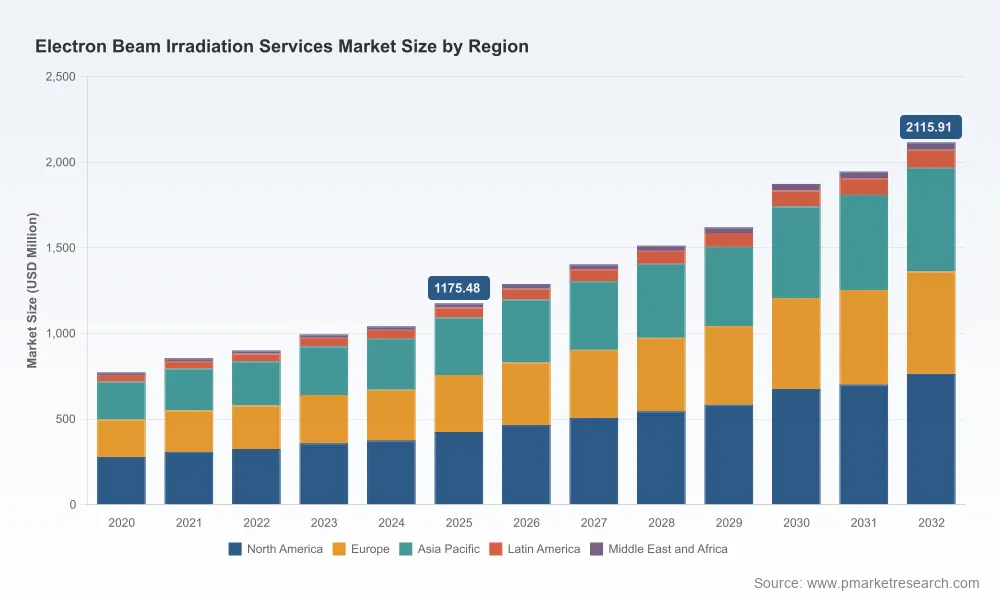
The global electron beam irradiation services market has entered a phase of steady, sustained expansion. Valued at approximately 772.45 million USD in 2020, the market reached 1175.48 million USD by 2025, reflecting a compound annual growth rate of 8.76 percent over the historical period. Projections extend through 2032, with revenue expected to surpass 2115.91 million USD. This trajectory is not merely a function of incremental demand growth; it signals a structural shift in how industries approach sterilization, material modification, and precision processing. Electron beam technology has moved from a niche alternative to a strategically integrated capability within high-value supply chains.
Several structural pressures are reshaping how operators and end-users navigate this expansion. First, regulatory scrutiny around traditional sterilization modalities, particularly ethylene oxide, has accelerated qualification and adoption of electron beam alternatives. Facilities must now navigate ISO certifications, FDA registration for medical device and pharmaceutical contract sterilization, and rigorous dosimetry and process validation standards. Compliance has become a barrier to entry but also a competitive moat for established players. Second, the energy intensity of e-beam accelerators introduces operational vulnerability. Radiation processing with e-beam accelerators is energy-intensive, and sustainable operations depend on reliable electricity sources and efficient accelerator utilization. As industrial energy costs fluctuate, operators are forced to balance throughput optimization with power management. Third, the market exhibits moderate concentration, with the top three players capturing roughly 38.42 percent of revenue and the top five accounting for 52.18 percent. This level of concentration suggests room for specialized entrants in underserved geographies or application niches, while simultaneously pressuring mid-tier operators to consolidate or differentiate through service quality and turnaround speed.
For decision-makers, the core implication is clear: electron beam irradiation is no longer a commodity utility. It is a capability-driven service where validation expertise, energy efficiency, geographic proximity to end-users, and turnaround reliability determine market share. Companies that treat irradiation as a strategic partnership rather than a transactional processing step will capture disproportionate value as demand scales.
Key Demand Drivers: Technology, Regulation, and Supply Chain Realignment
The expansion of electron beam irradiation services is being propelled by a convergence of technological maturity, regulatory pressure, and shifting supply chain priorities. Each driver reinforces the others, creating a self-sustaining momentum that extends well beyond cyclical demand fluctuations.
Technological Innovation and Processing Precision
Accelerator technology has progressed steadily, enabling higher throughput, tighter dose control, and broader material compatibility. Modern high-energy systems above 5 MeV dominate revenue share, reflecting their established role in medical device sterilization and polymer cross-linking where deep penetration and consistent dosing are critical. Medium-energy systems in the 1 to 5 MeV range capture substantial demand for surface-level treatments and thinner material profiles, while low-energy systems below 1 MeV serve specialized applications requiring minimal penetration depth. The practical impact of this segmentation is operational flexibility: providers can match energy levels to product geometry, density, and sterility assurance requirements without over-processing or compromising material integrity.
Trans Resveratrol Market
Recent capacity investments illustrate this trajectory. In February 2026, E-BEAM Services Inc. announced investment in a new high-energy electron beam accelerator to enhance processing efficiency and capacity. Such capital deployment signals confidence in sustained demand and underscores the industry’s focus on throughput scalability. For end-users, the implication is shorter lead times, more consistent batch-to-batch results, and the ability to qualify electron beam processing earlier in product development cycles rather than retrofitting sterilization strategies after design lock-in.
Regulatory Environment and Sterilization Modality Shifts
Regulatory dynamics continue to reshape sterilization strategy across medical device and pharmaceutical manufacturing. Electron beam sterilization facilities require ISO certifications, FDA registration for medical device and pharmaceutical contract sterilization, and compliance with dosimetry and process validation standards. These requirements are non-trivial, but they also create a structural advantage for operators with established quality systems and validated processes. More importantly, e-beam processing offers advantages in meeting time-sensitive supply chains through customized dosing and fast product release without quarantine periods compared to other modalities. In an industry where inventory buffering and rapid market access are increasingly valuable, turnaround speed has become a commercial differentiator, not just an operational metric.
The regulatory tailwind is not limited to compliance. As health authorities and industry groups emphasize residue-free sterilization and reduced environmental impact, electron beam technology benefits from its non-chemical profile. Manufacturers seeking to diversify their sterilization mix are evaluating e-beam alongside gamma and EtO, often positioning it as a primary or secondary modality depending on material compatibility and volume requirements. This modality diversification reduces single-point risk in sterilization supply chains and expands the addressable market for electron beam service providers.
Demand-Side Shifts and Supply Chain Resilience
On the demand side, medical device and pharmaceutical manufacturers are prioritizing sterilization partners that can scale with product launches, support rapid iteration, and maintain consistent quality across geographies. The rise of decentralized manufacturing, nearshoring, and dual-sourcing strategies has increased the need for regional irradiation capacity. Customers are no longer willing to ship sensitive products across continents for processing when localized facilities can offer faster release and reduced logistics risk.
Energy cost and operational efficiency are also reshaping procurement decisions. Smaller in-line electron beam systems operate at about 4 dollars per hour, while larger systems cost between 15 and 20 dollars per hour, with stable clean electrical power being a key requirement. These cost differentials influence facility siting, capacity planning, and service pricing. Operators that invest in accelerator utilization efficiency, load management, and energy-optimized scheduling can offer more competitive terms while preserving margin integrity. For buyers, the strategic question is not only whether electron beam sterilization is technically suitable, but whether the service provider’s cost structure and energy resilience align with long-term supply chain stability.
Competitive Landscape: Positioning, Differentiation, and Market Evolution
The competitive environment in electron beam irradiation services is defined by a mix of global contract sterilizers, specialized e-beam providers, and regional operators expanding capacity to capture localized demand. Leadership in this market is increasingly determined by facility footprint, accelerator capacity, validation expertise, and the ability to serve multiple industries under one quality system.
Several companies illustrate the dominant strategic archetypes. Steris AST provides global contract electron beam irradiation sterilization services with facilities across the Americas, Europe, Asia, and South Africa, including comprehensive laboratory testing and technical support for medical devices and pharmaceuticals. Its positioning emphasizes geographic reach and integrated technical services, which appeals to multinational manufacturers seeking consistent quality across regions. Sterigenics offers electron beam sterilization services as part of a broad portfolio including gamma and EtO, operating numerous facilities worldwide with focus on medical devices and pharmaceuticals. This multi-modality approach gives it flexibility to route products based on material constraints, volume, and regulatory requirements. E-BEAM Services, Inc. operates as a specialized contract electron beam processing provider with over 700 kW installed accelerator capacity across multiple US facilities in Ohio, New Jersey, and Indiana, serving medical device, pharmaceutical, and material modification needs. Its strategy centers on depth of e-beam expertise and domestic capacity concentration, which supports fast turnaround and close collaboration with US-based manufacturers.
Regional and specialized players are also shaping the landscape. BGS Beta-Gamma-Service GmbH & Co. KG provides radiation sterilization services including a state-of-the-art E-Beam facility in the US, focusing on medical devices and pharmaceuticals with fast turnaround. In August 2025, BGS US launched a state-of-the-art E-Beam sterilization facility in Imperial, PA, near Pittsburgh International Airport, to provide rapid validated sterilization for medical devices and pharmaceuticals. This expansion reflects a deliberate strategy to place high-throughput capacity near logistics hubs and customer clusters, reducing transit time and accelerating release. Steri-Tek operates as a high-volume E-beam and X-ray contract sterilizer and R&D center serving medical device, biotech, pharmaceutical, and tissue industries with facilities in California and Texas. Its dual focus on production and R&D supports early-stage qualification and process development, which is increasingly valuable for innovators bringing complex devices or biologics-adjacent products to market. NextBeam provides reliable contract electron beam sterilization services with emphasis on precise, efficient processing for various volumes and industries including medical and consumer products, positioning itself around consistency and flexible volume handling.
The competitive field also includes international capacity builders and equipment-linked service models. CGN Nuclear Technology Development is a major provider of electron beam irradiation services with significant capacity expansion, particularly active in Asia-Pacific for sterilization applications. NHV Corporation offers electron beam irradiation equipment and related processing services globally, while Guangzhou Huada Biotechnology provides irradiation sterilization technology solutions including electron beam services. Acsion offers electron beam irradiation services for sterilization, and Ionisos provides contract irradiation sterilization services including electron beam capabilities. Nutek Bravo specializes in E-beam and X-ray sterilization services along with engineering support, adding a technical services layer that can be attractive to customers navigating validation and line integration.
The market is evolving along two parallel tracks. On one hand, consolidation pressure is rising among mid-tier operators who must invest in accelerator upgrades, quality systems, and geographic coverage to remain competitive against well-capitalized global players. On the other hand, differentiation opportunities remain strong for providers that specialize in fast turnaround, regional proximity, multi-industry flexibility, or integrated engineering support. New entrants are most likely to succeed by targeting underserved application niches, aligning facility siting with logistics corridors, or offering hybrid e-beam and X-ray capabilities that broaden material compatibility. The strategic lesson is that scale alone does not guarantee leadership; validated process expertise, energy-efficient operations, and customer-centric turnaround models are becoming equally decisive.
Castor Oil Modified Polyol Market
Future Outlook: Three Vectors Shaping the Next 3 to 5 Years
Looking ahead, the market is likely to be shaped by three interlocking trends. First, capacity additions will continue to concentrate in regions with strong medical device manufacturing, pharmaceutical production, and material modification demand. Expect further facility launches near logistics hubs and customer clusters, particularly in North America and Asia-Pacific, as operators seek to reduce transit times and improve responsiveness. This geographic realignment will gradually shift bargaining dynamics for buyers who gain access to more localized options, while also raising the importance of regional regulatory readiness and dosimetry standardization.
Second, energy efficiency and operational resilience will move from back-office concerns to strategic differentiators. As accelerators become more powerful and utilization rates increase, providers that master load scheduling, power stability, and maintenance optimization will be able to sustain competitive pricing without sacrificing throughput. This trend creates opportunities for partners who can integrate energy management into facility design and for buyers who evaluate irradiation suppliers on total cost of ownership rather than per-batch price alone. The risk is that energy volatility or grid reliability issues could asymmetrically affect operators in regions with less stable power infrastructure, potentially delaying capacity deployment or raising operating costs.
Third, the sterilization modality mix will continue to diversify, with electron beam gaining share in applications where speed, residue-free processing, and material compatibility align. The practical opportunity lies in early qualification: manufacturers that validate electron beam processing during product design rather than after commercialization will benefit from faster release, simpler supply chains, and greater flexibility in partner selection. The counterrisk is regulatory or standards evolution that could alter validation requirements, dose specifications, or acceptance criteria, requiring operators and customers to adapt processes and documentation. Companies that maintain close engagement with quality systems, dosimetry practices, and regulatory developments will be better positioned to navigate such changes.
Strategic Actions for Decision-Makers
For medical device and pharmaceutical manufacturers, the priority is to treat electron beam sterilization as a design-stage consideration rather than a late-stage compliance check. Engaging irradiation partners early can accelerate qualification, reduce rework, and unlock faster product release through customized dosing and shorter turnaround cycles. Manufacturers should also map their sterilization modality mix to material requirements, volume profiles, and geographic logistics, ensuring that e-beam capacity is positioned where it delivers the greatest supply chain value.
For investors and strategic acquirers, the opportunity lies in identifying operators with scalable accelerator capacity, strong validation track records, and facility footprints aligned with demand corridors. Capital deployment in high-energy systems, regional expansion near logistics hubs, and integration of engineering support services are indicators of competitive intent. Due diligence should weigh energy resilience, regulatory readiness, and customer concentration alongside revenue growth, since operational durability will increasingly determine margin stability.
PW Consulting
For procurement and supply chain leaders, the actionable focus is supplier diversification and total-cost evaluation. Engaging multiple qualified irradiation providers across regions can reduce single-point risk, while evaluating energy-efficient operators and fast-release capabilities can improve overall supply chain responsiveness. Buyers should also verify ISO certifications, FDA registration where applicable, and dosimetry and process validation compliance to ensure that service quality matches commercial expectations.
Detailed segmentation data, regional revenue breakdowns, application-level demand patterns, and company-level capacity assessments can sharpen these decisions further. Stakeholders seeking granular intelligence on service-type dynamics, energy-level adoption, competitive capacity maps, and scenario-based forecasts can access the full PW Consulting report for comprehensive datasets and customized strategic recommendations.
For detailed analysis of this topic, please visit the official page: Worldwide Electron Beam Irradiation Services Market
Lacy Lee
Senior Marketing Manager
[email protected]
PW Consulting: www.pmarketresearch.com



























Sign in to leave a comment.