
Why Sourcing Needs A Complete Lifecycle Approach
An End to end sourcing strategy looks beyond supplier selection and contract negotiation. For modern enterprises, procurement decisions affect operating models, cost structures, risk exposure, technology adoption, stakeholder alignment, and long-term business performance. That is why end to end procurement consulting is becoming more valuable for organizations that want sourcing decisions to deliver measurable results beyond the initial transaction.
A supplier may be selected successfully, but that does not guarantee the expected savings or operational improvements will materialize. Transition issues, unclear ownership, weak governance, supplier performance problems, and changing business requirements can quickly undermine the original business case.
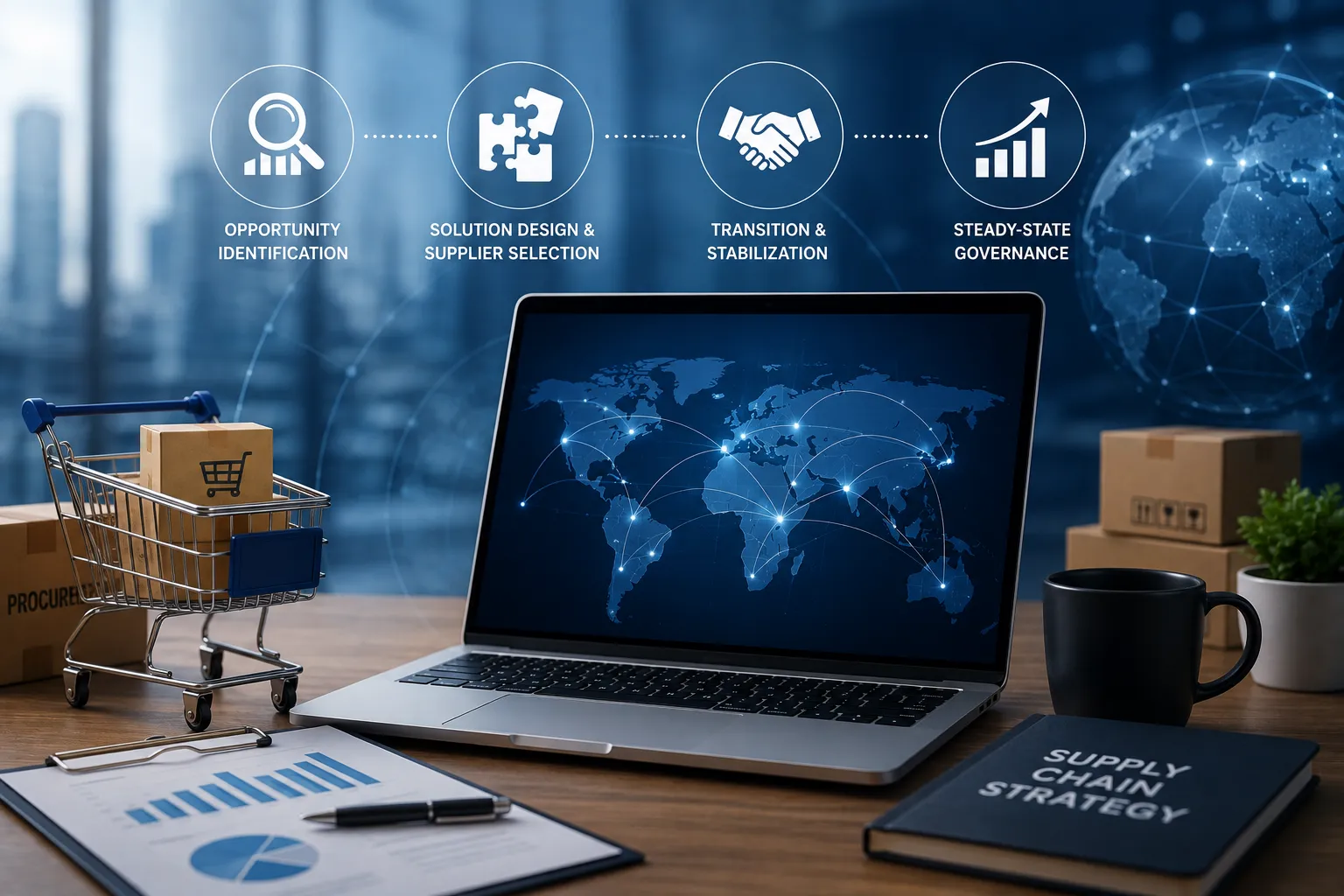
The stronger approach is to treat sourcing as a connected lifecycle. Neo Group's Global Sourcing Lifecycle Framework follows this principle by connecting strategy, execution, transition, and governance rather than treating them as separate projects.
End To End Procurement Starts With Strategic Alignment
End to end procurement consulting should begin before an organization starts comparing suppliers.
The first question should not simply be, “Which supplier should we select?” It should be, “What should we source, retain internally, automate, or redesign?”
This distinction matters because not every business activity should be outsourced. Neo's framework uses a Core vs. Context approach to distinguish activities that create competitive differentiation from those that are necessary for operations but do not directly differentiate the organization.
For example, a financial institution may consider product innovation and risk modeling core capabilities, while infrastructure support or certain administrative activities may be considered context functions.
This type of assessment creates a stronger foundation for an End to end sourcing decision because the organization is evaluating ownership and operating-model choices before entering supplier discussions.
Designing The Right Operating Model First
Once a sourcing opportunity has been identified, the next stage is designing the future-state operating model.
This is where outsourcing procurement services can extend beyond traditional procurement activity. Organizations may need to evaluate whether outsourcing, a Global Capability Center, automation, or another sourcing model is the best fit for the business.
The decision should consider more than price.
Operational requirements, scalability, governance expectations, technology, risk, internal capabilities, and long-term business objectives all influence the right model.
A lower-cost supplier may not necessarily be the best option if the operating model cannot scale with demand or support future transformation.
That is why an End to end approach connects supplier selection with the broader operating model rather than treating procurement as an isolated purchasing exercise.
Supplier Selection Needs More Than Pricing
Price will always matter in sourcing, but it should not become the only measure of supplier suitability.
A mature sourcing process evaluates whether a supplier can support the organization's broader objectives and operating requirements.
Supplier capability, scalability, performance expectations, governance, transition requirements, and long-term value should all be considered before contracts are finalized.
Neo Group describes its approach as a buy-side perspective, with recommendations designed around client interests rather than supplier-side incentives. The company states that it has not accepted supplier fees, referral payments, research sponsorships, or commissions since its founding in 1999.
For decision-makers, this kind of independence can be particularly important when several suppliers offer similar commercial propositions.
The best sourcing decision is not always the cheapest one. It is the one that provides the strongest balance between cost, capability, risk, flexibility, and business outcomes.
Contracts Must Support Changing Business Needs
Contracting is another area where an End to end approach makes a difference.
Traditional agreements can be built around assumptions about labor, service volumes, processes, and delivery models. But those assumptions can change quickly as automation and AI reshape how services are delivered.
Neo's framework highlights the need for contracts that support flexibility, accountability, and continuous adaptation as technology and operating models evolve.
This is especially relevant when businesses are considering outsourcing procurement or technology-intensive services.
A contract should provide commercial clarity while leaving enough flexibility to respond to changing business requirements.
The goal is not simply to negotiate favorable terms at the beginning. It is to create an agreement that can continue supporting the business as circumstances change.
Transition Is Where Sourcing Plans Face Reality
A well-designed sourcing strategy can still fail during implementation.
Transition introduces practical challenges that may not be visible during supplier evaluation. Knowledge transfer, stakeholder resistance, unclear responsibilities, process disruption, and communication gaps can all affect operational continuity.
Neo identifies transition, adoption, and operational stabilization as a distinct stage within its Global Sourcing Lifecycle Framework.
The Human Side Of Transition
Employees need to understand why the change is happening, what will change, and how responsibilities will evolve.
Leadership communication is equally important. Without consistent communication, uncertainty can create resistance even when the underlying sourcing strategy is commercially sound.
Ownership Must Be Clear
Internal teams and suppliers also need clearly defined roles.
Without shared accountability, issues can move between teams without resolution. Establishing responsibilities early helps organizations maintain control during the transition.
An effective End to end model therefore treats transition as business transformation rather than simply project administration.
Stabilization Creates The Foundation For Performance
Once a new sourcing model goes live, the work is not finished.
The organization needs to stabilize operations and confirm that the new delivery model is functioning as intended.
This involves establishing performance measures, escalation paths, governance structures, and accountability mechanisms.
A successful transition should move the business from implementation into stable operations without unnecessary disruption.
For example, if an outsourced finance process goes live but invoice exceptions increase significantly, the organization needs a defined mechanism for identifying the cause, assigning ownership, and correcting the problem.
Without those mechanisms, operational issues can become normalized.
This is why outsourcing procurement services should be evaluated not only by how efficiently a supplier is selected but also by how effectively the resulting operation is managed.
Governance Determines Long-Term Value
Governance is often where the difference between sourcing success and sourcing disappointment becomes most visible.
Many organizations associate governance with service-level reviews and periodic supplier meetings. Those activities are useful, but effective governance goes further.
It connects contractual commitments with business outcomes.
Neo's framework describes governance as a mechanism for maintaining accountability, improving visibility, identifying emerging risks, enabling continuous improvement, and supporting innovation.
Strong governance should answer practical questions.
- Is the supplier delivering the expected outcomes, and are performance issues being addressed before they become larger business problems?
This ongoing oversight is particularly important in global sourcing environments where supplier relationships, operational conditions, and business requirements can change over time.
Continuous Value Requires Active Supplier Management
Supplier management should not become a routine administrative exercise after implementation.
A strong End to end approach continues to evaluate supplier performance, strategic alignment, risk, innovation, and opportunities for improvement.
This is where global vendor management becomes important.
A supplier may meet contractual service levels while still failing to contribute meaningful improvements to the business. Conversely, a supplier that consistently identifies process improvements and responds to changing requirements can create value beyond the original agreement.
Regular business reviews should therefore focus on outcomes rather than activity alone.
This creates a more strategic relationship between the organization and its suppliers.
AI Is Changing The Economics Of Sourcing
AI and automation are changing service delivery models across IT, business process outsourcing, and knowledge-based services.
That creates a new consideration for End to end procurement consulting.
Organizations need to understand how automation could change supplier economics, workforce requirements, service models, and future contract structures.
A sourcing model that works today may need to evolve as automation becomes more capable.
This does not mean every organization should immediately automate every process.
Instead, sourcing teams should evaluate where AI and automation can improve efficiency while considering governance, risk, quality, accountability, and business continuity.
Integrating technology considerations into sourcing decisions helps prevent organizations from building operating models around outdated assumptions.
Measuring Success Beyond Initial Savings
Cost reduction is an important sourcing objective, but it should not be the only measure of success.
A mature End to end strategy should consider whether the sourcing initiative improves operational performance, scalability, risk management, supplier accountability, and long-term value realization.
For example, an organization may achieve a 15% reduction in supplier costs but experience slower service delivery and increased operational risk. On paper, the sourcing initiative looks successful. From a business perspective, the result may be much less attractive.
This is why sourcing performance needs to be connected to broader business outcomes.
The real question is not simply how much was saved.
It is whether the organization created a better way of delivering the work.
Making Procurement A Strategic Business Capability
The strongest procurement functions are increasingly moving beyond transactional purchasing.
They are becoming involved in operating-model decisions, supplier strategy, transformation, risk management, and long-term value creation.
This is where end to end procurement consulting can provide a broader perspective.
Instead of approaching each sourcing project independently, organizations can establish a repeatable lifecycle that connects strategic assessment, solution design, supplier selection, transition, stabilization, governance, and continuous improvement.
Neo Group's framework follows this lifecycle-oriented model and emphasizes execution and measurable outcomes rather than treating sourcing as a one-time event.
For organizations managing complex global sourcing environments, this approach can create greater consistency and visibility across sourcing decisions.
Final Thoughts
An End to end approach gives organizations a more complete way to think about sourcing and procurement.
The strongest outcomes rarely come from supplier selection alone. They come from making the right sourcing decision, designing an appropriate operating model, structuring flexible contracts, managing transition effectively, establishing accountability, and continuing to improve performance after implementation.
That is the core value of end to end procurement consulting.
For businesses using outsourcing procurement services, the same principle applies. Procurement should not stop when a contract is signed. The real measure of success is whether the sourcing model continues to deliver business value throughout its lifecycle.
As AI, automation, global delivery models, and changing business requirements reshape procurement, organizations need sourcing strategies that can adapt.
Treating procurement as an End to end business capability rather than a single transaction can help enterprises build stronger supplier relationships, improve operational resilience, manage risk, and create sustainable value.
FAQs
1. What does End to end procurement consulting mean?
End to end procurement consulting covers the broader sourcing lifecycle, from identifying sourcing opportunities and designing the operating model through supplier selection, contracting, transition, governance, and ongoing value realization.
2. Why is an End to end sourcing approach important?
An End to end approach helps organizations connect strategic sourcing decisions with implementation and long-term governance. This reduces the risk of losing expected value after supplier selection or contract signing.
3. What are outsourcing procurement services?
Outsourcing procurement services involve using an external provider to support selected procurement or sourcing activities. The appropriate model depends on the organization's capabilities, objectives, risk requirements, operating model, and long-term strategy.
4. How does governance affect sourcing performance?
Governance maintains accountability after implementation. It provides visibility into supplier performance, supports issue resolution, manages emerging risks, and creates a framework for continuous improvement and value realization.
5. How are AI and automation affecting procurement decisions?
AI and automation can change service delivery models, operating costs, workforce requirements, and supplier economics. Procurement teams increasingly need to consider these changes when designing sourcing strategies and contracts.



















Sign in to leave a comment.